







Commentary

By M.R. Josse
KATHMANDU: Winston Churchill in 1939 famously described Russia as “a riddle, wrapped in a mystery, inside an enigma.” Analysts who attempt to keep abreast of the vagaries and ambiguities of Sino -Indian ties, will be powerfully reminded of Churchill’s epigrammatic description of Russia.
After weeks or even months of fiery daily rhetoric directed from one side to the other – not to mention lethal armed clashes between the Indian Army and China’s People’s Liberation Army – we are now informed that all is light and sweetness between them!
How credible is that assumption; what might its limitations be?
KISSING AND MAKING UP?
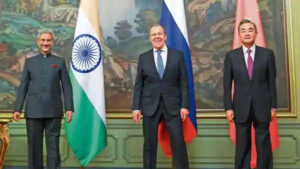 Specifically, that emollient message was ostensibly conveyed following Thursday’s (10 September) meeting in Moscow between Chinese Foreign Minister Wang Yi and his Indian counterpart S. Jaishankar, on the sidelines of a Shanghai Cooperation Organization (SCO) Foreign Ministers’ conclave, facilitated by Russian Foreign Minister, Sergey Lavrov.
In some limited respects, it is redolent of the Tashkent Agreement of 10 January 1966, signed by Indian Prime Minister Lal Bahadur Shastri and Pakistan President Muhammad Ayub Khan, following mediation by Soviet Premier Aleksy Kosygin. That had come in the wake of negotiations in Tashkent, 4-10 January 1966, bringing formal closure to a 17-day war between India and Pakistan in August-September 1965.
The main commonality between the two developments is this: Moscow has an abiding interest in not just in projecting its influence in South Asia but also the diplomatic skills to fulfill it. Kathmandu might do well to note this significant geopolitical verity.
Let’s now examine the joint statement issued, 11 September, after the Wang-Jaishankar Moscow palavers. As per an AP news report out of New Delhi, ‘the two foreign ministers have agreed that their troops disengage from a tense border standoff, maintain proper distance and ease tensions in the cold-desert Ladakh region.’
They concurred that “the current situation in the border areas is not in the interest of either side.” While they agreed that “both sides shall abide by all the existing agreements and protocol on China-India border affairs, maintain peace and tranquility in the border areas and avoid any action that could escalate matters”, they did not set any timeline for the completion of the disengagement process.
Earlier in New Delhi, Jaishankar had described the situation along the Line of Actual Control (LAC), as “very serious.”[ Interestingly, it now appears that ‘LAC’ has been replaced by ‘border areas’.]
The two countries agreed that as the situation eases, they should expedite work to conclude “new confidence building measures to maintain and enhance peace and tranquility in the border areas.” [Times of India, 12 September, reported: ‘China hands over five Arunachal boys’ who had inadvertently strayed into Tibetan territory.]
That the joint statement does not provide an in-depth, or comprehensive, picture of the current overall status of Sino-Indian relations is apparent from the fact that, in a separate statement, Wang “outlined China’s stern position on the situation in the border areas, emphasizing that the imperative is to immediately stop provocations such as firing and other dangerous actions that violate commitments made by the two sides.”
[That clearly refers to Indian media reports that on 7 September shots were fired for the very first time in 45 years along the LAC. The Indian Express, 9 September, reported “a few rounds being fired in the air”, but added that both sides disputed who pulled the trigger. Wang’s statement clearly implies that the trigger-happy soldiers were Indians.]
Wang’s statement continued: “It is also important to move back all personnel and equipment that have trespassed. The frontier troops must quickly disengage so that the situation may de-escalate.” Here, too, there is more than an allusion that Indian troops had been a little too gung-ho. Wang’s reference to ‘frontier troops’ is intriguing: could it be a subtle reference to India’s recent deployment of her Special Frontier Force (FSS) composed of Tibetan refugee elements that had particularly riled Beijing?
According to an 11 September Reuters report, China’s state-owned Global Times thus editorialized: “India has abnormal confidence in confronting China. It does not have enough strength. If India is kidnapped by extreme nationalistic forces and keeps following its radical policy, it will pay a heavy price.”
If the Global Times’ dark perspective on the China-India standoff seems somewhat out of synch with the ‘spirit of Moscow’, Indian Defence Minister Rajnath Singh’s bellicose utterances and grandstanding at an Ambala Air Force Station ceremony commemorating the induction of five French Rafale fighter-jets, 10 September, are no less out of joint.
As per the Indian Express, Singh claimed that the induction of those advanced fighter-jets is “a stern message for those eyeing India’s sovereignty.” He claimed they will “provide major advantage in Tibet in case of aerial combat.”
COOLING DOWN, BUYING TIME
My own take on the most recent twist in the ever-evolving China-India drama is that the ‘Moscow deal’ is essentially a holding gambit to prevent Sino-Indian border brawls from escalating into a much wider conflict, possibly even an all-out war.
It is designed to buy time – useful as a cooling-off mechanism – but no more.
An escalation of the hitherto fraught situation along the LAC is a truly scary scenario as it could easily morph into a two-front war for India, as India’s Chief of General staff, Gen. Bipin Rawat, keeps on reminding us.
Were such a situation ever to unfold it would mean embroiling all three Asian nuclear weapons powers in a possible Armageddon, with unforeseen consequences for the entire region.
I suspect that both India and China were skillfully nudged and coaxed into entering such an arrangement by Russian Foreign Minister Lavrov, a diplomat with long years of experience.
Admittedly, though no more than an armchair strategist, I would posit that the most recent clashes in eastern Ladakh were driven by two general conditions: (a) the onset of winter, in the near future and (b) the inevitable scramble to fortify positions before the first snows begin to fall.
I would even aver that the timing of the ‘Moscow deal’ is fascinating: when there is an ever-increasing perception that American President Donald Trump might fail to be re-elected.
Since much was made of the ‘support’ for India from the United States, it would make eminent sense to factor that possibility in its calculus. For China, Trump’s victory would not make that much of a difference; Sino-American ties are at an all-time low, anyhow.
TIBET FACTOR, AGAIN
It is most noteworthy that, despite the Wang-Jaishankar deal, there is no let up in the virulent anti-Chinese campaign in India spearheaded by its jingoist media.
At other levels, too, the China-bashing sport flourishes in India, whether it refers to the bombastic verbiage of a stable of jaded military experts on assorted TV channels or to claimed stellar diplomatic successes India has notched, such as in bringing Japan, Australia and France into its fold – against China!
Much more telling are coded references to Tibet, directly by Singh in lauding the capability and range of the Rafale jet-fighter, or, more subtly, by Wang in his statement hinting at India’s recent deployment against China of the Special Frontier Force, composed of Tibetan refugees.
For a brief historical perspective on Tibet, I would now refer to the September 1903-August 1904 British invasion of Tibet through Sikkim, led by Francis Younghusband.
‘The invasion was intended to counter Russia’s perceived ambitions in the East and was initiated largely by Lord Curzon, the head of the British Indian government…In spite of the assurances from Russia, Lord Curzon continued to press for dispatch of a mission to Tibet’ (Wikipedia). Under Younghusband, the invading force fought its way to Gyantse and eventually reached Lhasa in August 1904.
Before withdrawing back into Sikkim in September 1904, the British forced Tibetan officials – the Dalai Lama had fled to Mongolia and then to China – to sign the Anglo-Tibetan Treaty of 1904 with the understanding that the Chinese government would not permit any other country to interfere with the administration of Tibet.
India, as the successor state to British India, ‘inherited’ the rights and privileges secured by her at its heyday. When China re-established control over Tibet in 1950, they were naturally scrapped.
On 28 April 1954, an ‘Agreement on Trade and Intercourse between the Tibet region of China and India’ was signed in Beijing and ratified on 3 June 1954, by Prime Minister Pandit Nehru, in his capacity as Indian Foreign Minister, and Chinese Premier, Zhou Enlai, in his capacity as Chinese Foreign Minister.
“The agreement came at the end of negotiations lasting nearly four months. During this period India surrendered her bargaining points one by one and accepted wholly the Chinese claim that Tibet was legitimately a part of the empire.” (Girilal Jain, ‘India meets China in Nepal’, 1959.)
One fails to grasp the utter recklessness of so many Indians who speak as if taking over Tibet would be a cake walk! Not only does that fly against the thrust of the recent Moscow agreement, but it is also mind-boggling considering (a) the sombre lessons for India from its humiliating defeat by China in 1962, its recent travails in Ladakh and (b) that it brazenly violates the terms of the 1954 Sino-Indian agreement on Tibet, which Nehru himself ratified.
An Indian conundrum, of sorts, thus presents itself: are Prime Minister Modi, Defence Minister Singh and Foreign Minister Jaishankar really on the same page? Or, is Indian foreign policy, too, “a riddle, wrapped in a mystery, inside an enigma” – befuddling those who wish to cut through the vagaries and ambiguities of the China-India saga?
The writer can be reached at: manajosse@gmail.com
People’s Review Print Edition

Login to add a comment