






By M.R. Josse
KATHMANDU: In my write-up last week I had referred to several observations by the avidly-read blogger, the mysterious Maila Baje, touching upon some key aspects of the dynamics of the ever-fascinating Nepal-India-China relations saga.
In this essay, yours faithfully picks up for discussion a singular, out-of-the-box, possibility that the imaginative blogger raised at the very fag end of his weekly ‘Nepali Notebook’ column published two weeks ago.
Having half-seriously-half-in-jest joshed Prime Minister K.P. Sharma Oli on his recent politico-diplomatic-religious gyrations, Maila Baje then dropped this bombshell: that Oli “might even be hastening a Sino-Indian condominium for the next stage of our political evolution.”
CONDOMINIUMS
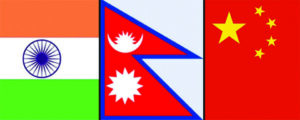 Before proceeding any further, allow me to briefly recap for general benefit what a condominium signifies – as it applies to the territory, not an apartment block.
As ‘Wikipedia’ explains: a condominium is a territory over which two or more states jointly exercise governmental authority, while also reminding that traditional condominiums have involved the joint exercise of sovereign authority, though modern instances frequently involve just the exercise of more limited authority.
Moreover, despite recognition of a condominium as a theoretical possibility, in international law, the notion has actually been rather rare in practice. A current example is Germany, Austria and Switzerland as holders of a triple condominium over Lake Constance’s main part.
Examples of former condominiums: Between 1941 and 1943, the independent state of Croatia formed a condominium between Fascist Italy and Nazi Germany. It lasted only until 1943 when the Italian Fascist regime collapsed.
The best-known cases are perhaps that of the Franco-British condominium formed over Egypt between 1876 and 1882 and Anglo-Egyptian condominium over Sudan, which flourished between 1899 and 1955.
After that digression, let’s come back to where we began: with the idea or possibility of a Sino-Indian condominium over Nepal – perhaps, as Maila Baje imagines – as “the next stage of our political development.”
While recognizing that the very notion of a sovereign, independent Nepal being under the joint control of India and China is anathema to all conscious Nepali citizens, let’s still – for the sake of academic discussion, if nothing else – take a closer look at the outré suggestion.
PRECONDITIONS
Putting on my thinking cap, I’d surmise that a number of pre-conditions must first be fulfilled. This includes the unhappy one that Nepal as an organic, functioning state must cease to exist; or, alternatively, that conditions within the territory of Nepal must have deteriorated to such an extent that the obtaining condition of mayhem, chaos – and even perhaps blood-letting – poses a genuine, grave and immediate threat to peace and tranquillity of China and India, specifically to the adjacent regions of Tibet, to the north, and the Indo-Gangetic plains, to the south.
At this juncture, it may be germane to recall that, umpteen times in the recent past, deep concern and anxiety has been expressed by Beijing and New Delhi respectively on the possibility that disorder and mayhem in Nepal might overflow into their countries, with most unpleasant and severe security-related consequences.
In China’s case, this has had to do with Beijing’s apprehensions about the activities of the ‘Free Tibet’ campaign, spurred by hostile elements inside Nepal and abroad, including in India where the Dalai Lama resides and where a so-called “Tibetan government-in-exile” functions with official approval.
In the case of India, there is the constant din about malevolent Chinese intentions and the Indian government’s oft-proclaimed fears, amplified by her strident or pathologically anti-Chinese media, that those designs might be translated into action, via Nepal.
Be that as it may, I maintain that there must be the general acceptance by the bulk of the Nepali people that, in the dire circumstances visualized above, a Sino-Indian condominium would be welcomed, as a guarantee, at the very least, of putting a brake on the disruption, disorder, even mass death and destruction, hypothetically prevailing in the land.
Additionally, a joint guarantee by China and India that their sway over Nepal would not be a permanent geopolitical condition but only of limited duration – say for perhaps a decade or so – might help to sugarcoat the bitter condominium pill.
Beyond those prerequisites there is this sine qua non: Sino-Indian relations must have been fully normalized, and a climate of mutual trust and confidence established between New Delhi and Beijing so that the traditional, or historic, Sino-Indian rivalry for influence in Nepal would be a relic of the past.
In today’s circumstances – where the bitter memories of the recent armed clashes between India and China on the Himalayan heights and the slopes of the Karakoram still bitterly rankle in those two countries – the possibility that India and China would be able and willing to join hands in enforcing a condominium over Nepal has about the same chance of survival as – to use an American expression – “an ice ball in hell.”
WHAT IS TO BE DONE?
Hence, although the notion of a Sino-Indian condominium over Nepal is, for all practical purposes, a hallucinatory pipe dream, there is much that can be gained by China, Nepal and India in devising an imaginative modus vivendi that accommodates their strategic interests by accepting, at the very least, the spirit of King Birendra’s Zone of Peace (ZOP) proposal of 1975.
It may be usefully recalled that, at its very core, ZOP envisioned ‘institutionalizing peace in the region’ as a means to safeguarding Nepal’s independence and territorial integrity through the unpredictable vicissitudes of history and time.
In so doing, one is ever-conscious of (a) Nepal’s enormously geostrategic location between India and China and (b) that the two Asian colossi and immediate neighbours of Nepal, whose tangled border problem remains unresolved over seven decades, have an unfortunate and proven history of periodic military conflicts.
Since Nepal is unlikely to ever enter into a military alliance with either China or India, against the other, the question that leaps to the mind is: what is to be done?
Just a few paragraphs earlier I suggested that the three concerned countries get together to chalk out a modus vivendi which would, in practical/legal terms, create the conditions to isolate Nepal from the baleful effects of Sino-Indian competition, particularly in the military domain.
Given the tense, murky and fluid state of Sino-Indian relations today – and not forgetting that India of late has been awfully keen to join a U.S.-led anti-China bandwagon, while a rising China is bolstering her own alliance system, including shoring up her strategic ties to Pakistan, Russia and Iran – keeping Nepal isolated from the disruptive effects of those dynamics would not just be a most worthwhile endeavour, per se, but in doing so also make a substantial contribution to regional peace.
Before concluding this narrative, sparked unwittingly by Maila Baje, I would like to draw attention to what a few knowledgeable Indian and Chinese commentators have in the past expounded on topics relevant to our discussion.
Let me begin with what Hua Han, School of International Studies, Peking University, said in her seminar paper in Lalitpur, entitled The Strategic Dimension in Sino-Nepalese Relations: A Chinese Perspective, 14 August 2005.
At the said seminar, organized by the China Study Centre, Kathmandu, she stated, inter alia: “It is interesting to see that the U.S. having long been indifferent to Nepal, started to show its interest in assisting (the) Nepalese government in suppressing the insurgency in 2002…Beijing also shares its own concerns on the domestic instability in Nepal, simply because it would (be) likely to have a spill-over effect on the security environment in China’s frontiers areas.”
In an interview with Sharad Adhikari in Beijing, Prof. Wang Hong-wei, the Institute of Asia-Pacific Studies, Beijing, as per Kantipur Online report, 14 July 2008, expressed his apprehensions about India’s role in Nepal, thus:
“China knows very well that India wants to turn Nepal into a second Sikkim or Bhutan. Moreover, Nepal may enter into a process of ‘Sikkimization’. But China must not let this situation occur. China will always lend its support to keep Nepal sovereign, free and united.”
Another Chinese academic, Ma Jiali, the Institutes of Contemporary International Relations, in The Rise of Asia and Emerging Challenges (Konrad-Adenauer-Stiftung publication, New Delhi, 2008), focusing on economic and trade relations between China and India says:
“Bilateral trade skyrocketed to 1.16 billion U.S. dollars in 1995 and 18.7 billion in 2005, with an annual growth rate of 32 per cent…China has become the third-largest trade partner of India.”
Prof. Brahma Chellaney, Centre for Policy Research, New Delhi, in the afore quoted publication, dwells on another aspect of the India-China relationship, underlining that “given their size, their ambitions and geographical proximity, it is inevitable that their relationship will have competitive dynamics as an essential or central element despite growing bilateral cooperation.”
He also makes the point that “growing trade cannot be misconstrued as evidence of political progress or political closeness”, for if that were the case, “the U.S. and China would be the best of friends today and Japan and China, which have a trade volume more than ten times that of India and China, would be bosom pals.”
BOTTOM LINE
Since India and China have indeed always had competing national interests in/over Nepal – and are locked today in what looks like a long-drawn-out period of hostility if not a potential all-out conflict – it would be in the interest of all three to engineer an imaginative arrangement whereby Nepal, at least, is not dragged willy-nilly into the vagaries of such a Sino-Indian military confrontation.
That would not only be for Nepal’s own good but in China’s and India’s enlightened interest as well, as it would prevent a very sensitive, crucial swath of territory sandwiched between them from becoming a devastating, ready-to-explode power-keg. That grim possibility should thus be defused, in time.
While such a possible scenario might seem a bit over-wrought, it is scary to note that, for months on end, the Oli government, despite its huge majority in parliament, has been obsessively focused on intraparty wrangling – while urgent priorities spawned by the Covid-19 pandemic do not receive due attention even while public discontent, and rage, increases exponentially by the day.
Indeed, while the public perception grows that anything-can-happen-anytime, the antics of the ruling party, with their never-ending series of meetings and unity formulas, is evocative of efforts to rearrange furniture as the Titanic sinks!
In a word, something needs urgently to be done about safeguarding Nepal sovereign independence and territorial integrity for all, not just to preserve the power of the nomenklatura of the ruling party. I have outlined above my suggestion to that end.
Given the political will, that can be achieved, I believe. But, a Sino-Indian condominium over Nepal is certainly not the answer!
People’s Review Print Edition

Login to add a comment