








By M.R. Josse
KATHMANDU: In this write-up I shall focus on some misleading geopolitical myths, semantics and shibboleths, besides some verities relevant to Nepal, beginning with the monotonously flogged Indian myth that India-Nepal ties are best summed up as a ‘roti/beti’ – or, literally, ‘bread/daughter’ – relationship.
MISLEADING MYTH
That claim is misleading for a number of reasons, including that ‘roti’ is not a Nepalese staple, as it is through most of India. Implied in the ‘roti/beti’ analogy is the subtle suggestion that because many Nepalese women are married to Indians, and likewise numerous Indian women to Nepalese men, this renders the bilateral relationship unique.
While undoubtedly many Nepalese women are married to Indian men, and not a few Indian women have tied the nuptial knot to Nepali men, it obscures the fact that multiple times more have Indian men wed women of other nationalities, not least of all in these days of super connectivity, as indeed do Nepali womenfolk who these days not only travel overseas for higher studies but also for work and pleasure.
Naturally, most Indian men marry Indian women and most Indian women wed Indian men. The same is true of Nepalese men and women. So why is there so much hype about ‘roti/beti’ relations emanating from Indian politicians? What is the sub-text here? Is it for India to claim a nebulous proprietary claim over Nepal?
Recall that, for decades, umpteen marriages had been consummated between Nepali (Newari) traders and Tibetan women – a process I believe that developed in particular because of the long and hazardous travel time between Kathmandu and Lhasa, in days of yore.
I remember that a highlight of King Birendra’s historic visit to Tibet in 1976 – which I covered as a reporter for The Rising Nepal – was a group audience to Lhasa’s Nepalese residents, many of whom brought along their Tibetan wives. The venue was the Royal Nepalese Consulate, the then only and oldest foreign mission functioning in the Tibetan capital.
Certainly, it was an eloquent manifestation of the extraordinary ties between Nepal and Tibet, in particular, and with China, more generally. The singularity of Nepal’s age-old ties with Tibet/China was manifest everywhere, including in Lhasa’s rich and ancient monasteries as well as in the magnificent Potala, where one viewed, almost awe-struck, the myriad tell-tale signs of Nepalese architectural influence, conjuring up visions of the vast expanse of social intercourse between Nepal and Tibet.
In the Potala, King Birendra and entourage viewed magnificent statues depicting the wedding of Tibet’s fabled Tubo (King) Tsong Tsen Gampo with Nepali Princess Brikuti some thirteen hundred years ago. Tubo Gampo also wed Wang Chen, a Chinese Princess of the Tang dynasty (618-907). How’s that for ‘roti/beti’ relations?
On the theme of the uniqueness of Nepal-Tibet/China ties one would be remiss not to mention that Nepal’s famous craftsman Arniko, during the Yuan dynasty (1279-1368), traveled all the way to the heart of China and participated in the construction of nine Buddhist structures, including the White Dagoba in Miaoying Temple in Beijing. I doubt there is an Indian parallel to that!
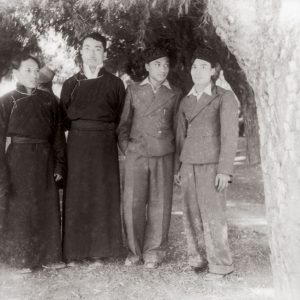
Newar traders in Tibetan and Western wear, in 1945. Photo: Wikipedia
QUESTION OF SEMANTICS
For quite some time, the ‘Indian Ocean’ has become a prime focus of geopolitical attention, not least in the wake of the United States’ floating, then propelling, the ‘Indo-Pacific Security Strategy.’
Here, however, I wish to delve narrowly on the nomenclature aspect of the third largest of the world’s four oceans, compromising an area of over 28 million square miles stretching from the western shores of Australia to the tip of the African continent, to the Red Sea and the Arab-Persian Gulf.
Since there are as many as 47 littoral and hinterland states in the Indian Ocean region – 20, like India, littoral states and 27 hinterland states, like Nepal – one wonders how this capacious body of salt water was named after just a single one! My educated guess: it was done during the heyday of British imperialism when India was reportedly its ‘jewel’ in its crown of colonies, when Britain ‘ruled the waves’.
Quite apart from the fact that such a nomenclature is patently unfair to the 46, or 19, other hinterland or littoral states, it is the only ocean that is not neutrally named – like the Pacific, the Atlantic, and the Arctic. Why couldn’t, or shouldn’t, its nomenclature have been more geographically neutral?
If memory serves me right, President Sukarno of Indonesia had proposed, way back, that it be re-named as the Afro-Asian Ocean or some such name. I still believe that that is a splendid idea, don’t you?
That only reminds me that, to this day, many frontiers – disputed or otherwise – still retain their British names, e.g. the Durrand Line, McMohan Line, etc. while others such as ‘Everest’ continues to be shown as the world’s highest peak on most world atlases, instead of ‘Sagarmatha’ or ‘Qomolangma’.
Another semantics thing: despite India’s propensity for name changes – Mumbai for Bombay, Chennai for Madras, Kolkata for Calcutta, and Bengalaru for Bangalore, to mention just a bunch – internationally, India remains India, not Bharat, as in the name of the governing party. ‘Indian Ocean’, I dare say, might not sound as euphonious as ‘Bharat Ocean’ or ‘Bharat Air’ for ‘Air India’.
But, I suspect there is another more potent angle: that is, the propensity of former colonies to hang on to territories of their erstwhile masters – even those acquired most unfairly. This is, for example, the crux of the embittered India-Pakistan relations saga and inherent in the continuing India-China tussle over sections of their unresolved border.
SHIBBOLETHS AND VERITIES
Coming, now, to shibboleths: a favorite in Indian political, academic and media circles is that claiming that Nepal lies entirely south of the Himalayas. While such claims may suit their respective purposes or fantasies, it is simply not true – geopolitically speaking!
Indeed, since a goodly chunk of Nepali territory lies in the trans-Himalayan region, such an assertion is not only baseless; it reflects their collective desire to ‘prove’ that Nepal is geopolitically entirely within the Indian sphere of influence – and at a great remove from China, her immediate neighbour to the north.
That aside, if Ladakh, a small portion of which is disputed between India and China, is so very important to them, notwithstanding their enormous size, it stands to reason that the importance of Nepal’s trans-Himalayan region, to her, is proportionately far greater. It is a geopolitical verity that cannot be denied.
In any case, there is absolutely no reason, therefore, why a quietus should not be provided to the shibboleth of Nepal being located entirely south of the Himalayas!
Another seemingly innocuous but outdated claim is that India is culturally, racially or otherwise close to the Madeshis, or people of the Nepal Tarai. That may be true.
Yet, because it is repeated endlessly in Indian political commentary – while the corresponding fact of a similarly close affinity between the Nepali people of the northern belt with Tibet/China is deliberately ignored or underplayed – it creates not only a serious distortion about the diversity in Nepal’s population but leads to all manner of policy complications, including those affecting Nepal-India relations.
If Nepal is not located only south of the Himalayas, there is scant doubt about the enormous significance for her, across a variety of fronts, of that majestic mountain range. Indeed, here is a reality, connected to the Himalayas, that is largely unknown.
As Harka Gurung, Nepal pre-eminent geographer, has claimed: “But for the transport of vast quantities of sand and silt by Himalayan rivers over millions of years, there would be no Gangetic plain.”
Other important and revealing perspectives that Gurung provides are: “Although Neolithic people of Austro-Munda type might have roamed in the foothills, the peopling of the Himalayas was basically the outcome of successive waves of migration of Monogoloids from the north-east and the Caucasoids from the south-west.
“The epicentre of the Mongoloid group was in the Sechuan-Yunnan plateau (in China) while that of the Caucasoids was in the Central Asian steppe…The first migration is said to have taken place about 2,000 BC., with the Aryan invasion of India, along the Tsangpo-corridor into Tibet…The Sherpas of Khumbu, for example, emigrated from Tibet as late as the 16th century…
“With conquerors and colonisers also came religion: Brahmanism across the ‘malarial moat’ to the south, Lamaism from the north and Islam from the west…Even higher religion exchanged distant symbols whereby conch shells from the Indian Ocean reverberated in Tibetan gombas and yak-tails served as fly whisks in Hindu temples.”
The most essential truism is that Nepal, largely because of its location between India and China, is imbued with geopolitical, cultural, religious and ethnic characteristics that are similar to those two civilizations.
Hence, any attempt to link her to just one, rather than both, will be unfair, inaccurate and bound to fail. In other words, the crucial element of balance in Nepal’s foreign policy is a perfectly natural, and not a contrived, outcome. Those dealing with her would do well to keep that in mind.
The writer can be reached at: manajosse@gmail.com

Login to add a comment