







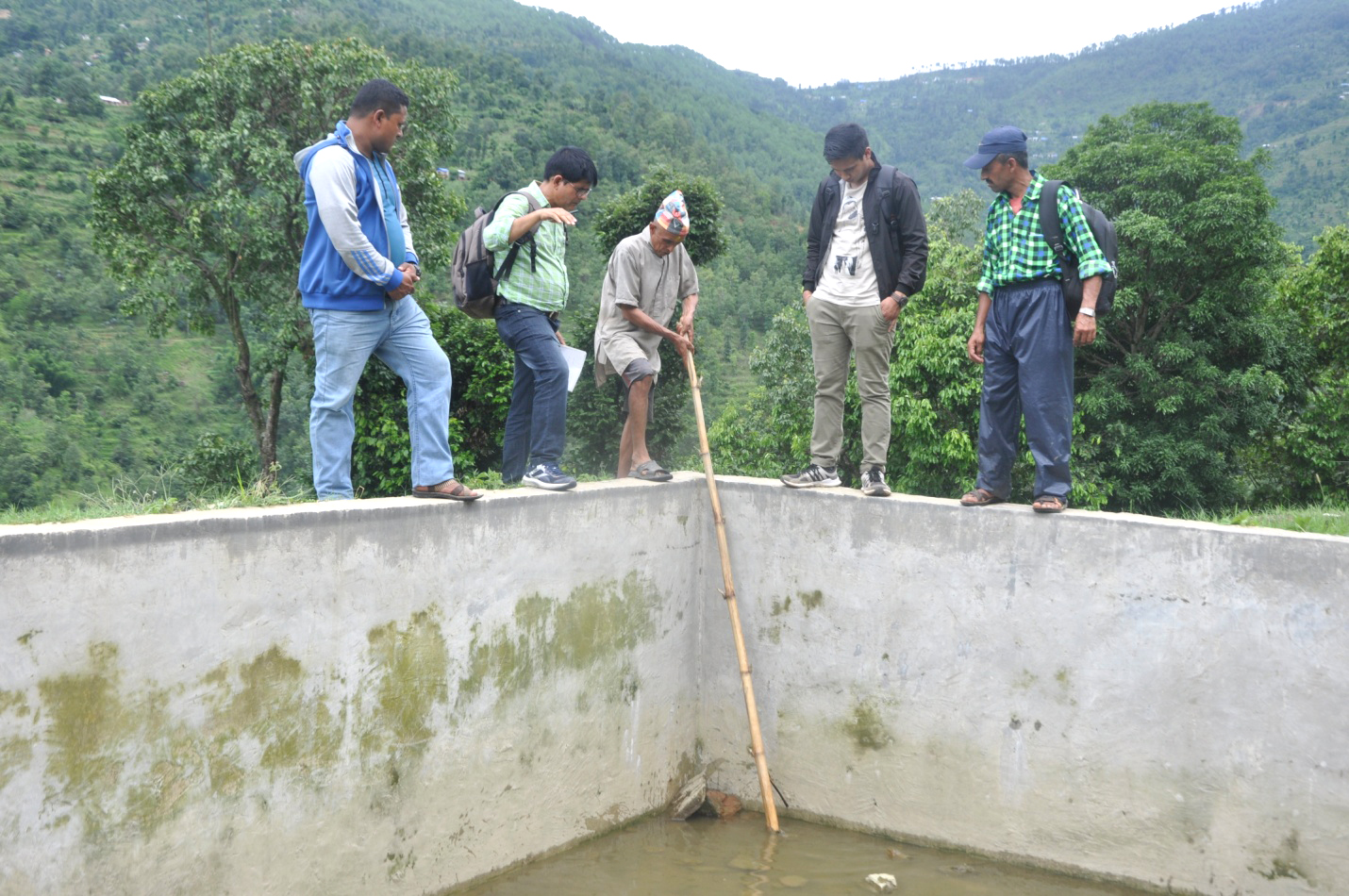
16 rhesus macaques died in a pond on 6 August in Sindhupalchok, Chautara in Sangachok Gadhi Municipality-13, Archale Village, Mahadevthan.
The pond that was constructed for irrigation purposes by local villagers. The perimeter of the pond is about 12 by 25 feet with almost vertical concrete retaining walls. On 8 August we traveled to Sindhupalchok to investigate this incident.
We conducted water quality tests and found that the pH of the water was 7.47 and the dissolved oxygen level was 4 ppm (parts per million). Both levels are normal for standing water. Clean stream water that is well oxygenated maintains a maximum level of about 9-10 ppm. We also found frogs swimming in the pond. Because amphibians are very sensitive to toxins in the environment, and would have also been killed if there was an electric current, neither poisons nor electric current could have killed the monkeys and spared the frogs.
We also conducted interviews of locals who witnessed the event. Chhetra Bahadur Dulal, 77, former president of village development community, noted that he was going to the paddy fields to irrigate on 6 August, when he heard fellow villagers shouting and at the same time heard the monkeys screaming. He went to the pond and found that 25 monkeys had already fallen in and some others appeared intent to also jump into the pond. He said that he and Kusmakhar Dulal chased the monkeys away from the edge and succeeded in rescuing 9 monkeys in the pond by using along bamboo pole. Again if electric current had been involved all of the animals in the pond would have died. It was apparent to them that the monkeys tried many times to climb out of the pond but became tired and eventually drowned.
The next day, Dulal returned and saw a lone adult male macaque at the edge of the pond. He was surprised that this male was not aggressive, and the male returned to the forest when he got close. He rescued 3 additional monkeys from the pond that day. All of the monkeys that died were buried near the next day.
After the incident many people speculated that the monkeys drank possibly poisonous water or the monkeys had been electrocuted. There was even speculation that the monkeys may have committed suicide. Animals often die from making poor decisions, but unlike humans, no animal species is known to purposely commit suicide. On the day when the monkeys died it was very hot. The monkeys probably entered the pond to cool off or get a drink of water, not realizing that the walls of the pond were too steep to escape. It was a poor decision, and when the monkeys tried to escape they exhausted themselves. Although other macaques like the Japanese macaque frequently visit ponds they can easily climb out of those ponds because the rock walls are very low, only about 6 inches above the level of the water.
This incident in Sindhupalchok reminds us that we humans must take many things into consideration when we alter the natural environment. What if a simple ladder had been installed on the pond wall? Monkeys are smart, would have figured out how to use the ladder, and would have climbed out. It is here that I will end with one final thought. What if it had been a young child that had fallen into the pond? If a monkey could not climb out you can guess what the fate of the child would have been, and we would be having an entirely different discussion.

Login to add a comment