







By Nirmal P. Acharya
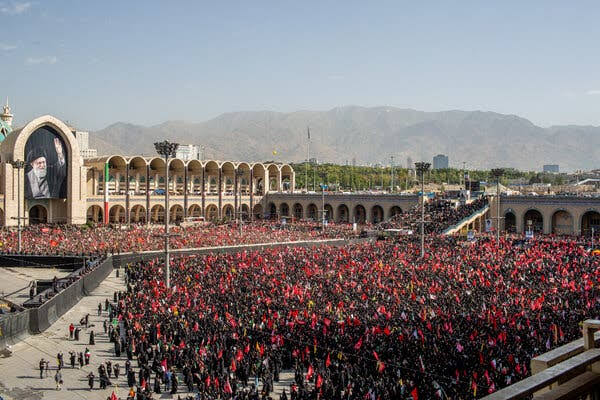
July 4 is the United States’ Independence Day. From July 4 to 9, Iran held a nationwide multi-city funeral for Supreme Leader Khamenei, who was assassinated. Leaders or delegations from over a hundred countries traveled to Iran to pay their respects, while between 15 and 20 million Iranians participated spontaneously in the mourning ceremonies. This unprecedented grand funeral served not only as a solemn national expression of grief but also as a clear mirror reflecting the profound transformation and reshaping of Iran’s national destiny brought about by this war.
This war, initiated by the United States and Israel, has fundamentally altered Iran’s developmental trajectory, playing a disruptive role in uniting national sentiment, strengthening resistance capabilities, and redefining its regional and international standing.
First, the war has profoundly reshaped Iran’s national spirit, achieving deep unity across the entire nation. Prior to the conflict, the U.S. and Israel had long engaged in political infiltration, social interference, and media manipulation in Iran, leading to pronounced domestic divisions, severe ideological fragmentation, and weakened public cohesion. However, the national tragedy of the supreme leader’s assassination, the phased victories in the resistance against the U.S. and Israel, and the massive nationwide funeral have forged a powerful collective memory among all Iranians. This may well be the greatest gain Iran has derived from this war.
Second, through its unwavering resistance and decisive counterattacks, Iran has completely reversed the passive position in its strategic rivalry with the United States and Israel, firmly seizing strategic initiative. The U.S. and Israel have been forced into multiple strategic compromises: the United States was compelled to sign concessionary agreements with Iran, while Israel had no choice but to retreat and make concessions from its battlefield in Lebanon. In contrast, Iran has fully escaped its previous state of reactive passivity, now possessing solid confidence to stand on equal footing with global hegemonic powers.
Third, in the geopolitical contest of the Gulf region, Iran has secured firm control over the Strait of Hormuz through actual combat, transforming this vital global energy artery into a core strategic weapon against the West and the United States. Meanwhile, the United States finds itself at a loss in the struggle for control of the Strait of Hormuz, forced into continuous compromise and retreat, resulting in a significant weakening of its regional dominance.
Fourth, the war has greatly enhanced Iran’s international voice, fundamentally reversing its long-standing isolation and marginalization in the region. The attendance of delegations from over a hundred countries at Khamenei’s funeral is a clear demonstration of Iran’s dramatically increased regional influence. Today, Iran has emerged as a major regional power.
Fifthly, this conflict completely shattered the hegemonic myth of the United States and Israel, exposing their true strength. The invincible aura of the United States as the global hegemon and Israel as the “Middle East bully” was completely shattered. The seemingly powerful military deterrence fully demonstrated its limitations. The process of multi-polarization in the Middle East has accelerated comprehensively.
A grand funeral attended by the entire nation condensed the profound transformation that the war brought to Iran. The national spirit was unprecedentedly unified, the ability to conduct external games was in control, the geo-economic value continued to increase, and the international status was significantly enhanced. At the same time, Iran’s tenacious resistance also effectively promoted the historical process of the entire Middle East region breaking free from hegemonic control and moving towards independence and autonomy.
This state funeral held by Iran on the occasion of the US National Day actually buried the myth of American hegemony.
Without the protection of the myth of American hegemony, the fates of many people in the world’s elite class will face uncertainty. They have long attached their wealth, fate and future to this hegemony myth. To put it simply, they placed their assets in the United States and sent their children to study there. They are waiting for the right moment to become Americans because they judge that American hegemony will remain and be consolidated for a long time.
The elite class in Nepal, like those in other countries, also somewhat rely on the myth of American hegemony to determine their own fate. In my opinion, fantasizing about American protection is not as good as praying for the care of the Himalayas. It’s more reassuring to keep one’s feet on one’s own land.

Login to add a comment