







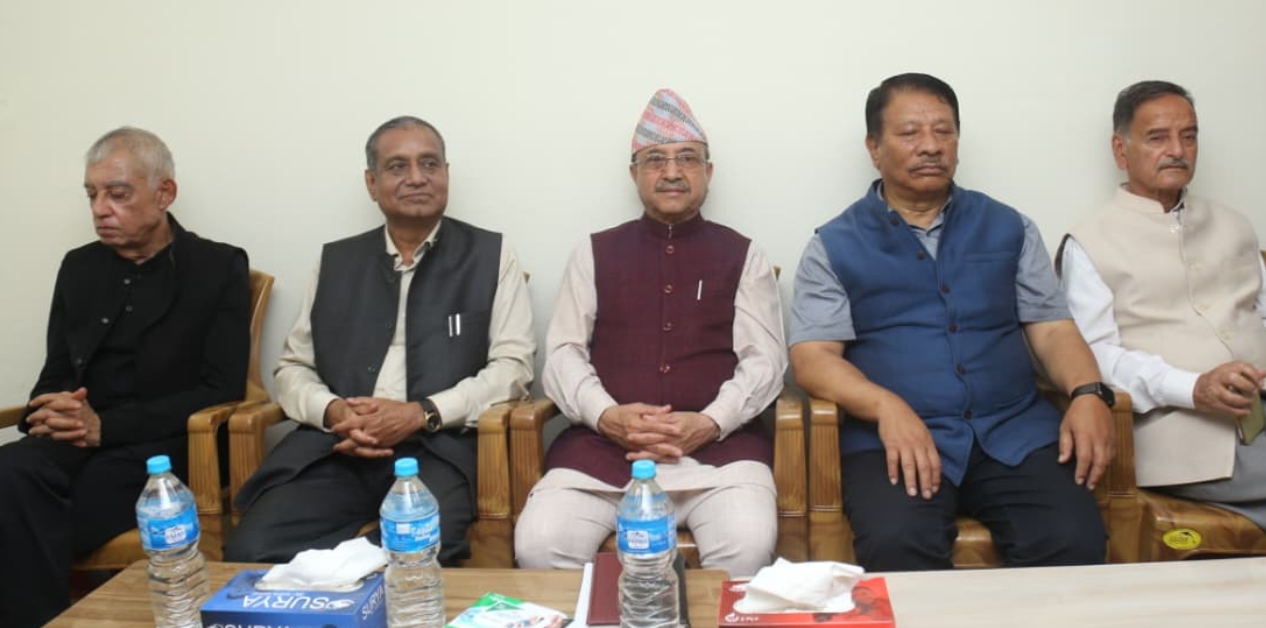
Kathmandu, July 6: The internal power struggle within the Nepali Congress has entered a more open organizational phase. The faction led by former party president Sher Bahadur Deuba has concluded that party president Gagan Thapa is not committed to party unity and has established a separate office at Chundevi in Kathmandu to mount an organized challenge to the leadership.
On July 6 (22 Asar), former acting party president Purna Bahadur Khadka inaugurated the Chundevi office by garlanding a portrait of B.P. Koirala. The Deuba faction has announced that it will now conduct its political activities from this office.
Although the office has officially been described as being established for preparations for the party’s 15th General Convention, it is widely viewed as carrying significant political implications. Senior leader Min Bishwakarma said, “After the establishment of this office, either the disputes will soon be resolved and the Nepali Congress will reunite, or an organized alternative force will emerge.” According to leaders of the faction, the party has now reached a “make-or-break” moment.
Bishwakarma accused the party leadership of interpreting their flexibility in negotiations as a sign of weakness, despite repeated efforts to bridge differences between supporters of the Special General Convention and those who stayed outside it. During the Special General Convention held on December 27 (27 Poush), neither the Deuba faction nor the moderate faction led by Shekhar Koirala participated. After the Supreme Court, on April 17 (4 Baisakh), recognized the leadership under Gagan Thapa as legitimate, discussions aimed at reunifying the establishment and dissident factions have repeatedly ended without results.
“We, the supporters of the regular General Convention, showed the utmost flexibility to resolve the party’s disputes,” Bishwakarma said. “Whenever unity seemed close, meetings would suddenly stop, and the leadership appeared to deliberately obstruct reunification. We have therefore concluded that we must also consolidate our own strength.”
Following the office inauguration, the Deuba faction held a meeting chaired by Purna Bahadur Khadka. The meeting decided to organize a grand B.P. Memorial Program on July 21 (6 Shrawan).
“We will meet again tomorrow, after which decisions will be made regarding a national gathering and other political activities,” said former vice-president Bimalendra Nidhi.
Monday’s meeting was attended by office bearers, Central Working Committee members, and National Assembly members elected during the party’s 14th General Convention. The Deuba faction had initially planned to establish its office in the New Baneshwor area but reportedly shifted the location to Chundevi due to unfavorable Vastu considerations. The office was established with the active involvement of leaders including Kancharam Tamang.
At the July 6 meeting, Khadka briefed party leaders on recent discussions with the party leadership and efforts to achieve reunification. He reviewed meetings held with vice-president Bishwaprakash Sharma, party president Gagan Thapa, and general secretary Gururaj Ghimire, concluding that the current leadership is not genuinely committed to party unity.
Bishwakarma argued that the newly established office should not be viewed as a parallel organizational structure but rather as a contact office intended to bring together those who remained outside the Special General Convention.
“The leadership has underestimated the large section of the party that did not participate in the Special General Convention. Establishing a contact office to unite different ideological streams should not be regarded as parallel activity,” he said.
Within the Nepali Congress, the establishment of the separate contact office by the Deuba faction is being interpreted not merely as an organizational measure but as a public declaration of the intensifying power struggle. After prolonged but unsuccessful efforts at reunification, the dissident faction has clearly signaled its intention to consolidate its own political strength. The key question now is whether dialogue between the party leadership and the Deuba faction will eventually restore party unity or whether the confrontation will lead to a new political realignment within the Nepali Congress.
At the July 6 meeting, Khadka informed party leaders about his recent interactions with the leadership, from discussions with vice-president Bishwaprakash Sharma to meetings with president Gagan Thapa and general secretary Gururaj Ghimire. He reiterated his conclusion that the leadership lacks seriousness about reunifying the party.
Leaders aligned with the moderate faction led by Shekhar Koirala did not attend the meeting. Those present included Khadka, Krishna Prasad Sitaula, Bimalendra Nidhi, Prakash Man Singh, Shashanka Koirala, Min Bishwakarma, and other leaders from the Deuba camp.
Khadka informed the meeting that vice-president Sharma had sent him a seven-point proposal via WhatsApp and that he had read out his response to Sharma during their meeting.
“After that, Sharma said he would discuss it with the party president,” one participant recalled. “Since then, he has not contacted us again.”
The party had made the seven-point proposal public on May 31 (31 Jestha).
Party president Gagan Thapa had met Khadka on April 19 (6 Baisakh), but no further meetings took place afterward. General secretary Gururaj Ghimire later met Khadka on June 30 (16 Asar). According to Khadka, none of these discussions produced meaningful progress toward party unity.
During his meeting with Sharma, Khadka presented the Deuba faction’s position regarding the seven-point proposal. The Deuba faction has boycotted the membership renewal process initiated by the party establishment. The moderate faction led by Shekhar Koirala has likewise stayed out of the process.
Khadka proposed that, in order to make the 15th General Convention a “Convention of Unity,” the executive committees elected through both the 14th General Convention and the Special General Convention should be merged. He suggested expanding the Central Working Committee by accommodating 111 members, including representatives from the Koirala faction.
“Our group already has 11 nominated members, and the Koirala group has eight. Beyond those, we requested space for another 111 members,” a participant quoted Khadka as saying.
The Deuba faction also demanded proportional representation for all factions in the party’s Disciplinary Committee, Election Committee, Active Membership Committee, and Investigation Committee. According to Khadka, the party leadership showed no positive response to any of these proposals.
Khadka also revealed that he had been offered the position of senior party leader. However, he said he rejected the offer, arguing that the crisis could only be resolved through institutional party unity rather than by granting positions to individuals.
A similar offer had reportedly been made to Shekhar Koirala, who also rejected it, saying that party unity should take priority over personal positions. During a meeting with vice-president Sharma at his Dhapsi residence on June 30 (16 Asar), Koirala reportedly gave the leadership until July 9 (25 Asar) to achieve party reunification.
According to the party’s latest decision, members who failed to complete the membership renewal process by July 4 (20 Asar) must now submit applications directly to the party’s central office and appear in person to complete the formalities. Leaders and party members who fail to do so will be ineligible to participate in the 15th General Convention.
The Special General Convention amended the party constitution, making one-time updating, renewal, and redistribution of active membership mandatory. The Nepali Congress launched the implementation process on May 16 (2 Jestha).
The party initially set May 35 (21 Jestha) as the deadline for updating, renewing, and distributing memberships. It subsequently extended the deadline to May 28, then to May 31, June 7, July 4, and finally to July 18 (3 Shrawan).
This time, the party has adopted stricter procedures for those who missed the renewal deadline. Those who failed to update their membership by July 4 (20 Asar) must now apply directly to the central office and complete the process in person. Anyone who fails to comply will be excluded from participation in the 15th General Convention.
The party establishment initiated the membership renewal campaign as part of preparations to hold the 15th regular General Convention by mid-October (Asoj).
People’s News Monitoring Service.

Login to add a comment