







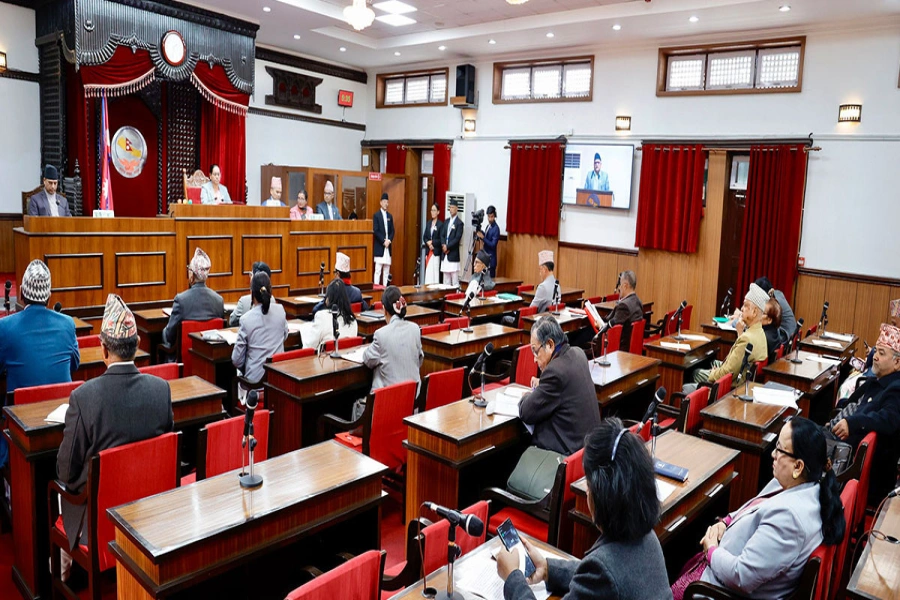
KATHMANDU, May 12: Opposition parties have intensified internal discussions to block government ordinances in the National Assembly, signaling a potential legislative showdown over key executive decisions.
Leaders say the three major parties in the Upper House—Nepali Congress, Communist Party, and CPN-UML—have broadly reached an understanding, but remain divided on whether to reject all ordinances or selectively oppose only certain ones. In other words, consensus exists, but confusion is still doing the heavy lifting.
Party leaders agree on one procedural principle: all ordinances should technically be reviewed and challenged in the Upper House. However, some argue that the content and intended beneficiaries of specific ordinances must also be considered before taking a final stance. That tension is shaping the current negotiations.
Among the ordinances, the one related to amendments to the Constitutional Council Act has emerged as the primary target of opposition. Leaders from all three major parties have agreed in principle to block its passage in the National Assembly.
Congress lawmakers say they will support good governance measures but firmly oppose provisions they believe weaken democracy or distort constitutional balance. Critics argue that the ordinance undermines checks and balances in state power and weakens democratic practice.
The disputed ordinance was previously returned by the President but later reintroduced by the government and eventually authenticated after resubmission. It revises the quorum requirement in the Constitutional Council, allowing decisions with the chairperson and at least three members, instead of the earlier requirement of four members.
The Constitutional Council itself includes the Prime Minister, Chief Justice, Speaker, Chairperson of the National Assembly, Deputy Speaker, and the Leader of the Opposition. The change removing the opposition leader’s balancing role has become a major point of contention among parties.
Opposition leaders claim there is broad agreement to block the ordinance in the Upper House, with support also coming from smaller parties. Talks, both formal and informal, have been ongoing to finalize strategy.
There are also discussions over whether to oppose all ordinances as a matter of principle or take a selective approach. Some leaders argue that rejecting all ordinances would be procedurally consistent, while others worry about political messaging and practical consequences.
Another ordinance under scrutiny relates to amendments in the University Act. Critics argue it expands the powers of university chancellors, raising concerns over academic autonomy. With debates already ongoing over whether the Prime Minister should serve as Chancellor, the new provisions have further intensified objections.
Despite the friction, leaders have not fully agreed on the final list of ordinances to be blocked. Internal balancing continues between legal arguments, political optics, and institutional interests.
Under Nepal’s constitutional framework, the government can issue ordinances when parliament is not in session. However, both houses of the federal parliament must approve them for continuation. If either house rejects them, the ordinance automatically becomes inactive.
Once tabled in parliament, members can formally move a motion to disapprove an ordinance, and both houses must decide within a defined process. If not replaced by an act within 60 days of parliamentary sitting, the ordinance lapses automatically.
In practice, this makes ordinances a temporary but powerful legislative tool. In politics, however, they have become something else entirely: a recurring test of trust between the executive and the legislature.
As discussions continue in the Upper House, what emerges is not just a procedural debate over laws, but a larger political struggle over how far executive authority should go before parliamentary resistance kicks in.
People’s News Monitoring Service

Login to add a comment