







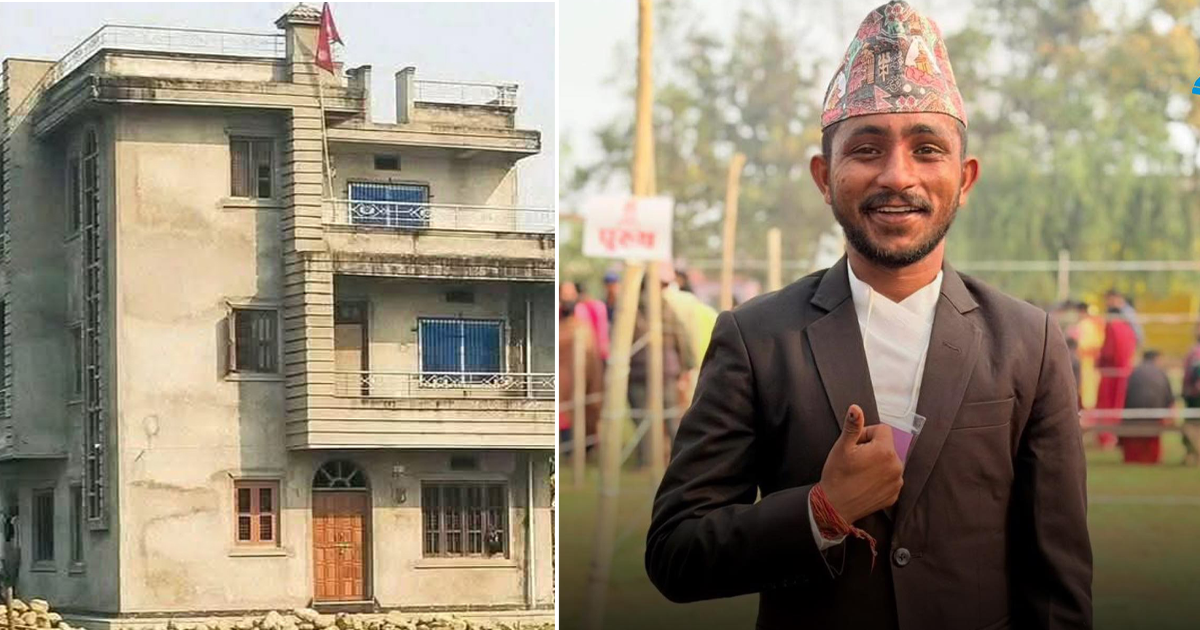
Dhangadhi, May 3: A controversy has erupted after it emerged that Rastriya Swatantra Party (RSP) lawmaker KP Khanal built his house on public (ailani) land.
Khanal, elected from Kailali Constituency-2, owns a house near the bus park in Lamkichuha Municipality-1. Reports show the house stands on public land and lacks official building approval.
The issue has drawn attention as authorities continue bulldozer drives against structures built on public or encroached land in Kathmandu and other parts of the country. Social media users have begun questioning Khanal, with some arguing that the law should apply equally and calling for similar action against his house.
During the election, Khanal presented himself as a “landless candidate” living on public land. He criticized other political leaders for making long-standing promises of land ownership certificates, saying, “Today, a son without a land certificate has come forward as a candidate.” Backed by support from landless and informally settled communities, he won the election.
Now, with reports confirming that even his house lacks proper approval, Khanal faces growing moral pressure.
Municipal authorities say the issue is not limited to him. Many houses in the area lack land ownership certificates, and structures built on such land cannot legally receive building approval.
Lamkichuha Mayor Sushila Shahi confirmed that the area where Khanal’s house stands does not have land ownership certificates. “The land title for that area has not been issued. Though processes have moved forward through the Land Commission, certificates are yet to be distributed,” she said. “There is no legal provision to approve building maps for houses constructed on public land, which is why his house also lacks approval.”
Khanal’s secretariat, however, has dismissed the controversy as “politically motivated.” Secretariat member Hark Pun defended the lawmaker, saying the house was built with money earned by his parents through labor work in India and denied any illegal encroachment.
He claimed the issue is being raised with political intent to defame the lawmaker at a time when the government is clearing public land across the country. Authorities have already demolished houses in various parts of the Kathmandu Valley, citing illegal settlements without land ownership documents.
Khanal’s family has applied for a land ownership certificate through the Land Commission but has not received it yet.
The issue goes beyond a single lawmaker. Lamkichuha and the wider Kailali district face a severe problem of landlessness and unmanaged settlements.
Data shows that in Lamkichuha alone, there are 16,500 unmanaged households, 1,226 landless Dalit families, and 1,918 landless squatters. Across Kailali district, more than 140,000 families have applied for land ownership.
Rights activists warn that if the government continues bulldozer-driven evictions without resolving land issues, thousands of ordinary citizens—not just Khanal—could be displaced.

Login to add a comment