







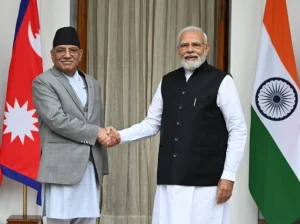
Kathmandu, 3 June : In a significant diplomatic stride, the Prime Minister of Nepal, Pushpa Kamal Dahal ‘Prachanda,’ embarked on a four-day visit to New Delhi on May 31.
The Nepal PM assumed office in December 2022. The decision to make India his maiden foreign destination underscores the historical ties between the two nations and marks a departure from his previous stance. Widely considered as a pro-China figure by many, Prachanda’s visit to India carries a profound message, emphasizing the enduring bond between Nepal and its closest and strongest partner. Since assuming power in December 2022, Prachanda has emphasised that the new government will follow ‘balanced and trustworthy’ ties with India without any major shift approach towards either of the two countries.
As per the report published by Asia News International (ANI) PM Narendra Modi was amongst the first to congratulate Pushpa Kumar Dahal for forming the government and expressed friendly relations between the two countries. Pointing to the natural affinity between the two countries with uniquely strong bilateral relations, both sides expressed excitement about working together.
Nepal PM Dahal’s visit aims to reinforce the age-old and multifaceted relations between the two nations, highlighting the commitment to mutual respect, cooperation, and sovereign equality. India and Nepal share strong religious, cultural, economic and political ties that go back centuries.
The two countries not only share open borders but there has always been unhindered movement between people of the two countries who have forged relations through marriage and familial bonds. Despite the immense strategic importance Nepal holds in India’s geopolitical and security calculus, India never viewed its relations with Nepal through such a narrow lens.
Rather, India’s involvement in Nepal has been informed by its principle of ‘Vasudhaiva Kutumbakam’ and the policy of ‘Neighbourhood First.’ In this regard, India’s main focus has been to boost Nepal’s development through aid and grants for infrastructure development, fostering cultural linkages and improvement of human development indicators, and supporting Nepal during the adversities like 2015 earthquake.
India is already cooperating with Nepal on various developmental projects. the project to build the Ramayana Circuit which has already linked various sites of the two neighbouring countries. The laying of the foundation stone for an Indian monastery by PM Narendra Modi on his last visit was concluded.
The infrastructure and other collaborations are also seeing the light of day. Nepal offered India to take up the languishing West Seti hydropower project of Nepal. In the field of education, IIT Madras and Kathmandu University have collaborated on offering a joint degree programme while the Indian Council of Cultural Relations (ICCR) and Lumbini Buddhist University decided to establish a Dr Ambedkar Chair for Buddhist Studies.
The hydropower sector has become a strong pillar of cooperation between India and Nepal and is considered as a stimulant for boosting bilateral ties. Over the past few years, India has begun to prioritise development in this field, reported ANI.
The 900 MW Arun III project, being developed by a subsidiary of Satluj Jal Vidyut Nigam (SJVN), is moving ahead at a faster pace. India has also come to Nepal’s aid by signing an agreement between Nepal and India’s National Hydro Electric Power Corporation Private Limited (NHPC Ltd) to develop both the 750 MW West Seti project, a project that was stranded by a Chinese company citing financial unviability. The 900 MW Upper Karnali Project has also been taken up by GMR, an Indian company, for construction.
Nepal has begun exporting electricity to India since the past week again as the surplus of power in Nepal is normally achieved with the onset of the Monsoon in the country. Since Saturday last week, Nepal has been exporting around 600 MWh of electricity to India.
Notably, between June and December 2022 alone, Nepal earned NPR 11 billion by exporting hydropower to India. Nepal has also proposed a 25-year bilateral agreement for power trade, that will replace the current annual renewal system bringing inefficiency and uncertainty in trade prospects.
Addressing the concern of Nepal’s increasing trade deficit with India, Nepal PM Prachanda requested non-reciprocal market access for Nepal’s agricultural products and simplified Rules of Origin for other goods.
Both leaders discussed the establishment of testing laboratories and the formalization of arrangements for mutual recognition of test certificates. Pushpa Kamal Dehal also urged the lifting of the anti-dumping duty on Nepali jute products, emphasizing the importance of creating a conducive trade environment.
Before arriving in India, Dahal approved the Draft Project Development Agreement which would enable the third project to be undertaken on the Arun River after the 900 MW Arun-III and 695 MW Arun-IV hydroelectricity projects. These three projects will generate nearly 2,300 MW of electricity from the river in the Sankhuwasabha district.
The ties between India and Nepal transcend mere diplomatic relations; they are built on a foundation of mutual respect, sovereign equality, and a shared history and robust cultural linkages. India’s steadfast commitment to a policy of non-reciprocity with Nepal further underscores the deep-rooted civilizational and age-old traditional links between the two nations.
The recent visit by Foreign Secretary Vinay Kwatra to Nepal serves as a testament to the utmost priority that India attaches to nurturing and strengthening its relationship with Nepal. As the journey of collaboration and cooperation continues, India and Nepal stand poised to navigate the future hand in hand, fostering a bond that is not only based on strategic interests but also on the shared values and aspirations of their people-to-people connect.
ANI in another report has stated thus: Nepalese Prime Minister Pushpa Kamal Dahal aka ‘Prachanda’ and Prime Minister Narendra Modi are satisfied with the progress the two countries made in power sector cooperation and have also finalised an Agreement for Long-Term Power Trade wherein it was agreed to strive to increase the quantum of export of power from Nepal to India, the Ministry of External Affairs (MEA) informed through a press release on Friday.
The Nepal Prime Minister is on an official visit to India after assuming office in the current term.
During his meeting with PM Modi, both leaders held wide-ranging bilateral discussions marked by traditional warmth and cordiality. They reviewed the entire spectrum of the bilateral agenda between India and Nepal covering political, economic, trade, energy, security and developmental cooperation.
Prime Minister Prachanda also called on President Droupadi Murmu and Vice President Jagdeep Dhankar. National Security Advisor, Ajit Doval called on the Prime Minister during his stay in Delhi.
The two leaders noted the excellent cooperation between the two countries, including in the aftermath of the Covid-19 pandemic. Highlighting the strong economic and trade partnership between the two countries, they welcomed the signing of the revised Treaty of Transit which, among others, provides access to India’s inland waterways.
Recalling the Joint Vision Statement on Power Sector Cooperation of April 2022, the two Prime Ministers expressed satisfaction at the progress made in power sector cooperation, which covers the development of generation projects, power transmission, infrastructure and power trade. Both Prime Ministers appreciated the growth in the export of upto 452 MW of power from Nepal to India and the progress made in the construction of the 900 MW Arun-3 hydroelectric project in Nepal, as per the MEA release.
Both sides finalised an Agreement for Long-Term Power Trade wherein it was agreed to strive to increase the quantum of export of power from Nepal to India to 10,000 MW within a timeframe of ten years and towards this end take all necessary measures to encourage mutually-beneficial investments in Nepal’s hydropower generation sector and transmission infrastructure.
The two leaders also jointly carried out the groundbreaking of the 400 kV Gorakhpur-Butwal transmission line. The signing of the MoU for the development of the 480 MW Phukot-Karnali project by NHPC and VUCL Ltd, Nepal and the Project Development Agreement for the development of 669 MW Lower Arun between Satluj Jal Vidyut Nigam (SJVN) and the Investment Board of Nepal (IBN) was welcomed by both sides.
The Nepalese side welcomed the decision of the Government of India to facilitate the first trilateral power transaction from Nepal to Bangladesh, through the Indian grid with an export of upto 40 MW of power. Both sides expressed their commitment towards greater sub-regional cooperation, including in the energy sector, which would lead to increased inter-linkages between the economies for the mutual benefit of all stakeholders.
The Pancheshwar Multipurpose Project (PMP), as envisaged in the Mahakali Treaty, is in accordance with the aspirations of the people of Nepal and India. In this context, it was agreed that the concerned officials of both governments shall expedite the bilateral discussions towards early finalization of the Detailed Project Report (DPR) of the PMP within a period of three months. The Pancheshwar Development Authority (PDA) shall submit the finalized DPR to both Governments. The two Governments and their relevant entities shall take the lead in arranging finance for the PMP. The modalities of implementation shall be concluded within one year after approval of the DPR by the two Governments, stated the official release.
The two sides welcomed the construction of the Tanakpur Link Canal and agreed that water will be released from the Tanakpur Barrage to the irrigation command area of Nepal through this canal in a phase-wise manner based on the readiness of the necessary facilities on the Nepali side. The technical teams of the two sides will be in touch in this regard.
Both sides also welcomed the decision of the Government of India to fund the Bheri Corridor, Nijgadh-Inaruwa and Gandak Nepalgunj Transmission lines and associated substations under the Indian Line of Credit at an estimated cost of US$ 679.8 million.
The two Prime Ministers appreciated the positive momentum in the development partnership and reviewed the implementation of major ongoing projects. Prachanda assured Prime Minister Modi of his government’s full support in facilitating the time-bound completion of all India-assisted projects.
Giving a further fillip to connectivity through the creation of Integrated Check Posts (ICPs) between India and Nepal being built under the Indian grant assistance, both leaders inaugurated the mirror ICPs in Rupaidiha (India) and Nepalgunj (Nepal). Both leaders also conducted the ground-breaking ceremony of the mirror ICPs in Sunauli (India) and Bhairahawa (Nepal). An MoU on the construction of another ICP in Dodhara Chandani in Nepal under Indian grant assistance was also signed during the visit. These ICPs will help improve transportation facilities to further enhance people-to-people connectivity as well as trade, commercial and economic linkages between India and Nepal.
In a major initiative towards enhancing rail connectivity, both leaders presided over the inaugural run of the cross-border freight rail operations between Bathnaha (India) and Nepal Customs Yard (Nepal) on the Jogbani-Biratnagar rail link constructed with Indian grant assistance. This will further enhance trade and commercial linkages between both countries through Biratnagar, a major economic hub on the eastern side of Nepal. Further extending the Jaynagar-Kurtha passenger rail operations launched in April last year, the Kurtha-Bijalpura rail section was handed over to the Government of Nepal which will now be due for operationalization shortly.
The Final Location Survey report of the Raxaul-Kathmandu rail link was also handed over to the Nepali side during the visit. The Centre also agreed to the Government of Nepal’s requests for the training and capacity building of Nepali rail officials in the Indian Railway institutes and the provision of a one-time grant for maintenance of the railway infrastructure for the Jaynagar-Kurtha rail section that was flagged off by the Prime Ministers of India and Nepal in April last year.
On Energy connectivity, both leaders noted with satisfaction the benefits of the Motihari-Amlekhgunj petroleum pipeline which was inaugurated in September 2019. In further enhancing this cooperation, both leaders also laid the foundation stone for Phase II of the Motihari-Amlekhgunj Pipeline in Chitwan. An MoU for the construction of petroleum supply infrastructure by laying the new pipeline between Siliguri and Jhapa, and extending the existing oil pipeline from Amlekhgunj till Chitwan, as well as the construction of two greenfield terminals at Chitwan and Jhapa, was also signed during the visit.
The two sides also decided to further enhance digital financial connectivity between the two countries. In this regard, an MOU between NPCIL India and NCHL of Nepal for facilitating cross-border digital payments was exchanged.
Both the Prime Ministers noted with satisfaction the understanding reached in February last year on the supply of urea and DAP from India to Nepal. Strengthening this cooperation further, both leaders agreed to set up a fertilizer plant in Nepal with the participation of public and private sector entities from Nepal and India to meet the fertilizer needs of both Nepali and Indian farmers and with adequate assurance of market in both the countries. The two Prime Ministers directed the concerned authorities to explore the viability of such a plant.
India has also decided to build two bridges across the Mahakali River at Shirsha and Jhulaghat in Nepal connecting to Champawat and Pithoragarh districts in India under the grant. These bridges will boost connectivity between the State of Uttrakhand in India and Sudurpaschim Province in Nepal.
With the aim of providing renewed momentum to the agriculture sector, the two sides discussed new avenues of bilateral cooperation like nano-fertilizers and natural farming. As part of India-Nepal cooperation in agriculture and livestock-related sectors, 15 Murrah buffaloes are being supplied to the Government of Nepal at their request.
The Government of India has offered to create a ground station and supply 300 user terminals to offer the services of South Asia Satellite to Nepal under grant assistance. This initiative would promote regional cooperation in the space sector, and space technology applications in the areas of telecommunication and broadcasting, tele-medicine, tele-education, e-governance, banking and ATM services, meteorological data transmission, disaster response and networking of academic and research institutions.
Prime Minister Modi congratulated Nepal on becoming a founding member of the International Big Cat Alliance.
Prime Minister Prachanda also visited Indore and Ujjain in Madhya Pradesh on Friday. His visit to these cities reflects the deep religious and cultural links between the two countries.
“Nepal is one of the key partners of India’s ‘Neighbourhood First’ policy. The visit of the Prime Minister of Nepal to India continues the tradition of high-level visits and exchanges between the two countries, strengthening the age-old ties between the two countries. The productive discussions held during the visit helped to widen the understanding between both countries and perspective on the wide range of bilateral agenda and gave a robust direction to take the deep-rooted partnership forward,” stated the MEA release.
People’s News Monitoring Service

Login to add a comment