






View from America

By M.R. Josse
GAITHERSBURG, MD: For American President Joe Biden the past week has been a usually packed one with significant, even momentous, events and developments segueing across a wide spectrum of policy concerns, including those on the foreign policy front – the focus of this column.
Let’s get started with the U.S.-China meeting in Anchorage, Alaska, last week, hot on the heels of the first (virtual) summit meeting, hosted by Biden, 12 March, of the informal ‘Quad’ security grouping – that includes U.S. treaty-allies Japan and Australia and ‘partner’ India – whose anti-China orientation is as now clear as daylight.
ALASKA MOMENT
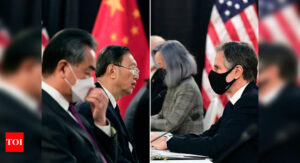
The U.S.-China meeting in Anchorage, Alaska. Photo: TOI
The U.S.-China palaver in Anchorage was the first high-level talks between the Biden administration and China. The talks were led, on the American side, by Secretary of State, Antony Blinken, and National Security Adviser, Jake Sullivan, and, on the Chinese, by the head of China’s Communist Party’s foreign policy department, Yang Jiechi, and Foreign Minister Wang Yi.
The very opening session turned out to be an angry war of rebukes and insults lasting one hour – in front of the world’s media! It was sparked by Blinken’s opening statement that the U.S. would “discuss our deep concerns with actions by China, including in Xinjiang, Hong Kong, Taiwan, cyber attacks on the United States, and economic coercion.” Each of those actions, he alleged, “threatened the rules-based order that maintains global stability.”
In response, Yang – a former Chinese ambassador to the United States and ex-foreign minister of China – accused Washington of “using its military might, financial supremacy to suppress other countries”, while using allegations of human rights abuses and so-called notions of national security to obstruct “normal trade exchanges, and incite some countries to attack China.”
It may be noted that just ahead of the Alaska meeting, the United States had sanctioned 24 Hong Kong and Chinese officials.
As reported by CNN’s James Griffith, following Blinken’s blunt opener, Yang pushed back by warning the United States to stop meddling in China’s “internal affairs” saying it should “stop advancing its own democracy in the rest of the world” adding that many Americans “actually have little confidence in the democracy of the United States.”
Incidentally, Yang charged that human rights in the U.S. were at a low point, with Black Americans being “slaughtered.”
To be noted, too, is that the subsequent talks behind closed doors had been “substantive, serious, and direct” and ran over two hours.
Incidentally, Chinese state media quoted Yang as urging, during those off-camera talks, that the “serious difficulties in China-U.S. relations in the past should not continue.”
BIGGEST GEOPOLITICAL TEST
It would be useful to take note of some other pointers having a bearing on the China-America relationship which Biden has termed as “the biggest geopolitical test of the 21st century.”
As Griffith has reminded, since 2010, China has been calling for a “new model of major-power relations” – a framework for a more balanced relationship that has been largely rejected by Washington.
Clearly, that was a signal that China is not prepared to play the role of a junior player vis-à-vis the United States – as India now seems increasingly tempted to do!
In any case, while Beijing had made it clear that it prefers a stable relationship with Washington, the aggressive moves by the former Trump administration also demonstrated that China can weather a lot of what the United States has to throw at it, be it on trade tariffs, sanctions or diplomatic pressure.
As Griffiths has it, while China’s global reputation was damaged by the coronavirus pandemic, the country has emerged largely unscathed, economically and politically, with the Chinese Communist Party even more secure than ever, “as demonstrated by renewed crackdowns in Xinjiang and Hong Kong.”
The fact that, as the recent ‘Quad’ confabulations proved once again, America needs Japan, Australia and India, among others, as a counterweight to China says it all.
It may be germane to point out two other geopolitical verities – this against the backdrop of frequent references to a new ‘cold war’ brewing, or in the offing, between America and China.
They are: that (a) China is a lynch-pin of the global economy as the erstwhile Soviet Union never was and (b) that China’s economy is still deeply integrated with that of the United States, also quite unlike that of the former U.S.S.R. in the heyday of the U.S.’s ‘containment’ policy.
Useful illumination has also been shed by Nicholas Burns, a former U.S. ambassador and senior State Department official, and, one is informed, a leading contender to become Biden’s ambassador to China.
That is reflected in this comment: “The United States is standing up for itself after four years of not doing that. And I think it’s been an important week to reposition the United States.”
PUTIN A ‘KILLER’
Even before the storm kicked up by the Alaskan slanging duel between the two superpowers had subsided, came another: this one in the shape of Biden’s public acquiescence to a TV news anchor’s query whether he thought Russian President Vladimir Putin was a “killer.”
While that truly put the American cat among the Russian pigeons, it not only marked a massive ‘reset’ in America’s Russia policy, as compared to that of the Trump era, but triggered the recall of the Russian ambassador to the United States – for the first time in over 20 years – and an invitation from Putin to Biden for an online, open debate/discussion on TV, not to mention his best wishes for Biden’s “good health.”
As CNN’s Moscow correspondent Matthew Chance explained, Russian media had for sometime been filled with speculation on Biden’s age, health and so forth, not to mention a “litany of historical grievances” by Russia against America – “speaking to a domestic audience.”
Notably, the White House had no regrets in labeling Putin a killer, though even some of Biden’s advisers who share his assessment were taken aback by what they viewed as an overshot in Biden’s opening bid in dealing with an increasingly adversarial counterpart.
Together with the Alaskan hi-jinks, the Biden administration clearly wished to showcase a surprisingly combative foreign policy that projected America’s strength and moral authority.
So what was its genesis? According to the worldly-wise, it was squarely directed at China and Russia, which seemed to the Biden administration to have assumed that America’s power is waning.
In other words, Washington wanted to advertise to the world that Biden will not be pushed over, even if the upshot would be a dramatic deterioration in relations with Beijing and Moscow!
Though the short and long-term effects of such a nebulous foreign policy rationale will surface only by and by, for the present, it is striking that, thus far, there has not been any public support for the same from America’s European allies.
Not too long ago, one recalls, they spurned American urgings not to cut economic deals with China.
There are other interesting singularities, as well. Though Biden has publicly spoken of the need to engage Russia on selected issues in America’s national interest, how does he now sit down and negotiate with a “killer”?
With respect to China, Biden would possibly need Beijing’s cooperation with Beijing not only to frame policy towards North Korea – which has reportedly spurned efforts to establish a dialogue with the U.S. – but also in the context of a well-known Biden’s hope to work with her on climate change.
China, which has close political and economic ties with Tehran, could play an important diplomatic role in facilitating another key Biden foreign policy goal: getting Iran back into negotiations on an acceptable deal on her nuclear programme.
INDIA CROSSES THE RUBICON
Closely connected with the assertive, new-look Biden foreign policy is the question of where India fits in.
Though hitherto New Delhi had attempted to alternately placate and antagonize Beijing in terms of her foreign/security policy, it is now increasingly clear that she has finally made her choice: to join the ‘Quad’ grouping as an unapologetic ‘partner’ of the United States and her treaty-allies Japan and Australia in attempting to ‘contain’ China.
While New Delhi, under Prime Minister Narendra Modi, obsessed with acquiring Great Power status for India, had long being playing ‘footsie’ with Washington – including unabashedly during the Trump era – she has decided, for whatever reasons, to jettison all pretences that she still holds on to at least some vestiges of non-alignment. In other words, the ‘footsie’ has now morphed into an openly torrid Indo-U.S. tango.
As much was rendered crystal clear last week following the short visit to India of U.S. Secretary of Defense, Llyod Austin, when, as per the Indian Express, he met Modi and conveyed Washington’s “commitment towards strengthening the bilateral defense relations between the two countries.”
Austin also met National Security Adviser Ajit Doval and held talks with Indian Defence Minister Rajnath Singh after which the foreign visitor declared India is “an important partner in the rapidly shifting international dynamics” hinting at the centrality of defence in Indo-U.S. ties.
Fareed Zakaria’s observations in his popular TV programme on CNN the other day are worthy of recall. The Pentagon, he disclosed, has now set its sights on China.
Though China is not a threat to the United States in military terms, given America’s overwhelming military strength, the Pentagon needs an enemy to securing her ever-increasing annual budgets – a function once admirably served by the Soviet Union.
Indeed, as Zakaria claimed, the Pentagon budget is presently much higher than it was even during the height of the Vietnam War.
Zakaria also disclosed that the U.S. Defence Department is “a financial fiasco;” without a declared enemy such as China today it would be difficult for it to justify the colossal budgetary expenses it continually seeks for its upkeep.
With Modi’s India now virtually a subaltern in the United States’ global strategic game plan, there could be two unintended consequences for India: one, a souring of relations with Russia, a long-time comrade-in-arms; and two, an end to her fervent dream of permanent membership of the UN Security Council.
WHAT IS IT TO US?
The ripple-effects of the changes now being set into motion in the international system will reach far and wide. Our policy makers thus need to ponder what the implications for Nepal’s national security and territorial integrity could be from the developments just touched upon.
To cut to the chase, Nepal could face increased pressure, in a variety of forms, principally against China in Nepali soil from the free-Tibet lobby.
At a time when Nepal’s fragile political system continues to be riven by dissent, confusion and contradiction, all patriots, and the independent media, should to be extra-vigilant.
The writer can be reached at: manajosse@gmail.com

Login to add a comment