






By Abid Hussain & Shruti Menon
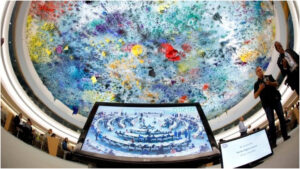
A dead professor and numerous defunct organisations were resurrected and used alongside at least 750 fake media outlets in a vast 15-year global disinformation campaign to serve Indian interests, a new investigation has revealed.
The man whose identity was stolen was regarded as one of the founding fathers of international human rights law, who died aged 92 in 2006.
“It is the largest network we have exposed,” said Alexandre Alaphilippe, executive director of EU DisinfoLab, which undertook the investigation and published an extensive report on Wednesday.
The network was designed primarily to “discredit Pakistan internationally” and influence decision-making at the UN Human Rights Council (UNHRC) and European Parliament, EU DisinfoLab said.
EU DisinfoLab partially exposed the network last year but now says the operation is much larger and more resilient than it first suspected.
The BBC is not responsible for the content of external
There is no evidence the network is linked to India’s government, but it relies heavily on amplifying content produced on fake media outlets with the help of Asian News International (ANI) – India’s largest wire service and a key focus of the investigation.
The EU DisinfoLab researchers, who are based in Brussels, believe the network’s purpose is to disseminate propaganda against India’s neighbour and rival Pakistan. Both countries have long sought to control the narrative against the other.
Last year, the researchers uncovered 265 pro-Indian sites operating across 65 countries, and traced them back to a Delhi-based Indian holding company, the Srivastava Group (SG).
Wednesday’s report, titled Indian Chronicles, reveals that the operation, run by SG, is spread over at least 116 countries and has targeted members of the European Parliament and the United Nations – raising questions about how much EU and UN staff knew about SG’s activities, and whether they could have done more to counter those activities, especially after last year’s report.
Mr Alaphilippe said the EU DisinfoLab researchers had never encountered such co-ordination between different stakeholders to spread disinformation.
“During the last 15 years, and even after being exposed last year, the fact that this network managed to operate so effectively shows the sophistication and the drive of the actors behind Indian Chronicles,” he said.
“You need more than a few computers to plan and sustain such an action,” he said.
The researchers cautioned against “definitively attributing Indian Chronicles to some specific actors such as Indian intelligence services” without further investigation.
Ben Nimmo, a disinformation network expert, told the BBC the uncovered network was “one of the most persistent and complex operations” he had seen, but he too was wary of attributing it to a specific actor.
Mr Nimmo, who is director of investigations at digital monitoring firm Graphika, cited previous examples of privately-run large-scale troll operations. “Just because they’re big, it doesn’t necessarily mean they’re directly run by the state,” he said.
The BBC approached the Indian government for comment but had received no response by the time of publication.
Of ghosts and defunct NGOs
One of the most important findings of the open-source investigation was establishing direct links between the Srivastava Group (SG) and at least 10 UN-accredited NGOs, along with several others, which were used to promote Indian interests and criticise Pakistan internationally.
“In Geneva, these think tanks and NGOs are in charge of lobbying, of organising demonstrations, speaking during press conferences and UN side-events, and they were often given the floor at the UN on behalf of the accredited organisations,” the report says.
The investigation shows that the operation led by SG began in late 2005, a few months after the UNHRC was founded in its current form.
One particular NGO which caught the eye of the researchers was the Commission to Study the Organisation of Peace (CSOP). The CSOP was founded in the 1930s and won UN-accreditation in 1975 but became inactive later in the 1970s.
The investigation found that a former chairman of the CSOP – Prof Louis B Sohn, one of the 20th Century’s leading international law scholars and a Harvard Law faculty member for 39 years – was listed under the name Louis Shon as a CSOP participant at the UNHRC session in 2007 and at a separate event in Washington DC in 2011.
The listings shocked the researchers because Prof Sohn died in 2006.
BBC

Login to add a comment