







By Our Reporter
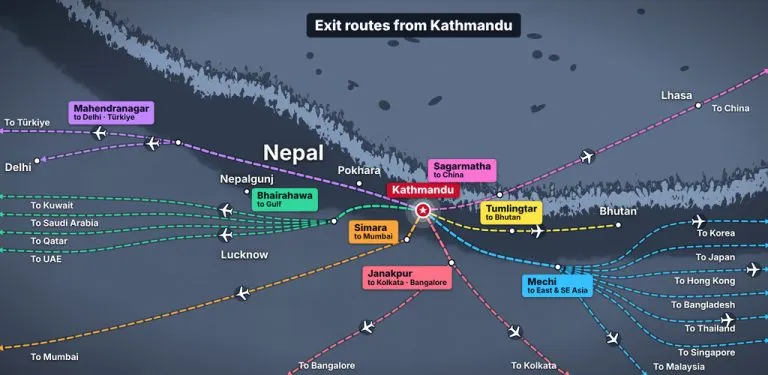
India’s decision to allow international flights to enter Nepal through Bhairahawa could ease a long-standing problem in the country’s aviation sector. For years, aircraft arriving from the west have had to enter Nepali airspace through Simara, even when their destinations were Bhairahawa or Pokhara. The detour has added flight time and operating costs, while limiting the usefulness of Nepal’s newer international airports.
The agreement reached during Prime Minister Balen Shah’s visit to India offers a way around that constraint. Its practical value, however, will depend on how quickly the two countries settle the technical details and how airlines respond.
Nepal handles around 100 to 115 international flight movements daily. Although departing aircraft can use several exit points, arrivals from most western destinations have relied on Simara. Flights from Qatar, the UAE, Saudi Arabia, Kuwait and Türkiye, along with services from Indian cities such as Delhi, Mumbai and Bengaluru, have had to follow the longer route before turning towards their destinations.
For aircraft heading to Bhairahawa, the detour has added an estimated 200 to 300 kilometres. Flights to Pokhara have faced a similar disadvantage. Allowing arrivals through Bhairahawa should remove much of this unnecessary distance for aircraft coming from the west.
Former Civil Aviation Authority of Nepal Director General Raj Kumar Chhetri estimates that flights from the Middle East and West Asia to Kathmandu could save up to 15 minutes. The savings would be greater for aircraft landing at Bhairahawa and Pokhara. These are estimates, not guaranteed reductions for every service. Actual savings will depend on the origin, destination, aircraft and flight path.
Even a 15-minute reduction can lower fuel consumption and operating expenses. Airlines may also save on crew hours and navigation charges payable to India for airspace they no longer need to use. Whether passengers see cheaper fares is less certain. Airlines will decide how much of the savings, if any, to pass on to customers.
The new route could also reduce pressure on air traffic around Kathmandu by giving some flights a more direct approach. But it would be premature to assume that it will solve congestion at Tribhuvan International Airport. That depends on traffic levels, scheduling and the capacity of air traffic control.
For Bhairahawa and Pokhara, the agreement removes one obstacle to attracting international flights. It does not address the larger commercial problem facing both airports: securing enough passengers to support regular services. Airlines need reliable demand, convenient connections and a reasonable prospect of making money. A shorter route helps, but cannot create that market on its own.
The failure to secure the Mahendranagar and Nepalgunj entry routes also limits the gains. Those corridors could have offered shorter approaches for aircraft travelling from western destinations, particularly to Pokhara. Bhairahawa is a useful concession after nearly 15 years of negotiations, but Nepal has not secured all the access it sought.
Regional connectivity with India could offer another benefit. Buddha Air currently uses Bhairahawa as an exit point on its Kathmandu to Varanasi service, but returning aircraft have to enter through Simara. Allowing two-way use of the Bhairahawa route would simplify these operations. It could also support links between Indian cities and Nepal’s religious and tourist destinations, including Lumbini and Pokhara. Such services will still depend on passenger demand and commercial viability.
The revenue argument also needs careful examination. Airlines currently pay India for the longer stretch of Indian airspace they use before entering Nepal through Simara. A more direct approach through Bhairahawa could reduce those payments while increasing the portion of a flight conducted within Nepali airspace. Nepal may therefore collect more in navigation charges. The actual gain will depend on the final route structure and applicable charges. No firm estimate of additional revenue has yet been established in the material available.
Political agreement is only the first stage. Nepal and India still need to settle flight altitudes, approach procedures and the operation of the Instrument Landing System at Bhairahawa, which lies about five kilometres from the Indian border. Any unnecessary altitude restriction could reduce the benefits of the new corridor.
Balen’s visit has secured an agreement that Nepal’s aviation sector has pursued for years. Its value will be measured by whether aircraft can use the route without operational restrictions, whether airlines add services and whether passengers gain from lower costs. Until those details are settled, Bhairahawa is a promising opening, rather than a completed aviation reform.

Login to add a comment