








By Narayan Prasad Mishra
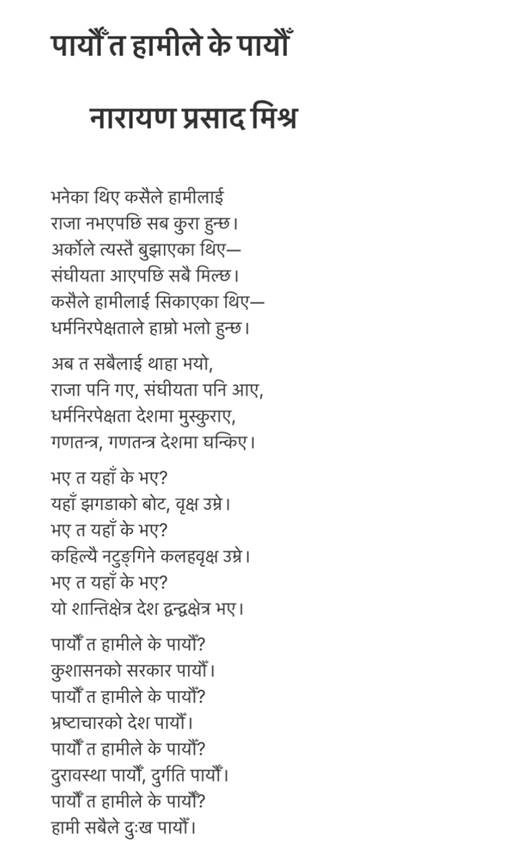
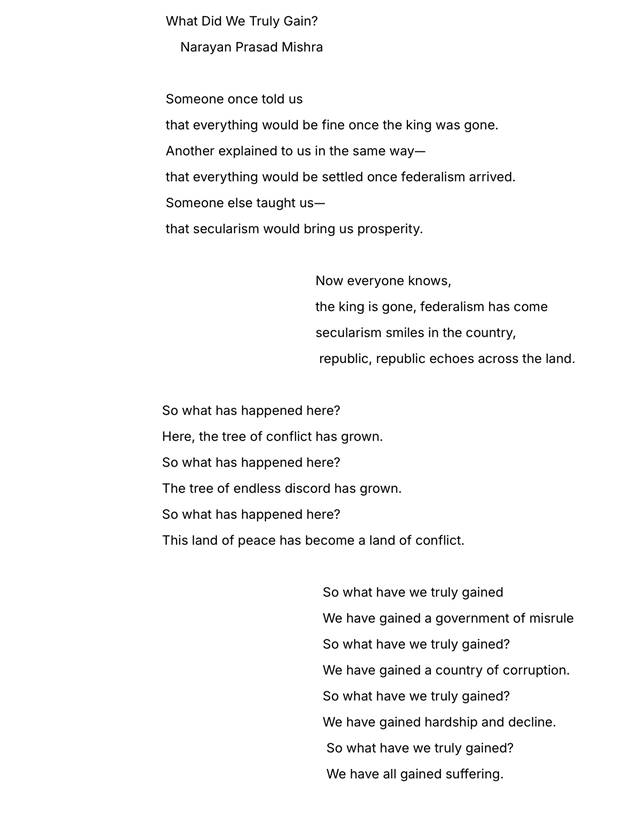
Our country has undergone profound political changes over the past several decades. Yet, with no tangible progress in national development and the welfare of its people, and with unbearable misgovernance, mismanagement, corruption, and decline, the country appears increasingly trapped in political conflict. Instead of concentrating on the urgent needs of the people, much of the nation’s political energy continues to be consumed by debates over monarchy, federalism, and secularism. In this context, I wrote a poem in Nepali titled: (पार्यौँ त हामीले के पायौँ ) What Did We Truly Gain? The poem is given below in both languages.
Poem in Nepali:
Poem Translated into English
These views and issues have become major sources of political disagreement and social tension. People from different communities and groups are often drawn into disputes over religion, federalism, and the form of government and head of state. Rather than bringing the country together, these contentious issues have contributed to division and confrontation.
The political situation in our country sometimes seems to revolve endlessly around the questions of monarchy, federalism, and secularism. We spend enormous amounts of time debating these matters while other pressing national priorities receive inadequate attention. Education, employment, economic development, infrastructure, public services, good governance, and the welfare of ordinary citizens should be at the center of national policy.
In my view, these political changes, introduced largely through the Maoist movement and the political developments that followed it, have become deeply rooted in Nepal’s political life. They were particularly prioritized by the Maoists, not by the people and the country. It seems the topics, though they have been an integral part of our constitution, have been established as the seeds of never-ending conflicts in the country. Whether one supports or opposes them, their consequences cannot simply be ignored. Unless these fundamental and contentious questions are properly addressed, political conflict in our country may continue.
At the same time, there is a serious difficulty. Whenever these subjects are raised, they themselves can create new disagreements and conflicts. Nepal therefore appears to be caught in a difficult cycle: the issues that most urgently need to be settled are also the issues most capable of dividing the nation.
What, then, is the way forward?
If there is a genuine and continuing disagreement among the people over fundamental questions such as monarchy, federalism, and secularism, the most peaceful and democratic way to resolve them may be through a referendum. The people themselves should have the opportunity to express their views directly on such fundamental questions concerning the future of their country.
Such a referendum should not be regarded as a victory for one political side over another. It should be conducted through mutual understanding, democratic principles, and respect for opposing views. Its purpose should be to settle fundamental questions peacefully and to establish a political arrangement that enjoys broad public acceptance.
If these issues remain unresolved, they may continue to be used as instruments of political mobilization and confrontation. Political parties may continue to exploit differences among citizens, while the country’s urgent problems remain neglected.
We cannot afford to spend its future endlessly debating its political past. Whatever political system the country ultimately chooses, that system should serve the people. The success of any political system should be measured not simply by its name or structure but by whether it provides the people with peace, security, good governance, education, employment, economic opportunity, and a better quality of life.
If our country remains permanently divided over these fundamental political questions, the country risks becoming trapped in a cycle of conflict similar to that experienced by other conflict-ridden countries. In such circumstances, meaningful national development cannot move forward.
We, the people of Nepal, deserve a better situation in the country. We deserve a peaceful and stable country in which the government can concentrate its attention and resources on development and the welfare of its citizens.
The time has therefore come to seek a peaceful and democratic settlement of our fundamental political questions. Once these issues have been settled with the consent of the people, the country can turn its full attention toward the work that matters most: building a peaceful, prosperous, educated, and developed Nepal.
Our future should not remain imprisoned in political conflict. It should be devoted to the welfare of its people and the development of the nation.
About the author: A non-partisan writer and author of several books and numerous articles in Nepali and English, including the book “Nepal: Between Beauty and Struggle”; a retired official of Tribhuvan University; and a senior citizen in his mid-eighties.

Login to add a comment