








By Our Reporter
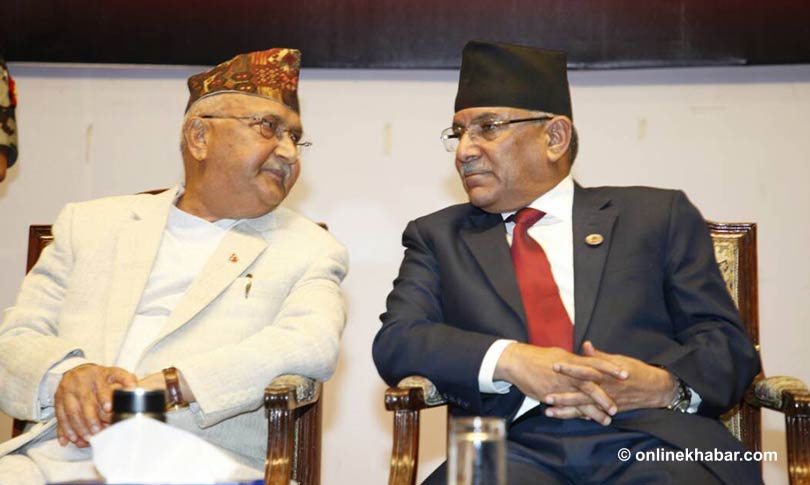
Pushpa Kamal Dahal “Prachanda” needed less than 24 hours to contradict himself. On one day, he warned that Nepal’s political parties must abandon the old game of making and breaking governments. He even cautioned that returning to that path could “crush” everyone in the next political backlash. The next day, he sat with KP Sharma Oli and signed a provincial power sharing deal that does exactly what he had condemned.
This was not a slip of the tongue. It was a reminder that Nepal’s politics continues to revolve around power first and principles later.
Prachanda defended the deal by arguing that the provinces need stability. That explanation sounds convenient rather than convincing. If stability had truly been the objective, he would have spent months strengthening existing governments rather than reshuffling them. Stability does not come from changing ruling coalitions every few months. It comes from allowing elected governments to function and be judged by their performance. The speed of Prachanda’s turnaround raises an obvious question: what changed overnight?
No public crisis emerged. No constitutional deadlock appeared. No emergency demanded immediate intervention. The only visible change was a political agreement that brought Prachanda closer to executive power. That has been the defining feature of his career. Whether leading the government or sitting in opposition, Prachanda has consistently tried to remain close to the levers of state power. Even when he lacks the numbers to lead the federal government, influence in provincial governments keeps his party relevant, preserves patronage networks and maintains bargaining power in Kathmandu.
The provincial deal reflects that calculation. Another explanation circulating in political circles is more serious. Some observers argue that Prachanda fears investigations into decisions taken during his years in power, including corruption allegations and controversial government decisions. Others speculate that he wants to protect people close to him, including family members, from possible legal scrutiny.
Those claims remain allegations. No court has established criminal liability against Prachanda or his family, and any assessment should make that distinction clearly. Still, politics is often driven as much by perceived risks as by proven facts. Leaders who believe they could become vulnerable outside power frequently seek alliances that maximise their political leverage.
That perception itself damages public trust. If politicians appear to change alliances whenever investigations gather pace or political pressure increases, citizens naturally begin to wonder whether coalitions are being built to govern or to survive.
KP Sharma Oli deserves equal scrutiny. Oli has repeatedly presented himself as a leader committed to political stability and institutional governance. Yet his political record also tells a different story. He has entered and abandoned alliances with remarkable ease whenever the balance of power shifts. His latest understanding with Prachanda again shows that ideological differences often disappear when political arithmetic demands cooperation.
Both leaders frequently accuse each other of betrayal. Both have described the other as unreliable. Yet when circumstances change, they return to the negotiating table without hesitation. The conflict appears less about principles than about who gets the larger share of power.
The provincial agreement also exposes another weakness in Nepal’s federal system. Provincial governments increasingly look like extensions of federal bargaining rather than autonomous governments accountable to provincial voters. Coalitions are stitched together in Kathmandu and imposed on provinces where local political realities often receive little attention. Provincial leadership becomes a bargaining chip instead of a democratic mandate.
This cycle has repeated itself for years. Leaders denounce instability while producing it. They promise institutional politics while relying on personal negotiations. They speak about ideology during public meetings but calculate numbers behind closed doors. Prachanda’s reversal within a day simply made that contradiction impossible to ignore.
The bigger problem is that this is no longer surprising. When political leaders repeatedly abandon their own words, public cynicism grows. Citizens stop believing promises because experience tells them those promises expire as soon as a better political deal appears. Prachanda’s latest move and Oli’s willingness to embrace it reinforce a familiar pattern in Nepal’s politics: principles remain negotiable, but power never is. Until that culture changes, promises of stability, reform and ideological commitment will continue to sound less like convictions and more like temporary campaign slogans.

Login to add a comment