







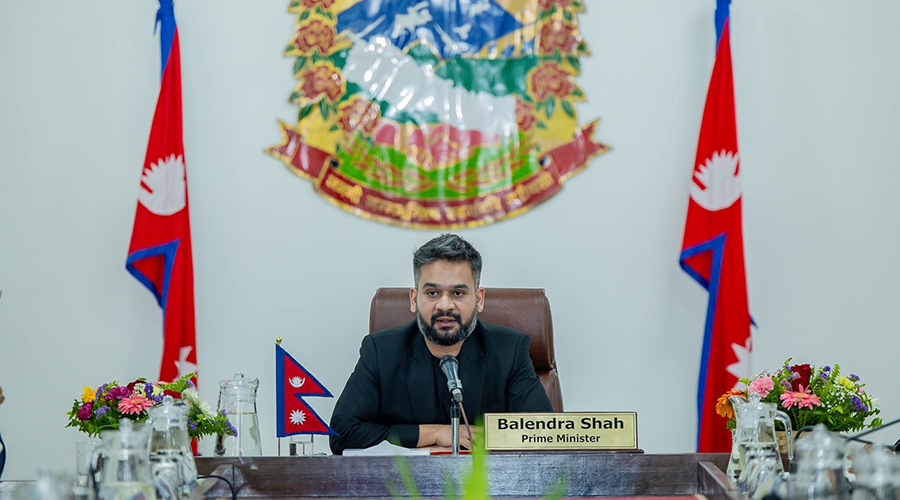
Kathmandu, July 3: In its first 100 days, the government led by Prime Minister Balen Shah has sought to distinguish itself through administrative reforms and an unconventional governing style, moving away from many of the symbolic practices long associated with Nepali politics.
Unlike previous prime ministers and ministers who routinely attended inaugurations, laid foundation stones, cut ribbons, accepted ceremonial shawls and garlands, and appeared at formal public events, Shah has largely stayed away from such functions. He has also instructed ministers not to attend inauguration ceremonies, emphasizing work over symbolism.
The prime minister has curtailed unnecessary appearances at public events, enforced office hours, limited meetings with party workers and political intermediaries, and focused diplomatic engagements on specific agendas.
According to officials close to the prime minister, Shah regularly attends office on time and spends most of his day reviewing ministry work, policy decisions and implementation progress.
Access to the Prime Minister’s Office has also been tightened. Meetings with party workers, well-wishers and those seeking political recommendations are now granted only for essential matters and by prior appointment.
The government has also changed the way it handles diplomatic relations. Rather than routinely meeting foreign envoys, Shah has delegated most interactions with ambassadors, development partners and visiting delegations to Foreign Minister Shishir Khanal. Officials say the practice of foreign diplomats seeking unscheduled meetings with the prime minister has effectively ended.
Soon after taking office, the government unveiled a 100-point good governance action plan prioritizing anti-corruption measures, public service delivery, administrative restructuring, digital governance and greater accountability.
Among its key commitments were expanding digital public services, setting time limits for government services, streamlining ministries and introducing a performance-based evaluation system for public officials.
To reduce the need for citizens to visit multiple offices and navigate lengthy procedures, the government plans to establish citizen service centers in major cities under an agency model, operating at least 12 hours a day.
According to a progress report prepared by the Prime Minister’s Office, the study for the service centers has been completed and submitted, while the E Governance Board has prepared draft operating procedures.
The government has also completed a “Calendar of Action” to monitor service delivery across ministries and government agencies. Monitoring schedules and checklists have been approved and are now being implemented.
Another reform completed within the first 100 days ends the practice of repeatedly seeking opinions from officials of the same rank on routine contract matters already covered by existing agreements.
The government has also compiled records of all boards, committees, projects and institutional bodies operating under ministries and submitted them to the Prime Minister’s Office. According to the report, 21 of the 100 pledged actions have been completed.
A 24-hour National Citizen Assistance and Grievance Management System has also been launched to respond more quickly to complaints, suggestions and service requests from across the country. Citizens can submit complaints through telephone, mobile applications, online portals and social media platforms, while a real time dashboard has been introduced to track responses.
As part of efforts to modernize public administration, the government has expanded the Government Integrated Office Management System (GIOMS) across government offices, making it the mandatory platform for official decisions and file management. The driving licence system has also been integrated with the Traffic Violation Record System (TVRS).
The government has also moved to improve safety in public transport. It coordinated with transport operators to install CCTV cameras and dashcams in buses. According to the progress report, all 111 Sajha Yatayat buses, including 71 diesel and 40 electric buses, have been equipped with surveillance systems. Another 46 buses operated by Mahanagar Yatayat have also been fitted with CCTV cameras and dashcams. Installation in other public vehicles is ongoing, while traffic police have been tasked with monitoring compliance.
Draft standards governing the installation of CCTV and dashcams in public transport have already been prepared and forwarded to the Ministry of Physical Infrastructure and Transport for approval.
The government has also introduced measures to make services such as passports, citizenship certificates and driving licences faster, more predictable, digital and free from middlemen.
Compared with previous administrations, which were often criticized for delays, excessive paperwork, political interference and weak anti-corruption efforts, the Shah government has pledged a policy of zero tolerance toward corruption. It has announced plans to scrutinize the assets of senior public officials, expand digital governance and make more government services available from home. The number of ministries has also been reduced to 18, alongside a commitment to restructure the bureaucracy and regularly publish institutional performance reports.
Despite these initiatives, the government has faced criticism during its first 100 days. Analysts say many promised reforms have not been completed within the announced deadlines, while allegations of corruption against some ministers have raised questions about the government’s credibility.
Opposition Nepali Congress chief whip Niskal Rai said questions were raised about the assets of several ministers soon after the government took office and an investigation committee was formed. However, he noted that the committee’s report has not been made public. “Instead, the same individuals facing questions have been brought back into government,” he said.
Some of the government’s decisions and proposed laws have also prompted concerns about civil liberties and democratic practices, adding to the scrutiny facing the administration.
People’s News Monitoring Service

Login to add a comment