








By Deepak Joshi Pokhrel
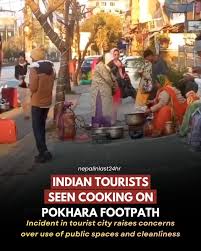
In the recent past, social media has been inundated with videos showing the immoral and unethical behavior of some Indians across the country. Many people have watched these videos with concern, while others have been taken aback by the conduct of citizens of a country that is one of the economic giants of Asia. The videos show Indian tourists urinating in open spaces, breaching public decency; cooking and eating on roadsides, inconveniencing commuters; and littering roads with plastic and other waste. In one video, some Indians were seen drying their clothes on top of a car owned by an international tourist on the premises of Muktinath. Amid this, there is growing concern about whether we should continue to welcome such tourists while embracing the long-standing slogan “Atithi Devo Bhava” (literal translation: The Guest is God).
Needless to mention, the only smokeless industry—tourism—has been playing a key role in keeping our economy afloat. Every year, a large number of tourists from across the globe visit Nepal to witness its mesmerizing beauty, receive blessings from the Living Goddess, and experience daring adventures. Logically speaking, from religious to adventure tourism, Nepal offers all genres to woo tourists from across the globe.
According to the latest data from the Nepal Tourism Board and immigration authorities, Nepal received about 1.16 million international tourists in 2025. The report also says that Indian tourists top the rankings, followed by the United States and China. The direct contribution of tourism to Nepal’s GDP is estimated at around 6.5%–7.5%. However, when indirect and induced effects are included (hotels, restaurants, transport, agriculture, handicrafts, etc.), tourism contributes 11.5%–13% of Nepal’s GDP.
At the same time, it supports more than one million jobs directly and indirectly in Nepal. More importantly, it is a major source of foreign exchange earnings, generating around NPR 87 billion in tourism receipts in 2025. This makes tourism one of Nepal’s most important economic sectors alongside remittances, agriculture, and services.
However, the recent conduct of some Indian tourists in Nepal has triggered a debate on social media and in the mainstream media about whether Nepal should be more selective in promoting tourism. It also raises pertinent questions about the stricter enforcement of tourism regulations. These are key concerns that call for convincing explanations.
While the issue of misconduct by Indian tourists has become a subject of debate across the country, experts argue that the government must ensure that Nepal’s image as one of the world’s beautiful tourist destinations is not placed under severe threat. Just Google “Indian tourists lack civic sense in Nepal”, and one will be bombarded with images and videos showcasing the immoral and unethical behavior of some Indian tourists in Nepal. The videos show Indian tourists urinating in public places and along roadsides, breaching public decency. We can also find a video in which a Nepali citizen confronted Indian tourists for spitting tobacco in a public place and asked them to clean the area.
During visits to Nepal, many Indian tourists are seen carrying their own food supplies, LPG cylinders, and utensils. They cook food along highways and litter the roads, polluting the local environment. Logically speaking, they appear to spend very little money in Nepal. This raises a pertinent question: can they still be considered tourists, or should they be regarded as visitors who come for leisure without contributing economically? We hope to receive a convincing explanation very soon.
Our neighboring country, Bhutan, has a Sustainable Development Fee in place. This is a mandatory government fee for most international tourists. The fund goes directly towards education, healthcare, environmental conservation, and infrastructure. At the same time, tourists must also book through licensed operators and follow regulated travel rules. Nepal, too, can introduce such reforms.
It is an established fact that tourists, regardless of their nationality, are seen as informal representatives of their country and are often called flag-bearers of their nation. They are responsible for portraying their country in either a positive or negative light. Their misconduct in destination countries can influence and shape people’s perceptions of their homeland. This is what is happening with Indian tourists at present. Through their unethical behavior and misconduct, many people may come to view India as a country where a significant number of citizens lack awareness, civic sense, and education.
Nepal and India share a special bilateral relationship. The people of both countries are socially and culturally connected. However, citizens of both countries need to understand that this special bond will grow stronger if they respect each other’s norms, values, and laws. On the contrary, some Indian tourists are disregarding local laws and norms while displaying an attitude of arrogance. The case of Indian cars being parked on footpaths in Pokhara is just one example. There are several others.
Nepal has requested the UN authorities for postponing Nepal’s graduation to the developing country’s status. Otherwise, in a few months, Nepal would have graduate to developing-country status. While this is a major achievement in itself, there will also be challenges in the aftermath of graduation. International funding is expected to decline significantly. Many donor communities will withdraw much of their financial support. The role of the tourism industry in the post-graduation period will be greater than ever before. Sadly, however, the misconduct of some Indian tourists could portray Nepal in a negative light on the international stage, thereby affecting tourist inflows. This could be detrimental, given that our economy relies heavily on the tourism industry.
In the face of such misconduct by tourists, experts suggest the enactment and enforcement of stricter tourism laws and regulations. They also recommend imposing hefty fines on offenders and strengthening monitoring and surveillance at tourist sites. In addition, they recommend introducing a code of conduct for visitors and swiftly penalizing those who violate local laws and cultural norms.
At the same time, the installation of CCTV cameras at major tourist sites to monitor visitors’ conduct could prove highly effective. A temporary ban or blacklisting of vehicles for repeat offences may help improve the conduct of Indian tourists arriving in Nepal. The installation of more waste-management bins to discourage littering is equally important.
We have long believed that tourists, irrespective of their nationality, are equivalent to God. This has been a hallmark of our culture and hospitality. However, we should not tolerate any irresponsible or unacceptable conduct on their part. This is a simple truth that everyone needs to understand and respect.

Login to add a comment