







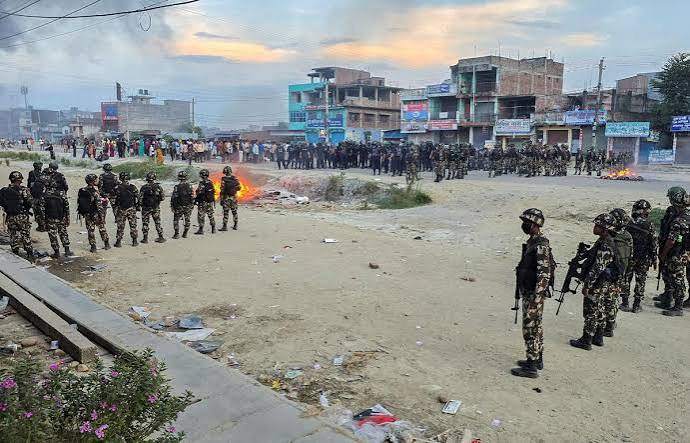
By Our Political Observer
Nepal has long taken pride in its religious harmony. Hindus and Muslims have lived side by side for generations, sharing marketplaces, festivals, workplaces, and neighborhoods. However, this harmony appears to have developed some cracks in recent times. The recent violence across Sunsari, Siraha, Saptari, Dhanusha, and other Madhesh districts is a grim reminder that small local disputes are increasingly turning into dangerous communal confrontations.
The pattern is becoming painfully familiar. A religious procession, loud music, an argument over public space, rumors on social media, mobs gathering, police intervention, deaths, curfew, political visits, an investigation committee, and then silence until the next clash. Nepal is trapped in a cycle that everyone acknowledges but few seriously try to break.
The first failure lies with political leadership. Leaders from every major party routinely preach harmony after violence erupts, yet rarely invest in preventing it. Religious harmony cannot depend on appeals issued after people have died. It requires constant engagement with communities, early intervention, and the courage to confront extremists within one’s own support base. Instead, politicians often prefer symbolic statements while avoiding difficult conversations about radicalization and hate speech.
The state also continues to treat communal violence as merely a law and order problem. Deploying police, imposing curfews, and forming inquiry committees may restore temporary calm, but they do little to address why these clashes keep recurring. Most investigation reports never lead to visible reforms or accountability. That sends a dangerous message that every riot will eventually fade from public attention.
Social media has become perhaps the biggest accelerant. False claims spread faster than facts. Anonymous accounts manufacture stories about attacks on one community, foreign conspiracies, demographic threats, or revenge plots. By the time authorities respond, thousands have already consumed inflammatory content. The government has been consistently slow in monitoring coordinated disinformation campaigns, while social media platforms themselves have done little to stop accounts repeatedly spreading communal hatred.
Imported political narratives have made the situation even more volatile. Nepal is increasingly absorbing ideological battles that originated elsewhere. Along the open border, communities consume the same media, political messaging, and religious rhetoric as neighboring Indian states. Polarizing slogans, identity politics, and majoritarian narratives that have transformed politics across the border now echo in parts of the Madhesh. They find fertile ground when amplified by local actors looking for political relevance.
But blaming only foreign influence would be convenient and incomplete. Domestic actors willingly amplify those narratives. Some political groups exploit religious identity to build support. Others remain silent because condemning extremists’ risks alienating potential voters. Silence, in such moments, becomes complicity.
The security agencies also deserve scrutiny. The deaths during recent clashes have again raised questions about whether nonlethal options were fully exhausted before live ammunition was used. Heavy handed policing may disperse crowds temporarily, but it deepens mistrust, particularly in communities that already carry memories of past confrontations with the state. Effective policing depends not only on force, but also on intelligence, local trust, and communication.
Federalism has not functioned as intended either. Provincial governments still lack adequate control over policing and crisis management. Local authorities often understand community dynamics far better than officials in Kathmandu, yet major security decisions remain centralized. That disconnect delays responses and weakens dialogue before situations spiral.
Communal tensions also expose a broader governance deficit. Local peace committees exist only on paper in many districts. Early warning mechanisms remain weak despite repeated intelligence about potential flashpoints. Preventive community engagement receives little attention compared to emergency deployments once violence has already begun.
Communities themselves must also shoulder responsibility. Religious processions should respect shared public spaces. Complaints over noise or routes should not become tests of religious identity. Community leaders must reject provocation from within their own groups instead of defending it for fear of appearing weak. Every rumor forwarded without verification, every hateful slogan tolerated, and every act of selective outrage pushes society one step closer to another confrontation.
The media, too, has an obligation to report carefully. Sensational headlines, unverified videos, and selective reporting can inflame already fragile situations. Responsible journalism should expose misinformation instead of amplifying it.
Nepal is not destined for communal conflict. Centuries of coexistence remain far stronger than the politics of division. Most Hindus and Muslims continue to celebrate each other’s festivals, conduct business together, and live peacefully. That everyday reality deserves greater attention than the voices trying to divide them.
Breaking this cycle demands more than curfews and committees. Authorities must act against hate speech regardless of who spreads it. Intelligence agencies should identify organized instigators before violence erupts. Police reforms must prioritize community policing and proportional use of force. Political parties should refuse to shield extremists from their own ranks. Schools, religious institutions, and civil society must actively promote dialogue instead of waiting for crises.
Nepal’s greatest strength has always been its diversity. Preserving it requires confronting those who profit from fear, whether they operate behind political platforms, religious banners, or anonymous social media accounts. Until that happens, the country’s communal wounds will keep reopening, each time at a higher cost.

Login to add a comment