







KATHMANDU, June 16: All seven provinces have unveiled their budgets for fiscal year 2083/84, outlining spending plans focused on infrastructure, agriculture, employment, governance reforms, and economic growth. While most provinces presented their budgets on schedule, Sudurpaschim tabled its budget late at night after disagreements among ruling coalition partners delayed the provincial assembly session. Opposition parties boycotted the meeting, but the budget was eventually presented.
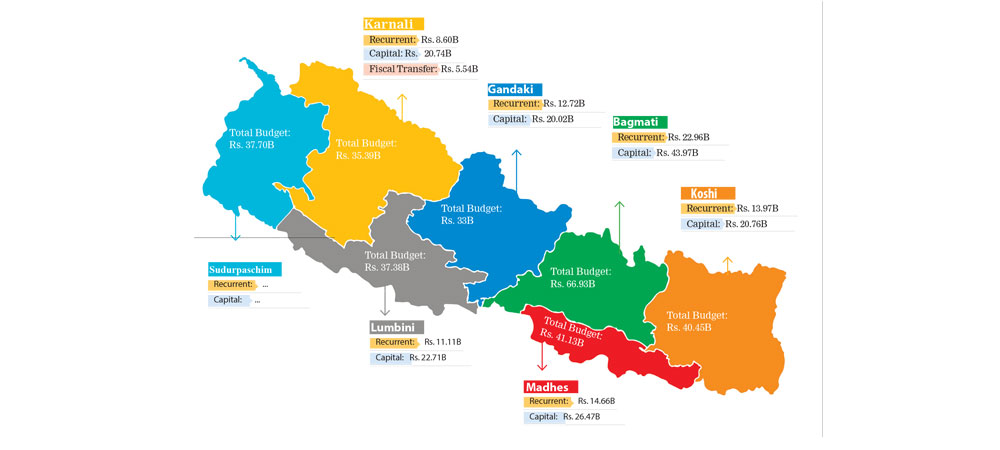
Bagmati Province announced the largest budget at Rs 66.93 billion, while Gandaki presented the smallest at Rs 32.99 billion.
Koshi Province allocated Rs 40.44 billion, a 12.74 percent increase from the current fiscal year. The budget prioritizes infrastructure development, production growth, improved service delivery, and expansion of economic activities. Of the total allocation, Rs 20.75 billion has been earmarked for capital expenditure and Rs 13.97 billion for recurrent spending.
Madhesh Province unveiled a Rs 41.13 billion budget with emphasis on agricultural innovation, entrepreneurship, education, and health. The province also announced governance initiatives including a “Hello CM” mobile application and toll free service. A 100 day employment guarantee programme targeting people aged 18 to 35 has also been introduced. The existing “Daughter Education and Protection” programme has been revamped to promote girls’ education and women’s entrepreneurship.
Bagmati Province presented a Rs 66.93 billion budget, allocating nearly two thirds of the total amount to capital expenditure. The province plans to encourage investment and stimulate economic activity through revised revenue policies. Revenue sharing, federal grants, provincial income, and accumulated savings will finance the spending plan.
Gandaki Province announced a Rs 32.99 billion budget, around Rs 1 billion higher than the current fiscal year. Capital expenditure accounts for more than 60 percent of the allocation. The province expects to mobilize resources through federal grants, revenue sharing, royalties, internal revenue, and a small amount of internal borrowing.
Lumbini Province tabled a Rs 37.38 billion budget focused on strengthening provincial institutions, improving financial governance, and expanding private sector participation. The budget offers incentives for industries other than alcohol and tobacco related businesses, establishes an Enterprise Development Fund for startups and innovation, and prioritizes digital governance through a Digital Lumbini programme. The province also plans to restructure ministries and review staffing levels.
Karnali Province announced a Rs 35.39 billion budget, giving priority to agriculture, infrastructure, tourism, employment generation, and social justice. The province aims to modernize agriculture through mechanization, irrigation expansion, crop insurance, concessional loans, and youth focused programmes. Funding has also been allocated for roads, bridges, airport expansion, hydropower projects, and administrative infrastructure.
Sudurpaschim Province presented a Rs 37.70 billion budget after a politically contentious assembly session. The budget will be financed through internal revenue, federal revenue sharing, grants, royalties, and savings carried over from the current fiscal year. Despite the opposition boycott, the provincial government proceeded with the budget presentation, making Sudurpaschim the final province to unveil its spending plan for the upcoming fiscal year.
People’s News Monitoring Service

Login to add a comment