







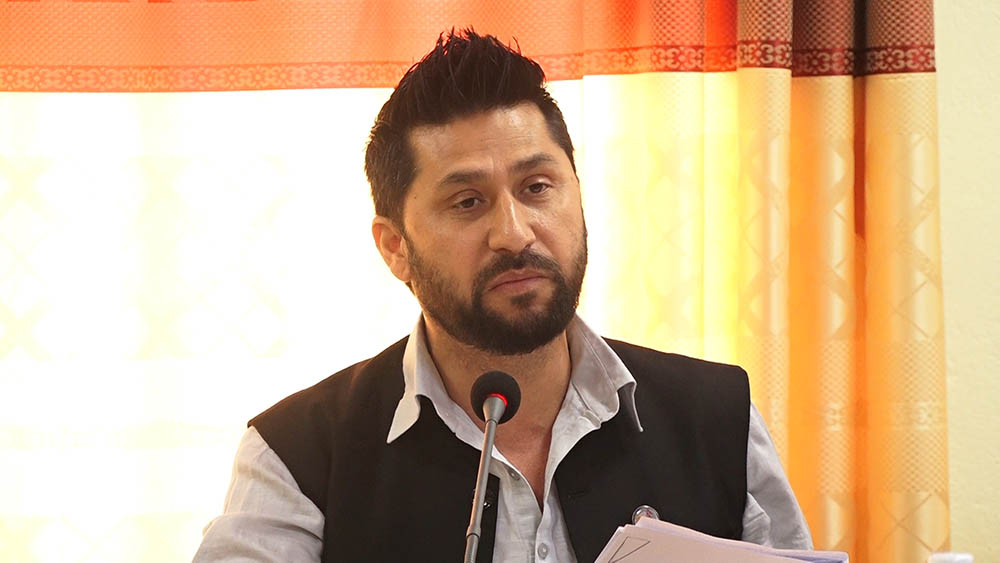
Kathmandu, June 2: During his visit to India, Rabi Lamichhane, president of the Rastriya Swatantra Party, has proposed shifting Nepal-India relations away from geopolitical disputes and toward what he calls “development diplomacy,” centered on economic cooperation, investment, trade, energy, and tourism.
In an article titled How Can an Aspiring Nepal and a Rising India Reconnect? published in the Indian daily Hindustan Times, Lamichhane argued that the vocabulary of Nepal-India relations needs to change. He said diplomatic missions should evolve from political contact points into engines of investment, trade, and economic collaboration.
Lamichhane, who arrived in New Delhi on Monday for a five-day official visit, is scheduled to meet senior leaders of India’s ruling Bharatiya Janata Party, including party president Nitin Navin. According to RSP, the discussions will focus on democratic cooperation, political experience sharing, and strengthening bilateral ties.
In the article, Lamichhane outlined eight key proposals for deeper Nepal-India cooperation.
Dialogue on Border Disputes
He stressed that trust should form the foundation of bilateral relations and said border disputes and other unresolved issues should not be allowed to linger indefinitely. Criticising ultra-nationalist rhetoric, he called for disputes to be resolved through dialogue based on historical facts and mutual understanding.
Recalling Indian Prime Minister Narendra Modi’s 2014 vision of turning the Nepal-India border into a bridge rather than a barrier, Lamichhane said the relationship should be defined by future opportunities rather than past suspicions.
Raxaul Kathmandu Railway
He identified the proposed Raxaul Kathmandu railway as one of the most important economic projects between the two countries. Noting that India builds roughly 15 kilometres of railway track daily, he said the less than 150-kilometres rail link could transform trade, tourism, transport, and regional connectivity.
Direct Flights from Pokhara and Lumbini
Lamichhane called for direct flights linking Pokhara and Lumbini with Indian cities such as Delhi, Mumbai, and Bengaluru to strengthen people-to-people and business connections.
Kathmandu Bengaluru Digital Corridor
In the technology sector, he proposed creating a Kathmandu Bengaluru Digital Corridor. He said cooperation in digital payments, fintech, and cross-border digital platforms could empower entrepreneurs in both countries.
Indian Institutions in Nepal
Lamichhane invited Indian technology firms, startups, and universities to establish innovation labs, incubation centers, and technology hubs in Nepal. He also suggested setting up institutions similar to the Indian Institutes of Technology (IITs) and the All India Institute of Medical Sciences (AIIMS) in Nepal.
Fertilizer Industry Along the Border
Drawing inspiration from Gujarat’s industrial development, he proposed joint investment in a chemical fertilizer plant in the Nepal-India border region. He said such cooperation could strengthen agriculture, supply chains, and economic development.
Hydropower and Energy Integration
Lamichhane urged closer integration of Nepal’s hydropower resources with India’s industrial corridors. He called for the creation of an integrated energy market, modern digital Integrated Check Posts, smoother transit systems, and the removal of trade barriers.
Sports Cooperation
He also argued that Nepal-India ties should extend beyond politics and diplomacy into sports. Referring to his recent attendance at the IPL final, he said future cooperation could include not only Nepali players participating in the league but also potential involvement of Nepali stadiums in the IPL ecosystem.
Describing Nepal’s recent political transformation as a “ballot box revolution,” Lamichhane said the country is entering a new political era. He portrayed the rise of the RSP as a challenge to the traditional political establishment and claimed younger generations increasingly favor development, good governance, and direct accountability.
People’s News Monitoring Service

Login to add a comment