







By Our Reporter
The new government’s 100-point action plan has come at a time when public trust in state institutions is quite low. For years, people have watched promises come and go while basic services stayed slow and uneven. So when the cabinet says it will investigate the assets of those who held power since 1991, it speaks directly to a long running concern in Nepal, the belief that political office has often been used to amass wealth without proper scrutiny.
Looking back, corruption has not always appeared as dramatic scandals. It has often shown up in everyday dealings, inflated project costs, delayed infrastructure, and political protection for those accused of wrongdoing. Big reconstruction budgets after the 2015 earthquake raised questions. Procurement processes in sectors like health and infrastructure have faced repeated criticism. Many reports have pointed to a pattern, weak enforcement, political interference, and slow investigations. That is why this new pledge to probe assets since 2048 BS, 1991 AD, feels significant. It goes after a long timeline, not just recent office holders.
Still, the real test lies in execution. Forming a powerful committee with the authority to seize documents sounds strong on paper. But past commissions have often struggled due to pressure from political actors. If the same networks remain in place, the process could stall or target only select individuals. To build trust, the investigation needs to move forward in a fair and visible way, not as a tool for political rivalry.
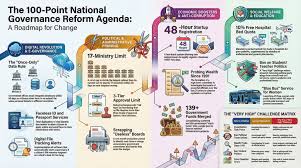
Beyond corruption, the agenda tries to fix structural issues in governance. Cutting ministries to 17 within 30 days signals an attempt to reduce administrative bloat. Nepal’s bureaucracy has often been criticized for duplication of roles and slow decision making. Fewer ministries could mean quicker coordination, but only if roles are clearly defined and not reshuffled for political convenience.
Another major promise is to remove party influence from public administration, schools, and universities. This is a sensitive but necessary step. Political affiliation has long shaped hiring, promotions, and even student activities. Teachers and civil servants often face pressure to align with parties. Breaking this link could improve professionalism, but it will not be easy. Political parties rely heavily on these networks for grassroots support, so resistance is almost certain.
Service delivery reforms also stand out. Making passports, licenses, and national ID services faceless and time bound could reduce middlemen and petty corruption. Many citizens still deal with long queues and informal payments just to access basic documents. Moving these services online and setting clear timelines can make a real difference in daily life.
The plan also touches on social justice. A formal apology to Dalits and historically excluded groups, along with reform measures, shows recognition of deep-rooted inequality. Words alone will not fix this, but they can open the door to policy changes if followed through. Similarly, relief packages for victims of the Gen G movement and a probe into the Bhadra 24 incident aim to address recent grievances that are still fresh in public memory.
Economic reforms in the agenda aim to speed things up. A startup fast track system and a two day industry registration process could help young entrepreneurs who often get stuck in red tape. Nepal’s business environment has long been seen as slow and unpredictable. If these steps are carried out properly, they could encourage more local investment.
In education, removing party student unions from schools and colleges is a bold move. Student politics has shaped campus life for decades, sometimes disrupting academic activities. Ending this system could create a calmer academic environment, but again, political pushback is likely.
Healthcare commitments, like enforcing 10 percent free beds for poor patients, address a long ignored gap. Many hospitals have had such rules on paper, but weak monitoring meant limited impact. Strict enforcement could bring real relief to low income families.
Even with all these plans, the road ahead is not smooth. Political resistance stands as the biggest challenge. Many of the reforms cut directly into established power structures. Bureaucratic inertia is another hurdle. Government systems do not change quickly, and officials may resist reforms that limit their influence or expose past actions.
Legal challenges could also slow things down, especially when investigating assets or dissolving institutions. Court cases can drag on, delaying implementation. On top of that, limited administrative capacity and coordination issues between ministries may weaken the pace of change.
Public expectation adds another layer of pressure. A 100-day timeline for several promises sets a high bar. If people do not see early results, frustration could grow quickly.
In the end, the 100-point agenda reads like an attempt to reset how the government works. It touches corruption, service delivery, social justice, and economic reform all at once. That is ambitious. Success will depend less on announcements and more on steady follow through. People have heard similar promises before. This time, they will be watching closely to see what actually gets done.

Login to add a comment