







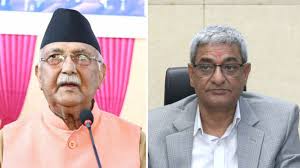
By Our Reporter
The detention of KP Sharma Oli and Ramesh Lekhak has shaken the political ground just as a new government led by Balen Shah settles in. Within 24 hours of taking office, the administration chose to act on the Gauri Bahadur Karki Commission report. The speed with which the government acted drew both praise and criticism. Some has called it a bold move while others criticized it as a reckless attempt. The arrest has send UML cadres into the streets, who clashed with police demanding the release of both leaders.
Start with what the government seems to be trying to do. For years, people have complained that probe reports gather dust. Commissions are formed after every major protest, every violent episode, and then little follows. By ordering immediate arrests, the new leadership appears to be saying, this time will be different. It sends a message that political rank will not shield anyone, at least in theory. After the deadly Gen Z protests, where dozens lost their lives, a section of the public has been demanding action. From that angle, the arrests look like a long-delayed response finally taking shape.
Yet the way it has unfolded raises hard questions. The Karki report, by most readings, points to failure in leadership and decision making. It does not clearly lay out criminal intent. That gap matters. In Nepal’s legal system, moral responsibility and criminal liability are not the same. Skipping that distinction risks weakening the entire case before it even begins.
Legal experts have already pointed out a basic issue, process. Normally, such reports go to the Attorney General’s office, then to police for investigation, and only after evidence is built do arrests follow. This sequence was bypassed. By moving straight to detention, the government may have handed the defense an early advantage. A habeas corpus petition could quickly turn the narrative from justice to misuse of power.
Then comes the question many are asking, why only political figures, and why now. The same report also mentions roles played by security agencies, Nepal Police, Armed Police Force, even intelligence bodies. Yet action against them has been delayed for “further study.” That choice has fed the claim that the report is being applied selectively. Critics are calling the Karki report lopsided, not only in findings but in how it is being used. If accountability stops at politicians while institutions walk free, the whole exercise starts to look uneven.
Political reaction has been swift and sharp. Communist Party of Nepal (UML) has taken to the streets, framing the arrests as revenge. Protests have already turned tense. The risk here is escalation. Once legal battles mix with street pressure, it becomes harder to pull things back. The opposition will not just fight this in court, it will fight it in public spaces and parliament.
Even voices outside party lines have raised concern. Bidya Devi Bhandari called the move immature and warned of instability. That is not a small comment. It reflects a wider worry that a government trying to show strength may end up appearing impulsive.
Still, it would be too simple to dismiss the arrests as purely political. Public anger over past violence is real. Families of victims have waited for answers. Doing nothing would also have drawn criticism. In that sense, the government faced a narrow path, act and face backlash, or delay and lose credibility. It chose to act fast.
But speed without groundwork often backfires. Past commissions in Nepal offer a clear lesson. Reports after the 1990 movement and the 2006 uprising failed to lead to convictions because courts found their legal basis weak. The same pattern could repeat. If the Supreme Court finds that due process was ignored, the case may collapse, and those arrested could walk free with stronger political standing than before.
That outcome would hurt more than help. It would not only weaken this case, it would make future attempts at accountability harder. People may start to see such moves as political theater rather than genuine efforts to address past wrongs.
So where does this leave the new government. It has shown intent, no doubt about that. It has also shown impatience. Both can shape its image going forward. If it corrects course, follows legal steps, expands the scope of investigation to include all actors, and builds solid cases, it could still turn this moment into something meaningful. If it continues on the current path, it risks turning a promise of justice into a prolonged legal and political mess.
In the end, this is not just about two arrests. It is about how power is exercised right at the start of a new administration. Acting tough is easy. Acting right takes more care. Right now, the government looks like it rushed in, hoping to fix the past in one move. The system rarely works that way.

Login to add a comment