







By Our Reporter
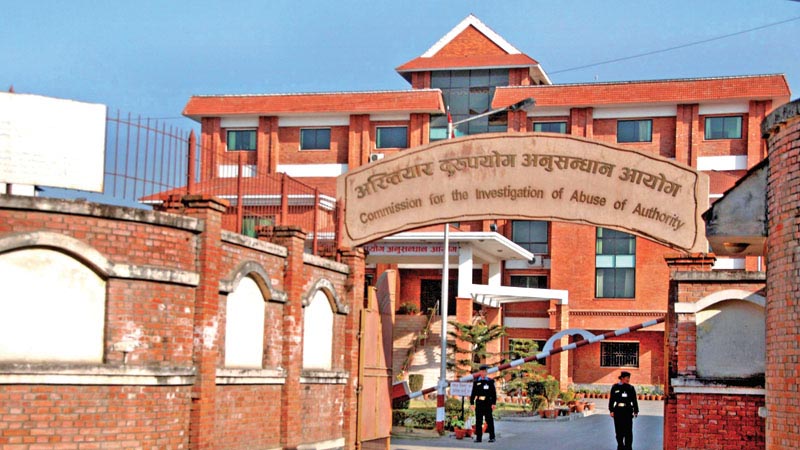
The corruption case surrounding the Pokhara International Airport exposes one of the largest and most intricate graft scandals in Nepal’s recent history. The Commission for Investigation of Abuse of Authority (CIAA) has filed a case at the Special Court against 55 individuals, including five former ministers—Ram Sharan Mahat, Post Bahadur Bogati, Bhim Prasad Acharya, Ram Kumar Shrestha, and Deepak Chandra Amatya—10 former secretaries, and several high-ranking civil servants, alongside China CAMC Engineering Co. The allegations focus on deliberate inflation of the airport’s construction cost, resulting in a reported loss of $74.34 million to the state, equivalent to Rs8.36 billion. The scale of this financial mismanagement makes it the largest corruption case filed at the Special Court under Nepal’s state procurement process.
The Pokhara airport, designed to be the gateway to the Annapurna Circuit and a boost for Nepal’s tourism sector, became operational in January 2023 but has yet to host scheduled international flights. The project’s troubled history reflects decades of political instability, mismanagement, and susceptibility to undue influence. The initial master plan, prepared by German consultants in the 1970s and reviewed by JICA in the 1980s, remained dormant for years, repeatedly delayed by insurgency, political upheaval, and bureaucratic inefficiency. Once construction resumed, the project became entangled in secret agreements, manipulated tenders, and advisory committee recommendations that favored the Chinese contractor.
Central to the controversy was a 2011 memorandum of understanding secretly signed by then-Finance Minister Barsha Man Pun and China CAMC Engineering Co, which promised the contractor state support to secure the construction contract. Once revealed, the MoU was canceled, but the collusion set a precedent. Subsequent tender evaluations and advisory committee recommendations involved influential academics, bureaucrats, and ministry officials, including former secretaries Suman Prasad Sharma, Bhesh Raj Sharma, Mohan Krishna Sapkota, Sushil Ghimire, and Suresh Man Shrestha, whose actions allegedly helped artificially inflate project costs and facilitate excessive payments. Evidence in the CIAA charge sheet indicates that these officials misused their authority to favor CAMC, violating procurement laws, and undermining transparency in state projects.
The CIAA’s decision to pursue such high-profile individuals, from ministers to bureaucrats and corporate executives, reflects an assertiveness rarely seen in Nepal’s history of tackling corruption. In targeting multiple cases simultaneously, including the recent investigation into the Nalinchowk heliport, the agency demonstrates a commitment to exposing systemic corruption in projects with major public and international investment. These actions send a clear message that public officials cannot manipulate state resources without accountability.
This case highlights the broader consequences of corruption for Nepal’s aviation and tourism sectors. Airports and other critical infrastructure are vital to economic development, yet they have repeatedly been compromised by financial mismanagement and collusion. The Pokhara airport, which should have been a symbol of national pride and a tourism driver, illustrates how public funds can be misused, compromising project quality, safety, and investor confidence. The persistent corruption in the aviation sector is linked to recurring operational failures and accidents, further eroding public trust in governance.
While the final judgment rests with the Special Court, the act of filing such a comprehensive case marks a significant step toward transparency and accountability. By bringing ministers, secretaries, academics, and contractors to account, the CIAA demonstrates its readiness to challenge entrenched interests. For Nepal, long grappling with bureaucratic and political dysfunction, holding high-profile figures like Ram Sharan Mahat, Post Bahadur Bogati, Bhim Prasad Acharya, Ram Kumar Shrestha, Deepak Chandra Amatya, and secretaries Suman Prasad Sharma, Bhesh Raj Sharma, Mohan Krishna Sapkota, Sushil Ghimire, and Suresh Man Shrestha accountable could signal a turning point in the enforcement of the rule of law.
Ultimately, the Pokhara airport graft case underscores both the depth of corruption and the emerging capacity of Nepalese institutions to enforce accountability. While the scale of mismanagement is staggering, the CIAA’s decisive action may help restore public trust, deter future malfeasance, and reinforce institutional integrity in the planning and execution of state projects. Now, it should train its attention towards other alleged major corruption scandals such as wide-body aircraft purchase, Lalita Niwas land scam, Giribandhu Tea Estate scam and many more.

Login to add a comment