








By Narayan Prasad Mishra
There are many qualities to become a good human being. Some of those are honesty, sincerity, loyalty, integrity, courage, self-awareness, whole-heartedness, friendliness, love, and kindness. Of all the qualities, the first three qualities – honesty, sincerity, and loyalty are the most important ones for any person. People get those things from their culture rather than from any other things. You get those things from your parents, gurus, mentors, and spiritual teachers. You are influenced by them. People with the mindset to learn these things from their experiences seem more culturally rich. When we see those three qualities in some person, we say the person must be from a culturally rich family.
In the past, though Nepalese were poor in a materialist way, they were much rich culturally. They were known for their honesty, loyalty, and sincerity. They were God-fearing and had a remarkable sense of sinful and pious works. These things made them honest, kind, loving, loyal, and sincere. Those are the qualities for which Nepalese were wanted and loved in many other countries by other nationalities for low or high-paying jobs, and this holds true even now.
In this context, I remember the Jyapu farmers’ beliefs and sayings I experienced more than seven decades ago as a kid. We know the Jyapu farmers in Kathmandu Valley dump their rice in public places after cleaning and plastering it with mud to dry it for several days after harvesting during September-November. They cover their dumped rice with lots of straw to save it from the cold at night and spread the rice to dry it in the sun, taking out the straw when the sun appears in the morning. You see many families dumping and drying their portion of rice, carefully separating their portion from another’s. It looks like a rice drying fair under a clear, shining sun. You see it even now in rice harvesting time in Bhaktapur, Patan, and Kirtipur. They have a saying and belief that if they get even a portion of others’ rice not only by stealing but even by mistake, they will go to hell after death. That would be a sinful act and would make you go to hell.
Similarly, they believe you will surely die if you encroach on your neighbor’s land equal to the size of your body. They seriously care for their agricultural land, not mixing or encroaching on other’s land. Those beliefs that they got from their culture helped to establish a pious society in the country. There are many other wide varieties of sayings and beliefs in our country coming from our culture and traditions from centuries, making us good human beings. Unfortunately, these are disappearing as we are discouraged from respecting our culture and traditions in the name of being revolutionaries by our rising and shining progressive political parties. They also discourage our people from studying Sanskrit education which is the prime source of our moral education, making us good human beings. I have also written about this in the context of some other articles.
I recognize the high value of this culture and traditions and the moral lessons of our religious scriptures. When I felt that people were not learning and following good preachings of our holy scriptures and not becoming like Lord Ram and Lord Krishna, the symbols of idealism, and instead were becoming like Kansa and Duryodhan, the symbols of villain and evil characters, I had written the following poem titled Religion and Attitude in Nepali (Dharma Ra Prabrity), which was included in my poem collection book in Nepali “Boiling Agonies” (Umliyeka Pidaharu) published in 2003 (2060 B.S.)
Poem in Nepali
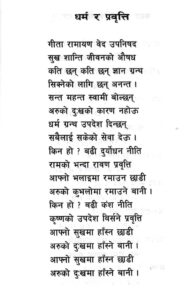
The poem translated into English
Religion and Attitude
Narayan Prasad Mishra
Gita, Ramayan, Veda, and Upanishad
are like medicines for peace and happiness.
There are unlimited scriptures
for those who want to know more
Sages, Hermits, and Swamis preach
Do not be a cause of another’s grief
The epics and scripture preach to us
Serve and help all in whatever way you can
Why do we have more of Duryodhan’s attitude
Why do we have Rawan’s attitude
Not being like Lord Ram
Instead of rejoicing in one’s own prosperity
Why do we rejoice in others’ suffering
Why do we have more of Kansha’s attitude
Why do we forget Krishna’s preaching
Instead of enjoying one’s own happiness
Why do we enjoy other’s suffering
Instead of enjoying one’s own happiness
Why do we want others suffering
As our moral values are slowly disappearing, we are also losing people with honesty, sincerity, and loyalty. Even our so-called leaders who became prime ministers had no honesty, sincerity, or loyalty towards the country, the people, colleagues, or opponents. It seems all their activities and roles are based on power, positions, opportunities, and facilities, all with selfish motives, totally different from the morally rich characters and benevolent attitudes taught by our scriptures. You do not see any principles or ideologies in them. They only pretend to have them when appearing as democrats and communists. Their prime ideology seems to grab power and enjoy what comes with it and nothing more. They can betray anyone at any moment. They can be best friends with their enemy at any moment.
The finest and most explicit example of it may be the cooperation, friendship, separation, and enmity between Shere Bahadur Deuba, ex-prime minister and the president of the Nepali Congress Party, Pushpa Kamal Dahal, the chairman of the Nepal Communist Party (Maoist Center) and the present Prime Minister, and K.P. Sharma Oli, the president of Nepal Communist Party(UML) and ex-prime minister. Their life history and characters are the clear pictures of it as you see in a looking glass. So I think we need to have a new revolution again in the country if we want to preserve our good culture of honesty, sincerity, and loyalty. Otherwise, we will see a more morally degraded, self-centered, sinful society in the country and the downfall of Nepal.

Login to add a comment