







By Ganesh Niraula
Many places in the beautiful hill district of Ilam in Nepal host various mela (fairs) viz., Maibeni, Gajurmukhi, Maipokhari, Naya Bazaar and Purnedanda. Each of these fairs has its own distinction and dignity. Yet the Jhyamte Fair organized in Purnedanda has comparatively a very special historical and cultural importance.
The Sugauli Treaty signed between East India Company and Nepal in March 1816 AD brought an end to the two-year-long war. One of the conditions of the treaty was that the Nepalese administration which was housed in Nagari Fort along with Nepalese soldiers had to quit the complete land area across the Mechi river within forty days. The Nepalese soldiers lugged jealousy in their hearts for being compelled by their commanders to relinquish the vast area from Tista river to Mechi in the eastern frontier within the given time without a single firing of rifle and settled them on the cliff of Purnesdanda of Karfok. A massive number of armed soldiers began to live there almost permanently and movement of the people in the area increased as suppliers of their everyday necessities like ration and other groceries on regular basis metamorphosed Purnedanda almost as a gadhi (fort). And possibly the infrastructure of the marketplace in Aitabare, Fikkal gradually developed. Quittance of land across the Mechi river to the relatively much weaker State of Sikkim without waging any war and signing of the treaty with East India Company was not a guarantee that Nepal would remain a secured kingdom without any fear. It was surely not the time for the Nepalese populace to remain complacent and sleep without being aware of the potential danger that could befall as a result of English encroachment on their sovereignty. In such a circumstance the Nepalese soldiers stationed in Karfok were the only guards protecting the eastern borders. One Security personnel was posted to watch the invaders who could enter Nepal by crossing the water drainage running through the foothills of Shihalika. Karfok was then the only centre of hope that could provide a sense of relief to the people during such a time when the independence of the country was in extreme emergency. Possibly, the surroundings of the area of Karfok where the Jyamte fair is held every year ever since the early days of Nepalese soldiers had begun to live, has so prominently surpassed the other fairs of Ilam in terms of its historic value.
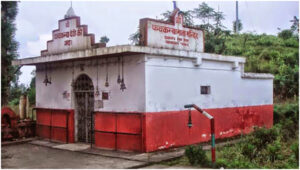
Panchakannya Temple near Purnedanda
During the middle ages, the Maipurba territories lying in Ilam, sometimes used to be under the rule of the Lepcha king of Sikkim and sometimes it was also governed by Limbuwan Sen Kings of Bijayapur. Nonetheless, the eastern Ilam was significantly populated by Kirats. Their population was also dense in the neighboring areas of Karfok. In addition, because of the abundant number of Rai people who also lived there in harmony with Kirats, observed their traditional festivals like Udhauli and Ubhauli accompanied by dances and music at the bottom of the hill on the top of which the Nepalese army had settled. It is believed that the ancestors of the Kirati people, adept in laboring hard, had begun to celebrate Udhauli while descending the hill and Ubhauli while ascending the hill depending on the environmental favor. The Chettriyas and the Brahmins, during both these occasions, use to burn incense in their byres. Oh yes, Udhauli is primarily a time of harvesting. The main purport of these festivals is to receive permission from God and the ancestors and then taste the harvested crops.
As such, these festivals are celebrated twice a year in Purnedanda, one on the full moon day of Mangsir (winter) and the other on the same day in Baishakh (spring). The Rai people belonging to all age groups mark the day by adorning their traditional attires and ornaments. After having sacrificed hens and pigs and offering home-brewed ale, leaves of banana tree, akchheta (grains of rice), incense, ginger, pati (leaves of flowers), seuli, bow and arrows, dhol (drum) and cymbal for their deities at a special place close to their fireplace to cook. They then worship the shrine for Sakela and following the order of their priest, they begin to dance. The next day, the same dance is performed in other spots. This dance is performed to the tune of the music produced by cymbals which are considered very important. Most probably people started calling this fair (mela) Jhyamte Fair. And since two such fairs are held every year on the days of Purnima (full moon days), the place is named Purnedanda. These reasons have rendered Jhyamte Fair a distinct cultural speciality.
Those days, the army who lived in the barrack had initiated the tradition of sacrificing animals on the altar of their deities placed in the Panchakanya temple that stood close to their barrack, after performing religious rites. Later when they established their permanent gadhi (fortress) in Ilam after Namsaling, they again used to offer special pooja (worship) to Goddess Panchakanya of Karfok on the very day of Bada Dashain (Durga Pooja) and Chaite Dashain (Ram Navami). Only after performing this ritual, worshipping Maisthan and then firing cannons would make their festival complete. And as Panchakanya temple is located in the precinct of the field where the fair is held, the magnitude of the Jhyamte fair seems to have increased.
Guru Narahari Sharma Adhikari who has led various high schools of Ilam as headmaster since the early decade of 2020 B.S. says, “the wall at the bottom of the fort was intact when we were children. Bricks needed to erect the fort were made of the soil dug out from the place which got filled with rainwater during monsoon. We used to call it the pond of the fort. The wooden frames of the windows and doors of the fort still exist as testimony in Maghesuntale. Nevertheless, the bricks used in the construction of the fort are also found on the hilltop.”
During those days, the Nepalese army living on this hillock was ever ready to lock horns with the English imperialistic power. The army following a long hiatus returned to the same place in 2054 BS. The Jhyamte Fair which was observed interminably for 181 years suddenly stopped due to the insecurity caused by the ongoing conflict within the country. Despite the Peace Treaty mutually signed by the rebels and the government in 2065 BS, it took quite some time for the popular fair to revive. Eventually, in Mangsir Purnima of 2078 BS, the fair began to be observed reminding the power of Shri Nath Platoon highlighting the importance of the national festival celebrated by the Kirant people of Nepal. This fair in Ilam does not only entice people in other districts of Nepal, no wonder it now exists as a heritage making others almost jealous. This fair is however not confined to Ilam alone but is also symbolic of our national valor reminding us of our territories up to Tista.
But, the worrying issue is that this place has gone under private ownership. This place where Jhamte Fair is held is not only historically important, but it also bears cultural and religious prominence and from an archaeological vantage, it is precious. According to local social worker Deepak Adhikari, the ownership of the place has now been transferred to a third/fourth individual. He says, “Such places of archaeological, historical and cultural import should be public property. This issue ought to be a matter of national agenda. The fort built 206 years ago should have been renovated to keep the glorious history of the Nepalese people alive. The State should occupy this property by providing due compensation and bringing it under its own surveillance. But who is going to hear it?
Is there any time left to do so as stated by Adhikari? Like the initiation taken by the local municipality to renovate Udayapur gadhi, will Suryodaya municipality be ready to conserve this fortress? Who can say if weapons of war are buried under the ground there as was found in Tansen of Palpa? Will Nepal Army show its concern about it? Or will the department of archaeology come forward to do something about it or the Federal or Provincial governments open their conscience towards solving this grave matter?

Login to add a comment