







By Our Reporter
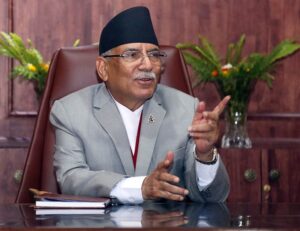
The post of the president has become a bone of contention between Prime Minister Pushpa Kamal Dahal, Prachanda, of the CPN-Maoist Centre and KP Oli of CPN-UML. The largely ceremonial position is now seen by the parties as a pivot that can exert influence on important national issues. Such as, current President Vidya Devi Bhandari has refused to sign the citizenship bill, passed by both houses of the parliament twice, and she has practically shelved it.
When this coalition was formed about a month ago, with Prachanda suddenly breaking away from the then coalition led by Nepali Congress, to ally with the UML so he could become prime minister that issue looked largely settled. The two parties saw it as a fair bargain with Prachanda as prime minister for the first two-and-a-half years leaving the positions of President and Speaker of the House to UML. And in the latter two-and-a-half years UML would take the prime minister and the Maoist the Speaker of the House. This arrangement would leave the Nepali Congress, the biggest party in the parliament, out in the cold, devoid of any role in the power structure.
However, things started to go wrong when Nepali Congress unexpectedly gave the vote of confidence to Prachanda although he had estranged the coalition with the party. That was seen by observers as a move by the Nepali Congress to sow a rift in the coalition and looks like it is working. The unexpected bonhomie of the Nepali Congress may have buoyed Prachanda to break away from Oli’s shadow and he began saying that instead of handing the presidential position to UML on a platter would seek a consensus candidate amongst all parties.
The CPN-UML has cried foul and has accused Prachanda of being dishonest, but the Maoist party said that there was no concrete agreement to give UML the post of president.
Now, the three parties have their own concepts: the UML and Nepali Congress want to have their party’s candidates become the president. It looks like Prachanda is not in the mood to let the UML have both the country’s highest positions when its term comes. The Maoist party wants a consensus candidate probably with the Nepali Congress and even from outside the political spectrum if possible, to become the next president. Here too, like in the federal parliament, the Maoist holds the key to who will become the next president.
The 5-year tenure of the current president and vice president will end in the middle of March. The Election Commission on Tuesday published the dates for the elections with the presidential election slated for March 9 and that of the Vice President on March 17. Under the constitution, the new president and vice president will be chosen by 334 members of both the House of the federal parliament and 550 members of the provincial assemblies. They will vote in these elections under the electoral college system with each federal parliament vote carrying 79 votes and each state assembly vote carrying 48 votes with a total of 52,786 electoral college votes if no seat of the federal parliament and provincial assembly remains vacant.
The Nepali Congress has the largest number of total of 16,221 electoral college votes followed by UML with 15,202 votes and the Maoist has 7,649 votes. The Nepali Congress and the UML will need the support of the Maoist and other smaller parties in their respective coalitions if they want to have their person at Shital Niwas, the presidential house.
But with the current political turmoil and the present coalition at risk of breaking up, a new political combination may come up when the country approaches the presidential election.

Login to add a comment