







Commentary
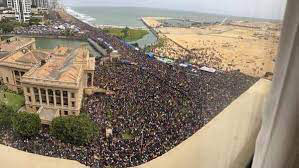
Sri Lankan unrest: People occupy President’s residence
By P.R. Pradhan
This week, the uprising in Sri Lanka has become a hot topic among social network users.
“Will Nepali political leaders learn from the turmoil in Sri Lanka?”, many have posed this question.
Many others have commented, “Not the leaders but the people must have learnt the lesson on treating their corrupt leaders!”.
“Enough is enough! Let the Nepali people also wake up against the leaders now!” some have remarked.
“Sri Lanka has taught us how the people should treat the leaders,” some intellectuals have noted.
Mumaram Khanal, an intellectual, has remarked, “Not the leaders but the people should be inspired by the Sri Lankan uprising!”
Political leaders and intellectuals are also debating while comparing the Sri Lankan and Nepali economies.
Narayankaji Shrestha, a senior leader in the Maoist Center, has remarked that Nepal is heading to the Sri Lankan path. Meanwhile, the government spokesman and senior minister Gyanendra Bahadur Karki remarked that Nepal’s economy is on a proper course.
“Nothing to worry, Nepal will not turn into a Sri Lanka,” former finance minister and present information and communications minister Karki, who is close to Prime Minister Sher Bahadur Deuba, defended his government.
However, nobody is ready to believe Minister Karki as all the economic indicators of the country have gone negative.
Moreover, the Nepal Oil Corporation has already announced that it has no reserve funds to clear its dues with the Indian Oil Corporation and suggested starting the Saturday holiday for all vehicles for reducing the consumption of petroleum products.
Anytime, the IOC may stop supplying petroleum products for Nepal and anytime NOC may announce end of the stuck of petroleum products!
At a time, when the Nepal Rastra Bank, the central bank of the country, is expressing worry about the continuous decline of the foreign currency reserve and negative balance of payments, the government has decided to procure billions of rupees worth of arms for the Nepal Police in a non-transparent manner.
The finance minister, who had presented the budget for the new fiscal year, has quit the post following the constitution of a probe committee in Parliament. He is alleged for changing the customs tariff by using an unauthorized person on the eve of the budget presentation. The Ministry also declined to present CC camera footage of the said date when the unauthorized person had entered the room where the budget was being finalized.
The then finance minister had slashed customs tariff on imports of sanitary pads directly affecting local industries producing sanitary pads.
The decision was made just to facilitate a company in the import business also owned by PM Deuba’s son Jayabirsingh Deuba.
Indeed, PM Deuba, Maoist Center chairman Pushpakamal Dahal and then finance minister, among others, are directly involved in facilitating a certain business group by creating a huge loss to the nation.
This is the government led by Deuba as he is elected from Parliament. Other ministers belong to him. In this regard, Deuba is equally responsible as long as then finance minister Janardan Sharma is charged with policy corruption.
Sharma claims he is honest and the probe committee would give him a clean chit.
If we monitor the activities of the ministers in the present government or the ministers in the previous government led by K.P. Sharma Oli, they all are in the same boat. They all are not clean. Perhaps, the probe committee of those MPs belonging to the ruling parties and the opposition parties may give a clean chit to Sharma in the process of also hiding corruption that was done by them during their tenure.
Political leaders are not bound by morale and ethics. When the chief minister of the Gandaki Province presented the budget for the new fiscal year, he didn’t miss to allot funds for a foundation established in the name of his late father. Accordingly, he has allotted an attractive amount of government funds for different foundations established in the name of different political leaders.
If we take a look at the budget presented by the federal government, seven provincial governments and above 700 local governments (out of 753 local bodies, the remaining local bodies are yet to present the budget), all have focused on the budget based on distribution on different titles. If we add all budgets together, perhaps, the amount allotted for distribution will dominate the entire funds for budget.
Less priority is given to the development sector and increasing local products. We are practising federalism, meanwhile, the three governments are practising loot-tantra. Looting the nation was limited within Singhadurwar, now, it has expanded to the provincial and local levels as well.

Login to add a comment