






View from America

By M.R. Josse
GAITHERSBURG, MD: While the past week has been chock-a-block with follow-up developments in the wake of President Joe Biden’s stellar victory in securing the passage of his transformational $ 1.9 Trillion relief package – including the rollout of stimulus checks into the bank accounts of Americans and his commitment to make all Americans eligible for the coronavirus vaccine by 1 May 2021 – this column will direct its focus elsewhere: to wit, the Quad front.
That decision was influenced by the first-ever summit, hosted by Biden, of the Quad grouping on Friday 12 March bringing him together, virtually, with Japanese Prime Minister Yoshihide Suga, Indian Prime Minister Narendra Modi and Australian Prime Minister Scott Morrison.
BACKGROUNDER
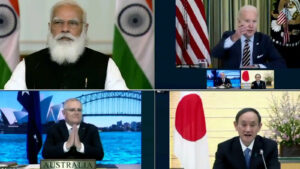
Photo: Hindustan Times
At the outset, here is a backgrounder. First, Quad is the code name for the informal strategic ‘Quadrilateral Security Dialogue’ forum comprising the United States, Japan, India and Australia whose innocuous genesis reportedly was their joint response to the Indonesian tsunami of 2004.
Although it took shape as an informal strategic grouping only in 2007, it then went into a hiatus for nearly a decade after Australia’s then Premier Kevin Rudd, an advocate of robust ties with China, withdrew Australia from the grouping in 2008. It was resuscitated in late 2017, as the Trump administration began ramping up confrontation with Beijing.
Before dealing with the Quad summit per se, it will be salutary to take note of some pre-summit expectations, including Indian ones, as reflected, for example, in C. Raja Mohan’s write-up in the Indian Express where he refers to “India’s expanding partnership with the U.S.” and debunks the prediction of many observers in the past that Modi’s bromance with Trump would impede development of good relations with Biden.
In any case, Mohan avers that the United States is now India’s “most comprehensive partner” – no matter that experienced former senior Indian diplomats such as Shyam Saran have publicly highlighted the fact that despite the border tensions between India and China, India’s number one trade partner in 2020 was China, at the same time that the U.S. was dislodged from its position as India’s top commercial partner in 2019!
Incidentally, as I had recalled in a past column, Trump’s former National Security Adviser, John Bolton, in his book, ‘In the Room Where It Happened’ revealed how little Modi and India mattered to Trump. It sharply undercuts Mohan’s extravagant claims.
WHAT ACTUALLY HAPPENED
Now, coming directly to the ‘achievements’ of the first-ever Quad summit, it will be useful to note BBC’s coverage and assessment. As BBC’s Barbara Plett-Usher reports, 12 March, while Biden has taken “cooperation between the four nations for the first time as part of his policy of strengthening a strategic counterweight to Beijing”, she is quick to point out that “his administration has been careful not to link the Quad explicitly to China.”
Meaningfully, she adds that the Quad’s plan “to massively increase the production and distribution of coronavirus vaccine in Asia would put them in a position to compete with China’s own vaccine diplomacy” and their intention to cooperate on critical and emergent technologies arises from concerns surrounding Chinese influence and action in cyberspace.
Following the Quad summit, U.S. National Security Adviser Jake Sullivan disclosed, as per BBC, that the vaccines would go to ASEAN as well as “the Pacific and beyond.” The Quad four leaders have agreed to deliver one billion doses of coronavirus vaccine to much of Asia by 2022.
It may be noted that China is also engaged in vaccine diplomacy, particularly in the Asia-Pacific region. Indeed, China’s ministry of foreign affairs has said China will donate vaccines to 69 countries in urgent need, and is exporting vaccines to 43 further nations.
Other news reports had it that Modi disclosed “vaccines, climate change and emergent technologies” were on the summit’s agenda. While all nations pledged to defend a “free and open” continent, Biden, declared: “We’re renewing our commitment to ensure that our own region is governed by international law, committed to upholding universal values and free from coercion.” Clearly, there seems to have been a deliberate attempt not to directly take on China.
The toughest line against Beijing appears to have been taken by Suga judging by his remarks to reporters after the event. He told them that he had raised “strong opposition to China’s unilateral attempts to change the status quo”, adding that other leaders had expressed support for his comments.
So, what has been Beijing’s reaction? According to a Beijing-datelined PTI report, 8 March, Chinese Foreign Minister and State Counselor Wang Yi, speaking at a press conference on the sidelines of the annual National People’s Congress, suggested that India should stop “undercutting each other, shed mutual suspicion” and create “enabling conditions” by expanding bilateral cooperation to resolve the border issue.
That aside, Beijing’s English-language Global Times quoted Chinese experts who suggested that Quad members are likely to follow their own interests above the interest of the group, rendering the alliance an “empty talk club”.
INDIA AND U.S.
Of most interest to Nepal should be the stance/approach taken by India and the United States vis-a-vis China. In my view, taking the case of India first, it is difficult to imagine that India – whose weaknesses in relation to China were vividly exposed to the world on the Himalayan heights not too long ago – can afford to run with the hares and hunt with the hounds.
Apart from that commonsensical consideration, note that the Quad is neither a NATO-type alliance nor is India a military ally of the United States, as indeed Japan and Australia are. It is hence difficult to imagine that the Quad can respond collectively to any future hypothetical threat from China. If, for example, China and the other three Quad members become embroiled in war, will India risk Chinese wrath and declare war against Beijing, too?
In any case, how pragmatic is it, then, for India to bank on the uncertain support from the U.S., Japan and Australia for advancing her national interests, rather than directly seeking Chinese cooperation to resolve their border dispute and enjoy the benefits of robust bilateral trade, investment and goodwill , as Chinese officials repeatedly suggest?
India should never forget this rock-hard geopolitical reality: that while China is a next-door neighbour, her Quad partners are thousands of miles away. In any case, policy makers in India should be well aware that America has more than once demonstrated a disturbing tendency to swing from interventionism to isolationism and back again to interventionism. Just ask Pakistan.
To go back to the Trump era, what concrete help did the United States – and/or Japan and Australia – provide to India in the context of the Sino-Indian border dispute? I far as I recall: support was merely rhetorical with limited intelligence aid thrown in, besides some anti-China posturing by American warships in the South China Sea.
As far as the United States is concerned, that’s a different kettle of fish. She can, of course, deal with China militarily and otherwise. Yet, remember that America has always restrained from frontally confronting China, especially in a land war. Besides, all nations, even strong ones, must first do a careful cost-benefit analysis of what war would entail before plunging head-on in that direction.
Would any military confrontation really prove to be worth the horrific costs for an America engaged in a war with China? Furthermore, to use a parallel from the Cold War, would the U.S. risk nuclear devastation of, say, Honolulu or San Francisco to shield Tokyo from being nuclear-bombed by Beijing?
Suga may have been most direct in his verbal assault against China. But, is there any sound reason why, as matters now stand, others should risk their lives, blood and treasure for the benefit of a gung-ho Japan using the Quad – specially the United States – as a shield or spear to advance her particular interests?
That Biden refrained from suggesting, even most tangentially, that such a prospect was possible or even probable thus carries its own commentary.
Possibly, even more eloquent is the report in Yahoo! News the other day that on 18 March America’s National Security Adviser Jake Sullivan and U.S. Secretary of State Antony Blinken are meeting with their Chinese counterparts, State Counselor and foreign affairs chief of the Chinese Communist Party, Yang Jaichie, and Foreign Minister and State Counselor Wang Yi, in a rare face-to-face meeting in Anchorage, Alaska, hot on the heels of the Quad summit.
Meanwhile, Foreign Policy has just reported the arrival in Tokyo of Blinken and U.S. Defense Secretary, Lloyd Austin. Important talks are scheduled to be held there on matters bearing on U.S.-Japan as well as U. S-Japan-South Korea relations.
For whatever it’s worth, it may be noted that according to BBC Biden had tried to reach out to North Korea’s Kim Jong-Un sometime back but the latter ignored the former’s gesture. No doubt that and other issues will be taken up in Tokyo, as possibly in Anchorage.
While the events of the past few months in the United States and the uncertain state of play of the domestic terrorism scene and white supremist movements have badly dented her credentials in that respect, there is a widespread perception, too, that her global standing as a sparkling democracy has been seriously tarnished, as well.
ELECTORAL AUTOCRACY
As such, other countries are unlikely to pay as much heed to America as in the past – at least for some more time to come. While that may explain North Korea’s snub to Biden, mentioned just above, this is especially applicable to Modi’s India.
In this respect, it will be salutary to refer to two important documents just made public. One is America’s Freedom House’s annual ‘Freedom in the World’ rankings on political rights and civil liberties and the other is the 2021 annual report on the state of democracy around the world issued by the Sweden-based V-Dem Institute. The latter classified India as an “electoral autocracy” because of “restrictions on multiple facets of democracy” such as civil society groups.
India’s grand-standing as a beacon of democracy is thus distinctly at odds when she has been receiving a wave of criticism about the poor state of human and political rights in the country.
Permit me, now, to quote some illuminating excerpts from a blog, 12 March, by Maya Tudor, Asst. Professor of Government and Public Policy, Blavatnik School of Government, University of Oxford:
“India long the world’s largest, most diverse and most hopeful democracy is, officially, no longer a democracy. For the first time in almost fifty years, the world’s foremost democracy assessor, Freedom House, downgraded India’s rating from Free to Partly Free.
“India now joins all other South Asian countries – Bangladesh, Sri Lanka, Nepal, Afghanistan, Myanmar and Pakistan – in a category that Freedom House considers non-democratic.
“Under Modi, India appears to have abandoned its potential to serve as a global democratic leader, elevating narrow Hindu nationalistic interests at the expense of its founding values of inclusion and equal rights for all.”
Need one say anymore?
UPSHOT
As far as we in Nepal are concerned there is little need to take much heed to the thinly disguised anti-China fulminations and hot air that has emanated from the Quad summit.
Though Nepal continues presently to be immobilized in a political bog – with little indication of how or when she is likely to emerge intact out of that stinking quagmire – she must realize the wisdom in judging her national interests by looking at things from her own, not imported, eyes.
China is not Nepal’s enemy; containing China cannot be a policy prescription for her.
The writer can be reached at: manajosse@gmail.com

Login to add a comment