







View from America

By M. R. Josse
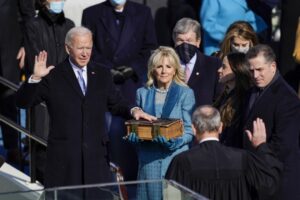
GAITHERSBURG, MD: Joe Biden was sworn in as the 46th President of the United States, 20 January 2021, in the wake of a divisive, even virulent, 2020 presidential electoral season. That came against the backdrop of an unprecedented and lethal assault on the Capitol, 6 January 2021, by a mob of frenzied supporters of defeated candidate, Donald J. Trump, blatantly egged on by his Big Lie myth: that he, not Biden, had swept the election!
In a euphonious acceptance speech, Biden waxed eloquent and optimistic: “This is America’s day. This is democracy’s day, the day of history and hope, or renewal and resolve.” Continuing on that cheery note, he declared: “Through the crucible of the ages, America has been tested anew and America has risen to the challenge.”
DAY OF HISTORY AND HOPE
Claiming that the will of the people had been heard as mirrored in his electoral triumph, he averred: “We’ve learned again that democracy is precious. Democracy is fragile. And at this hour, my friends, democracy has prevailed.”
Biden, who at 78 is the oldest person ever to assume the exalted office of president of the United States, exhorted the American people to resolutely face future challenges, thus: “To overcome these challenges, to restore the soul and secure the future of America requires so much more than words and requires the most elusive of all things in a democracy: unity…I know the forces that divide us are deep and they are real. But I also know they are not new. Our history has been a constant struggle between the American ideal that we are all created equal, and the harsh ugly reality that racism, nativism, fear, demonization, have long torn us apart.”
That the challenge to Biden’s fledgling presidency is indeed real and huge is perhaps best illustrated in Trump’s impending Senate trial, to which a growing number of Republican members are opposed, many on the plea that with Trump’s exit from the White House, there is no constitutional basis to take any further punitive action.
Not a few, including Republican Senator Marco Rubio of Florida, argue that in the interest of national unity it will be politic or pragmatic not to go ahead with the trial. To proceed to do so, Rubio says, would be tantamount to pouring gasoline over a raging fire.
Most public commentators dismiss that line of argument as spurious on two key grounds: that national unity in a democracy can only be achieved by respecting, not abusing, the doctrine of accountability; and that it is conditioned by Rubio’s desire to secure the Trump base, ahead of his 2022 re-election for another Senate term!
On the other hand, Mitt Romney, Republican Senator from Utah and a member of the Senate Foreign Relations Committee, bluntly questioned: “If incitement to rebellion is not an impeachable offence, what is?”
Notably, too, Democratic Senator from Hawaii, Mazie Hirono, one of the seven Democratic Senators who have called for an ethics probe against Republican Senators, Ted Cruz of Texas and Josh Hawley of Missouri, for their alleged incitement of the 6 January 2021 rioters, chimed in: “The two were too much in earnest with President Trump and others in propagating the big lie of the stolen election.”
Hirono, a member of the Senate’s Armed Services Committee, went on to charge that “they are very proud of their role and were doing this for their political careers” – not for the national interest.
Meanwhile, it remains to be seen how the political drama of Trump’s Senate trial eventually pans out. For the present, however, this much is clear. Later this evening (Monday, 25 January 2021), the Article of Impeachment adopted by the House of Representatives after the infamous 6 January 2021 outrage will ritualistically be delivered to the Senate for a trial, an elaborate process beginning the very next day.
According to the calendar set by the new majority Senate leader, Chuck Schumer (D-New York), trial arguments in the Senate will start on Monday, 9 February 2021.
SENATE TRIAL
In the interregnum, former president Trump – dubbed by one public commentator as the ‘Lord of Misrule’ – will be permitted to formally organize his pre-trial briefs via his lawyers, interacting with appropriate Senate officials for that purpose. Such a time span would however also allow the Democrats pursuing his conviction more time to prepare the prosecution case, including in calling as wide an array of witnesses, as possible.
It is a no brainer that they would be mostly members of Congress who not only faced humiliation but also a very real threat to their lives from the hooligans and domestic terrorists, inflamed by Trump and his cohorts to carry out their barbarous attack on the Capitol.
To recall, Trump is the only president in American history to be impeached twice; his imminent Senate trial will be the second time that he will face such a prospect. Last year, the Senate, voting on a partisan basis, defeated the motion; this time around, no one can be sure of the outcome, including, possibly, the adoption of a stricture barring Trump from ever holding public office again.
During the House impeachment process earlier this month, 10 Republicans voted for Trump’s impeachment, making it the most bipartisan impeachment vote in American history, thus far. For conviction in the Senate, it would require at least 17 Senate Republicans to join 50 Democratic Senators to secure such an outcome. This could be a bridge too far, but who knows?
While no one can be sure, at this stage, whether Trump will be convicted or not by the Senate, it is surely revealing that, as a BBC report had it, a slew of big American companies – including Walmart, JP Morgan Chase, AT & T, Comcast and Amazon – have announced that they were either suspending their political donations or suspending supporting specifically Republican politicians who supported Trump’s challenge to the presidential election results.
Notably, if a whole bunch of other companies have since indicated their disenchantment and disgust with the Trump shenanigans of the recent past, in myriad ways, many financial institutions too have similarly reacted.
WINTER OF PERIL
It is both easy and tempting to get into the weeds of the plans and prospects of the spanking-new Biden administration. I choose not to do so at this stage. There will be ample opportunities in the future to ponder over such matters, at some depth and length, including those touching upon the areas of foreign policy and national security.
At this juncture, it will be enough to paint a tentative overview of Biden’s tasks ahead. Though he and his team admittedly seem to have gotten off to a good start on a broad range of fronts – including with respect to the vital pandemic priority he wants of tackle on a ‘war footing’- it is far too early to draw facile or categorical conclusions.
His decision to rejoin the WHO has drawn widespread welcome, since coming to grips with a pandemic, by definition, mandates a global approach/coordination that an institution such as WHO can provide.
It can be conceded that Biden has been able to strike a hopeful chord among the mainstream of the American public, especially on his repeatedly highlighted goal of national unity. With his full cabinet not yet confirmed by the Senate, he will not be able to get down to brass tacks to implement his agenda at an optimal pace.
With more than 25 million Americans now having been infected by the Corona-19 virus and the vaccine rollout still not up to speed – despite Biden’s exhortations and formulation of a detailed, national plan to tackle the dread disease – it is evident that the coming winter will be dark.
As Biden’s Health and Social Services Secretary nominee, Xavier Bacerra, admitted frankly to CNN, referring to the pandemic, “the plane is in a nose dive” and there are no quick fixes. Before there is recovery there must be recognition of how dire the present situation is, he emphasized, hinting at how dismal the situation on the pandemic front was under the outgoing administration.
Thus far, only 25 million vaccine shots have reportedly been administered amid reports of shortages and technical snags in the process of manufacture and distribution logistics. An encouraging dimension is that a third vaccine – manufactured by Johnson & Johnson – is expected to available mid-February. This would be particularly welcome as it is a one-shot vaccination deal.
For approval of his proposed $1.9 trillion Covid-19 relief plan, Biden would, among other things, require the unstinting cooperation of the Republicans, especially in the Senate which will, for some time to come, be inevitably focused on a tense Trump trial, among other priorities.
Much the same is true for other contemplated measures such as addressing the manifold urgent problems of the economy. In other words, Biden will have to move forward on multiple fronts with all the finesse and dexterity of a tightrope acrobat, given that the ugly face of domestic extremism that was exposed to the world on 6 January 2021 may in fact be more than just a passing phenomenon. We shall see what the future brings on this and other scores won’t we?
LOW POLITICS IN HIGH HIMALAYAS
I note that a frisson of excitement has shot through some political and media circles back home over a 21 January 2021 write-up in The Telegraphonline, entitled ‘Low politics in the High Himalayas’ authored by S. Ramesh, identified as a former additional secretary, Indian Cabinet Secretariat.
Personally, it was first brought to my notice by Bharat Adhikari, my neighbour in Kathmandu. Subsequently, Keshav Poudel, editor of New Spotlight magazine forwarded a link to the very same article which he published. Then, it was the subject of substantial commentary by the mysterious but popular blogger Maila Baje who, among other things, zeroed in on Ramesh’s counsel, that “it might be smart for India to revisit its earlier doctrine of constitutional monarchy and multiparty democracy and support the restoration of the 1990 Constitution.”
The write-up was no doubt interesting, as was its publication at a time of political upheaval and disarray in Nepal, including a rising chorus, among some, for the restoration of the monarchy. What particularly got me was that the thrust of the article was that China’s recent inroads in Nepal are the direct outcome of India’s maladroit Nepal policy; as such, to eliminate China from the Nepali scene it is necessary for India to now back the monarchy.
Nowhere was it acknowledged that it was not China but India – among other actors – that was responsible for the creation, nurturing, supporting and training of the Maoists insurgents with the view to overthrowing the monarchy. Whatever they were/are called, the Maoists were/are dancing to the Indian tune, not the Chinese!
Also missing in Ramesh’s piece is the hard fact that the 12-point deal of 2005 for regime change in Nepal was finalized in New Delhi, not in Beijing. Also absent are such facts of geopolitical life such as that China, like India, is Nepal’s immediate neighbour.
China, in Nepal, is neither a Johnny-come-lately nor an interloper. The golden years of Nepal-China relations in the modern era were those symbolized by Mao/Zhou En-lai/Deng Xiapong and King Mahendra and King Birendra. Incidentally, China has not enforced a blockade against Nepal, as India has several times.
Incidentally, how long does Ramesh believe an India-restored monarchy will last? And, of course, there is nothing about how China might react, not least of all because the Dalai Lama is still resident in India. Wouldn’t they suspect that a pliant, India-installed regime in Nepal would pander to India’s dictations vis-à-vis Tibet and the Dalai Lama?
To be politically kosher, a restored monarchy must be a labour of love of the sovereign Nepali people.
In my view, Ramesh’s article is trial balloon floated by GOI to test the political waters in Kathmandu. It should be treated as no more than just that.
The writer can be reached at: manajosse@gmail.com

Login to add a comment