







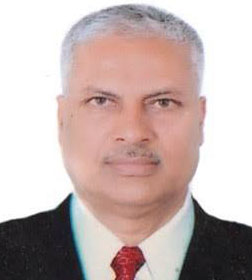
By Jagadish Dahal
Moving forward, one position worth considering within the Nepali Congress is whether the political and parliamentary principles associated with the Constitution promulgated on Kartik 23, 2047 BS, can offer lessons for re-establishing a stable political system in Nepal. At the same time, recent developments demonstrate how swiftly political alignments can change. Leaders ranging from Min Bishwakarma, who rose through the party during Sher Bahadur Deuba’s long leadership, to Purna Bahadur Khadka, who served as acting party president after holding several important positions in government, have increasingly taken political paths distinct from Deuba.
Deuba, who commanded an overwhelming majority within the Central Committee following the 14th General Convention, today leads a substantially diminished faction. Recent efforts at dialogue with Shekhar Koirala and other senior leaders further illustrate the extent to which the balance of power within the Congress has shifted. Historically, the Koirala family has repeatedly played an important role during periods of crisis within the Congress. It remains to be seen what role it will play this time.
None of the 13 office-bearers are by Deuba’s side right now. And how could they be when his advisers are opportunistic lawyers who have continually milked state power? This raises an important political question: How did Deuba, a five-time Prime Minister and two-time party president, arrive at such an isolated position within his own party? Looking at the situation more closely, three factors appear particularly relevant: his continued pursuit of political power, the quality of the advice surrounding him, and a gradual departure from the political approach once associated with Girija Prasad Koirala.
Deuba’s camp rejected the special General Convention called under the leadership of Gagan Thapa and Bishwa Prakash Sharma and continued to question its legitimacy. The Election Commission subsequently recognised the leadership elected through the special convention, and the Supreme Court upheld that decision in April 2026. However, the Supreme Court granted a review of that ruling in August, meaning that the broader legitimacy dispute remains under judicial consideration. Deuba’s continued resistance increasingly became intertwined with questions of political strategy and personal leadership. In the process, several leaders who had traditionally been regarded as his loyalists gradually distanced themselves from his position.
After spending several months abroad following injuries suffered during the Gen Z movement, Deuba returned to Nepal amid encouragement from senior figures, including Purna Bahadur Khadka, Min Bishwakarma, N.P. Saud, Prakash Sharan Mahat, Prakash Man Singh and Bimalendra Nidhi. Yet the political alignment around him continued to change. Purna Bahadur Khadka, in particular, has encouraged dialogue and participation in the convention process while also calling for efforts to preserve party unity.
In the midst of this dispute, the Thapa-led Central Committee adopted a significant conciliatory measure by allowing central members elected from the 14th General Convention to participate in the 15th General Convention process in their existing capacity. The decision had an immediate political impact. A substantial number of leaders previously aligned with Deuba indicated their willingness to participate in the Thapa-led process, further weakening the cohesion of Deuba’s camp.
Several leaders who had previously formed important pillars of Deuba’s faction, including former joint general secretaries and other central leaders, have consequently concluded that participation in the convention process led by Gagan Thapa offers a possible path toward keeping the Congress organisationally united. Their movement toward Sanepa reflects not merely personal realignment but a broader shift in the internal balance of the party.
In a bitter, heavy and harsh irony at the twilight of his political journey, Deuba, who narrowly missed becoming Prime Minister for a sixth time last September after being bloodied by the Gen Z movement, now faces extreme isolation within his own party amid worker boycotts, reduced to the state of a drenched, scrawny rat.
In conclusion, the present dispute demonstrates a familiar political principle: political choices eventually produce political consequences. In my view, Congress leaders and cadres should be cautious about binding themselves permanently to either the Deuba or Gagan camps while possibilities for a unified General Convention remain under discussion. The larger question should be whether the party can preserve unity while remaining faithful to its statute, democratic traditions and institutional principles associated with founding leader B.P. Koirala.
For those within the Congress who continue to favour the constitutional philosophy of 2047, the present crisis may also reopen debate over whether elements of that political framework have continuing relevance to Nepal’s parliamentary system. Any such argument, however, should recognise that the Constitution of the Kingdom of Nepal, 2047, established not only a parliamentary and multiparty system but also a constitutional monarchy, making its wholesale “revival” a substantially broader constitutional proposition than the restoration of parliamentary stability alone.

Login to add a comment