







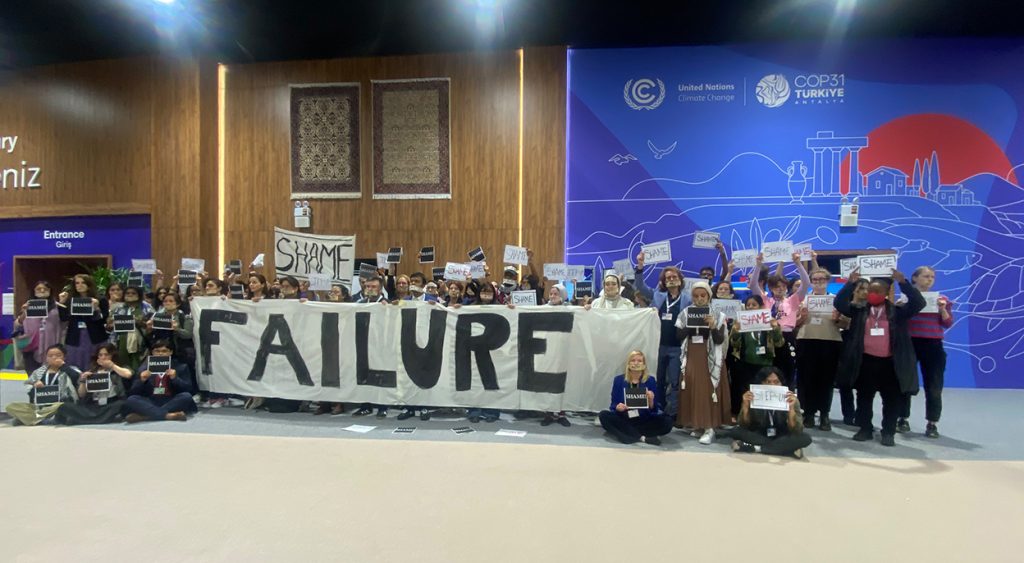
ANTALYA, Turkey, Nov 23: The UN climate conference COP31 ended without agreement on a key political declaration, firm climate finance commitments or a clear roadmap for phasing out fossil fuels, exposing deep divisions between developed and developing countries.
Delegates adopted adaptation decisions, the Adaptation Fund and just transition, but failed to reach consensus on the overarching political statement, known as the cover decision. Disagreements centred on fossil fuel transition, climate finance, the Paris Agreement’s 1.5 degree Celsius target and climate justice.
Developing countries had sought grant-based public finance, support for a just transition and a clear shift towards renewable energy. The negotiations produced no firm commitments on these demands.
For vulnerable countries such as Nepal, predictable public funding is needed for disaster recovery, reconstruction and climate adaptation. Without it, governments risk relying more heavily on loans from multilateral lenders, adding to existing debt burdens. The conference also failed to address the unequal climate burden, with poorer countries facing severe impacts despite having contributed less to historical emissions.
Developed countries reject cover decision
COP31 became the first UN climate conference since COP26 in Glasgow to end without an agreed cover decision. The proposed text failed to secure consensus on fossil fuels, emissions cuts and climate finance.
The European Union, the UK, Germany, Norway, Panama, Belize, the Marshall Islands and Vanuatu rejected the draft, saying it lacked a clear plan to move away from coal, oil and gas, a science-based pathway to meet the 1.5 degree target and concrete financial commitments.
The EU said it could not accept a decision that did not refer to fossil fuels. Panama and the Marshall Islands objected to language they believed could legitimise continued fossil fuel use through technologies such as carbon capture.
Norway, the UK and the Least Developed Countries group also opposed weakening earlier commitments and called for action consistent with climate science.
The failure to agree on the declaration delayed a decision concerning the Global Environment Facility. Nepal’s effort to secure a separate decision on mountain issues was also held up. A proposal for mountain-focused workshops over the next two years had, however, been approved at the Bonn session.
Negotiators also failed to settle disputes over adaptation finance, predictable funding and the financial responsibilities of developed countries. No concrete plan or additional funding was agreed for addressing climate-related loss and damage.
Dispute over fossil fuels and climate justice
Irish Climate Minister Darragh O’Brien formally stated the EU’s opposition at the final plenary, citing the lack of a fossil fuel transition plan, climate finance commitments and action consistent with the Paris Agreement.
Climate campaigners questioned the EU’s position, accusing the bloc of obstructing stronger commitments on just energy transition and adaptation finance. They said its rejection of a weak agreement contradicted its resistance to more ambitious action on climate justice.
Panama’s Environment Minister Juan Carlos Navarro called for an explicit commitment to phase out fossil fuel production and use. He argued that general emissions reduction pledges were inadequate without a timeline to end dependence on coal, oil and gas.
The COP28 agreement in Dubai had called for a transition away from fossil fuels. Its absence from the COP31 draft prompted objections. Navarro accused the oil industry of holding climate negotiations hostage and said wealthy countries must provide funding to help vulnerable nations respond to floods, droughts and rising seas. Panama formally rejected the proposed text.
Climate Action Network, which represents more than 2,500 civil society organisations, also criticised the draft. It said the text lacked a fossil fuel phaseout plan and adequate financial support for developing countries.
The network raised concerns over the emphasis on carbon capture and carbon dioxide removal technologies, arguing that their effectiveness, cost and scalability remain contested. It warned that these technologies could be used to justify continued fossil fuel production.
Gender and just transition commitments remain weak
COP31’s outcome on gender equality recognised women’s full and equal participation in climate decision-making but set no new targets, deadlines or clear implementation measures.
Earlier climate decisions had addressed women’s empowerment, climate finance and institutional accountability. The latest outcome offered no specific funding amounts or dedicated financial mechanisms for women.
The gap is significant for rural and Indigenous women, particularly those in climate-vulnerable communities who face greater disaster risks and have limited access to climate finance. Nepal and Bhutan had submitted a proposal on mountain issues. Mongolia’s proposal addressing the challenges faced by women in remote and mountainous areas was excluded from the outcome.
The conference also failed to establish adequate funding and implementation measures for a just transition. Moving away from fossil fuels can affect workers and communities dependent on coal, oil and gas industries. A fair transition requires alternative jobs, skills training and social protection for those affected.
Adaptation finance remained unresolved. Climate Action Network called on wealthy countries to provide at least US$120 billion annually for adaptation by 2035 through a credible funding plan.
Developing countries also sought grant-based finance to address climate-related loss and damage. They argue that wealthy nations, given their historical emissions, should help affected countries recover and rebuild without forcing them further into debt.
The outcome leaves major questions over who will finance climate action and how vulnerable countries will be supported. Without a clear fossil fuel phaseout plan and predictable public funding, commitments made at climate conferences will remain difficult to implement.
People’s News Monitoring Service

Login to add a comment