







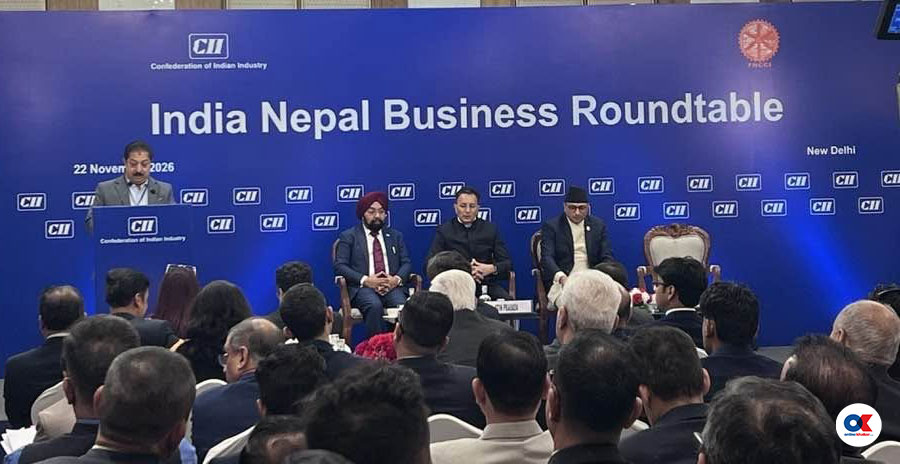
New Delhi, Nov 23: Nepali business leaders have called for the removal of trade barriers, expansion of infrastructure and increased Indian investment to make economic ties between Nepal and India more practical and result-oriented.
The demands were raised during the Nepal-India Business Roundtable held on the sidelines of Prime Minister Balendra Shah’s visit to India.
Responding to their concerns, Indian Commerce Minister Jitin Prasada said there were opportunities for investment and cooperation in Nepal’s production capacity, infrastructure and tourism sectors. He also offered suggestions for accelerating the pace of economic development.
Nepal’s Finance Minister Dr Swarnim Wagle urged Indian businesspeople and investors to expand their investments in Nepal. He said the government was working to create a favourable environment for investment.
Nepali industrialists and business leaders attending the roundtable said that despite close trade relations with India, Nepali products continued to face difficulties accessing the Indian market. They cited delays in quality certification and policy barriers affecting exports of certain products.
They also highlighted legal and policy reforms introduced in Nepal to attract foreign investment and invited Indian private sector companies to invest in hydropower, tourism, infrastructure, agro-processing, information technology and manufacturing industries.
Anjan Shrestha, president of the Federation of Nepalese Chambers of Commerce and Industry (FNCCI), said Nepal and India should move beyond their traditional trade and cultural ties and build a partnership focused on economic prosperity.
He proposed expanding cooperation in seven priority areas: trade, transit, connectivity, infrastructure, energy, investment and technology.
Although India is Nepal’s largest trading partner and a major source of foreign investment, Shrestha said Indian private sector investment had not reached its potential.
According to him, India accounts for around one third of Nepal’s total foreign direct investment. However, the actual volume of Indian investment remains below $1 billion.
Business leaders also complained that delays in certificate renewals by the Bureau of Indian Standards (BIS), along with complications related to raw materials, were causing Nepali products to be held up at the border.
Shrestha said Nepal had introduced several measures to attract foreign investment, including automatic approval for foreign investment in 102 sectors, removal of investment ceilings and streamlined procedures through a one-stop service centre.
Nepali business leaders placed particular emphasis on the problems faced by Nepali products in the Indian market. They urged the Indian side to review trade restrictions and duties affecting products from the jute and steel industries.
Shrestha said the anti-dumping duty imposed on Nepali jute products since 2017 had affected the industry. Pointing out that the jute industry supports farmers and workers in eastern Nepal, he urged India to view Nepali manufacturers as industrial partners that could benefit both countries, rather than simply as competitors in the Indian market.
He also said Nepal’s steel exports had fallen by more than 60 per cent in the last fiscal year due to safeguard duties imposed on steel imports in the Indian market.
Business leaders reiterated that delays in BIS certificate renewals and difficulties related to raw materials were preventing Nepali products from clearing the border.
To address these problems, Shrestha proposed setting up a joint task force between FNCCI and the Confederation of Indian Industry (CII). The task force could examine trade barriers, quality standards and trade remedial measures and make recommendations to the governments of both countries.
The Nepali delegation also raised the need to facilitate access to Indian ports, increase railway capacity and upgrade integrated check posts.
Vikramjit Singh Sahney, director general of CII, said improving customs procedures and expanding freight transportation services by rail should be prioritised.
Nepali business leaders also briefed Indian private sector representatives on investment opportunities in Nepal and called for cooperation in major infrastructure projects.
Shrestha said Nepal had reached an agreement to export 10,000 megawatts of electricity to India over the next 10 years, adding that the country had substantial potential for hydropower development.
Although Nepal has more than 40,000 megawatts of economically viable hydropower generation potential, only a small portion has been developed, he said.
Beyond hydropower, Shrestha identified opportunities for Indian investment in tourism, agro-processing, pharmaceutical manufacturing, cement, information technology and industrial infrastructure. He proposed developing projects involving expressways, airports, industrial zones and urban transport through public-private partnerships.
Yankee Ukyab, chief executive officer of the Investment Board Nepal, briefed participants on the policy and legal reforms introduced in the country. She also drew attention to the potential for Indian investment in the Bhairahawa Pokhara Expressway project.
Business leaders, including Bhawani Rana, president of the Confederation of Nepalese Industries and former president of FNCCI, also stressed the need to expand Nepal-India tourism ties and promote investment by Indian private companies.
They called for greater cooperation between the two countries in tourist movement, air connectivity and tourism infrastructure.
People’s News Monitoring Service

Login to add a comment