







By Our Reporter
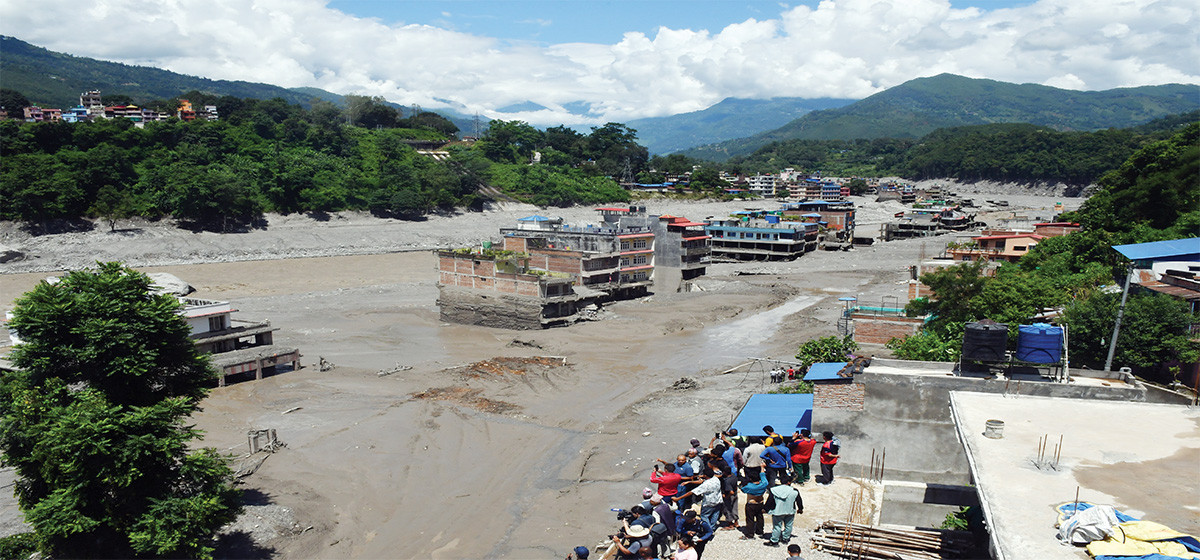
The government’s estimate of Rs 723.315 billion for rebuilding after the August 26 Bhotekoshi flood is a warning about the scale of the disaster and an even bigger question about Nepal’s ability to finance recovery.
The Rapid Damage and Needs Assessment prepared by the National Planning Commission and the National Disaster Risk Reduction and Management Authority puts the infrastructure requirement alone at Rs 473.57 billion. Energy accounts for Rs 390.62 billion, with 13 hydropower projects totalling 759 MW and five solar plants with 24 MW capacity affected. Transport infrastructure needs another Rs 73.34 billion after roads, motorable bridges and suspension bridges were damaged.
These numbers show that this is not a normal post-flood repair exercise. Nepal is being asked to rebuild an energy and transport network while also replacing homes, schools, health facilities, cultural sites and productive assets.
The social sector is expected to need Rs 103.55 billion, while agriculture, businesses, trade and banking require another Rs 50.77 billion. A further Rs 94.75 billion is earmarked for disaster risk reduction and river management. That last allocation is particularly important. Spending hundreds of billions to rebuild the same infrastructure in the same vulnerable locations without improving protection would leave the country exposed to another expensive disaster.
The immediate financial burden is relatively manageable. The government estimates Rs 8.73 billion will be needed during the first six months for relief and early reconstruction. The real test comes afterward, with Rs 714.58 billion expected for long-term recovery.
Where can Nepal find this money? The first source must be the national budget, but the government cannot finance the entire programme by cutting existing development projects or expanding borrowing sharply. Nepal already carries a sizeable public debt burden, and reconstruction spending will come on top of regular obligations. Excessive domestic borrowing could also squeeze private investment and push up financing costs.
The government should instead prepare a dedicated reconstruction financing framework. Development partners should be approached for grants and highly concessional loans, particularly for roads, bridges, public buildings and disaster-resilient infrastructure. Nepal also has a strong case for climate-related international financing because increasingly severe floods, landslides and other hazards are imposing costs on a country that has contributed little to global emissions.
The hydropower sector requires a different approach. Projects that remain commercially viable should be encouraged to mobilise private capital, project finance and insurance payments. Government money should focus on public infrastructure and projects that cannot attract commercial financing on reasonable terms.
The proposed reconstruction programme also needs strict prioritisation. Not every damaged structure needs to be rebuilt exactly where it stood. Roads, bridges, settlements and public facilities in high-risk areas should be redesigned after proper geological and hydrological assessment.
The forthcoming Post Disaster Needs Assessment must provide a more precise bill and identify who should pay for each component. That division of responsibility matters.
Nepal cannot afford a Rs 723 billion reconstruction programme driven by ad hoc decisions. The country needs a multi-year financing plan, transparent project selection and regular public reporting on money received and spent.
The Bhotekoshi flood has exposed the cost of weak disaster preparedness. The reconstruction effort should make sure Nepal does not pay the same bill twice.

Login to add a comment