A year of Gen Z protest: New faces in government, old system persists
People's Review
September 10, 2026
By Our Political Analyst
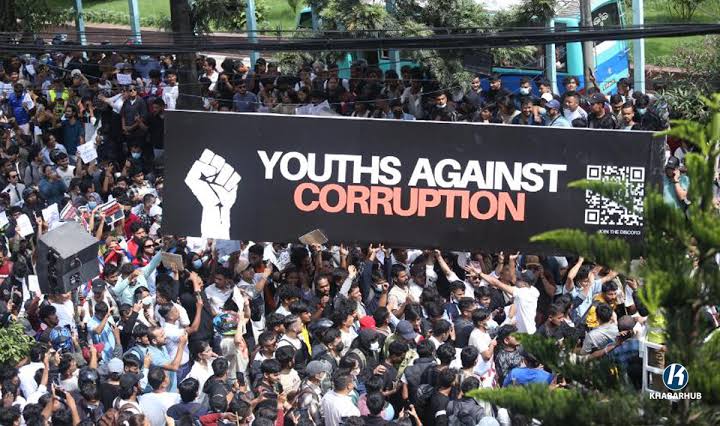
A year ago, Nepal’s youth accomplished something more important than bring down a government. They questioned the way the state was administered. The prohibition on social media served as an instant spark, but the rage went far deeper. For years, dissatisfaction has been fuelled by unemployment, corruption, nepotism, political privilege, and an ineffective government. When young people came to the streets on September 8 and 9 of last year, their discontent rapidly transformed into a political rebellion.
The magnitude of the rebellion was incredible. Police shooting killed protestors, resulting in 77 deaths and over 2,000 injuries. The demonstrations erupted into widespread violence and devastation, with government buildings, political figures’ homes, and large hotels being targeted. The government of KP Sharma Oli failed due its inability to sustain pressure. Parliament was dissolved ahead of schedule, and former Chief Justice Sushila Karki was appointed to oversee an interim administration.
The Karki government’s first main priority was to restore political stability and return the nation to an election process. It accomplished this rather rapidly. On March 5, the temporary administration conducted House elections, in which the Rastriya Swatantra Party won over two-thirds of the vote. In that sense, Karki’s administration met one of the movement’s primary demands: political transformation via elections rather than continuous turmoil.
It also reached a 10-point deal with Gen Z representatives. The accord addressed good governance, anti-corruption action, justice for those slain and wounded, free medical care, relief and employment assistance for victims’ families, digital rights, constitutional reform, and election amendments, including a “none of the above” option. Some of these pledges have resulted in real outcomes. Forty-five victims have been designated martyrs, 53 families have got Rs 1.5 million, and Gen Z clinics have been created in 16 hospitals. The administration also set up a task team to carry out the deal.
However, these actions were mostly concerned with the immediate aftermath. The more difficult issue was whether the temporary administration could launch the fundamental changes that the movement desired. There has been little movement on that front.
The Balen government is now in charge of the broader duty. It inherited a strong election mandate from people who want more than a change in political personalities. They wanted a state that operated differently. The current government has shown a higher sense of urgency than prior administrations. However, action is not the same as reform. Job creation, the investment climate, diplomacy, administrative efficiency, and corruption control are all still being debated.
The commitment to take action against the “big fish” is the most significant test. The Karki administration agreed to set up an impartial body to examine big corruption charges, and a five-member Property Investigation Commission was eventually constituted, led by former Supreme Court Justice Rajendra Kumar Bhandari. However, as issues were raised regarding its constitutional and legal foundation, the Supreme Court issued an interim injunction halting its proceedings.
That is significant since corruption was not a secondary concern in the Generation Z campaign. It was one of the reasons young people had lost trust in the political system. If significant corruption cases continue to be resolved via commissions, investigations, and legal challenges, the perception that politics protects the powerful will persist.
The economic situation is equally significant. A Tribhuvan University research cautioned that policy volatility harms company confidence and advised that economic policies be maintained for at least five years. Digital firms, software development, startup finance, and private sector engagement in energy trading are among the economic priorities of the incoming administration.
However, the most important test is employment. Hundreds of thousands of young Nepalis continue to flee the nation, while unemployment remains around 20 percent. A government cannot claim to have responded to the Generation Z appeal if young people continue to consider migration as their best viable option for a living.
Another unanswered issue is that of digital freedom. The social media ban sparked the campaign, and the government soon eased restrictions on 26 sites after the demonstrations. But the bigger takeaway was about the state’s relationship with a digitally connected generation. Young people want more than just access to social media, but also a more transparent, participatory, and responsible government. Increasing online public services is therefore just part of the solution. The government must also cease seeing digital space as a tool for control.
Politics has undergone one noticeable alteration. Younger politicians have acquired more clout in Parliament, while older parties have been under increasing pressure to change their leadership. The growth of the RSP has compelled the Nepali Congress, the CPN UML, and other established parties to take young representation more seriously. However, altering the age and appearance of politicians does not inevitably alter political culture.
That is where the true test of the Generation Z movement rests. Nepal has already seen an exceptionally quick political transformation, from street demonstrations to a government fall, an interim administration, parliamentary elections, and the rise of a new political party. However, the rate of political change cannot be used to quantify reform.
A year later, the core issues remain: will powerful personalities be held accountable, will young people be given meaningful chances at home, will public institutions become more responsive, and will the state make more transparent decisions?
The streets were successful in altering who rules Nepal. The more difficult goal is to change Nepal’s governance structure. That portion of the Generation Z revolution has yet to be completed.









Login to add a comment