








By Our Reporter
The devastation along the Nepal-China border is a reminder that Himalayan disasters rarely have a single cause. What looks from below like a sudden flood can begin thousands of metres higher, where glaciers, rock, frozen ground, rainfall and steep mountain slopes interact in ways that remain difficult to predict.
At the time of writing by Tuesday afternoon, at least 955 people are confirmed dead and over 4,400 remain missing across Nepal and the Xizang Autonomous Region of China following the catastrophic flash floods triggered along the Bhotekoshi river basin. Rasuwa and Nuwakot have suffered extensive destruction, with homes and settlements buried or swept away by mud and debris. Dozens of bridges and around 40 kilometres of roads have been destroyed. Rescue teams are still searching for survivors, including hundreds of foreign nationals.
But the most important question now is not simply how much damage the flood caused. It is what happened high in the mountains before the water and debris came rushing down.
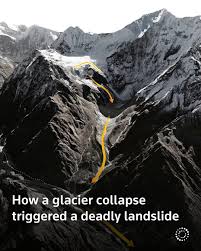
Geologist Dan Shugar of the University of Calgary has offered an important explanation. Satellite images showed a glacier at around 5,000 metres just two days before the disaster. By the following day, the glacier had disappeared. Further analysis suggested this was not simply a case of ice breaking away. A huge section of the mountain itself had collapsed, sending rock and ice plunging roughly one kilometre onto the valley floor.
When that much rock and ice falls at tremendous speed, it does not simply hit the ground and stop. The impact releases enormous energy. Friction and heat can melt large quantities of ice, while shattered rock and water mix with soil to form a powerful debris flow. Once that mixture enters a steep Himalayan valley, gravity does the rest.
The result may look like a flash flood, but the danger is much greater. Water alone can be destructive. Water carrying boulders, mud, ice and broken mountain material can rip apart bridges, roads, buildings and almost anything else in its path.
The Himalayas contain nearly all the ingredients for such disasters. The terrain is exceptionally steep, with huge differences in elevation between high peaks and valley floors. Material released at high altitude can therefore gain enormous speed as it moves downhill.
The geology adds another layer of risk. The 2015 Gorkha earthquake showed how unstable Himalayan slopes can become. The Langtang disaster, triggered by that earthquake, remains a stark reminder of how quickly an apparently solid mountain landscape can collapse.
Then there are the people living in these valleys. That may be the biggest difference between a remote geological event and a national disaster. Mountain communities have lived in the Himalayas for generations, while roads, hydropower projects, border facilities, hotels and other infrastructure have expanded rapidly. Economic development has put more people and valuable assets directly in the path of geological hazards.
That raises a difficult policy question. Nepal cannot simply move everyone out of the mountains. Nor can it stop building roads and hydropower projects. But geological risk can no longer be treated as something to consider after the development plans are already drawn up.
Climate change makes the problem harder. It would be premature to say that climate change directly caused this particular disaster. Shugar himself has cautioned that more research is needed before reaching such a conclusion. But climate change can alter the conditions in which Himalayan disasters occur.
As temperatures rise, glaciers lose mass and become thinner. Ice can help stabilise mountain slopes and valley walls. When that support weakens, rock formations that were once relatively stable may become more vulnerable.
Permafrost is another concern. Permanently frozen soil and rock help hold steep mountain terrain together. As warming causes permafrost to thaw, the bonds within slopes can weaken. That can increase instability and the risk of rockfalls, landslides and other failures.
Changing rainfall patterns could be just as important. Intense rainfall can force water into cracks and beneath glaciers, potentially acting as a lubricant between ice and rock and accelerating movement. Heavy rain can also saturate already unstable slopes, making collapse more likely.
Nepal therefore needs to stop thinking about floods only as events that happen in rivers. The source of the danger may be far above the river, inside a glacier, beneath frozen ground or within an unstable mountain slope.
That needs to change how the country prepares. Monitoring glaciers and glacial lakes across the Himalayas should become a permanent priority, with Nepal and China sharing data and warnings in real time. Satellite technology, ground sensors and local observation systems need to feed into a warning network that can reach vulnerable communities quickly.
Infrastructure planning needs a similar rethink. A road that is cheap to build but repeatedly exposed to landslides is not cheap in the long run. Hydropower projects, bridges, settlements and border infrastructure require serious hazard assessments before construction begins.
Most importantly, disaster preparedness cannot remain centred on Kathmandu. Communities living closest to the danger need access to information, equipment and the authority to respond before outside help arrives.
The Bhotekoshi disaster is therefore more than a story about a glacier or a sudden flood. It is a warning about a rapidly changing Himalayan environment, expanding human activity and a disaster management system that must keep pace with both.
Nepal did not create the climate crisis, yet its mountain communities are among those exposed to its consequences. Waiting for the next mountain to collapse is not a strategy. Nepal needs to understand its mountains better, monitor them continuously and act while a warning is still a warning, not after it has become another tragedy.

Login to add a comment