







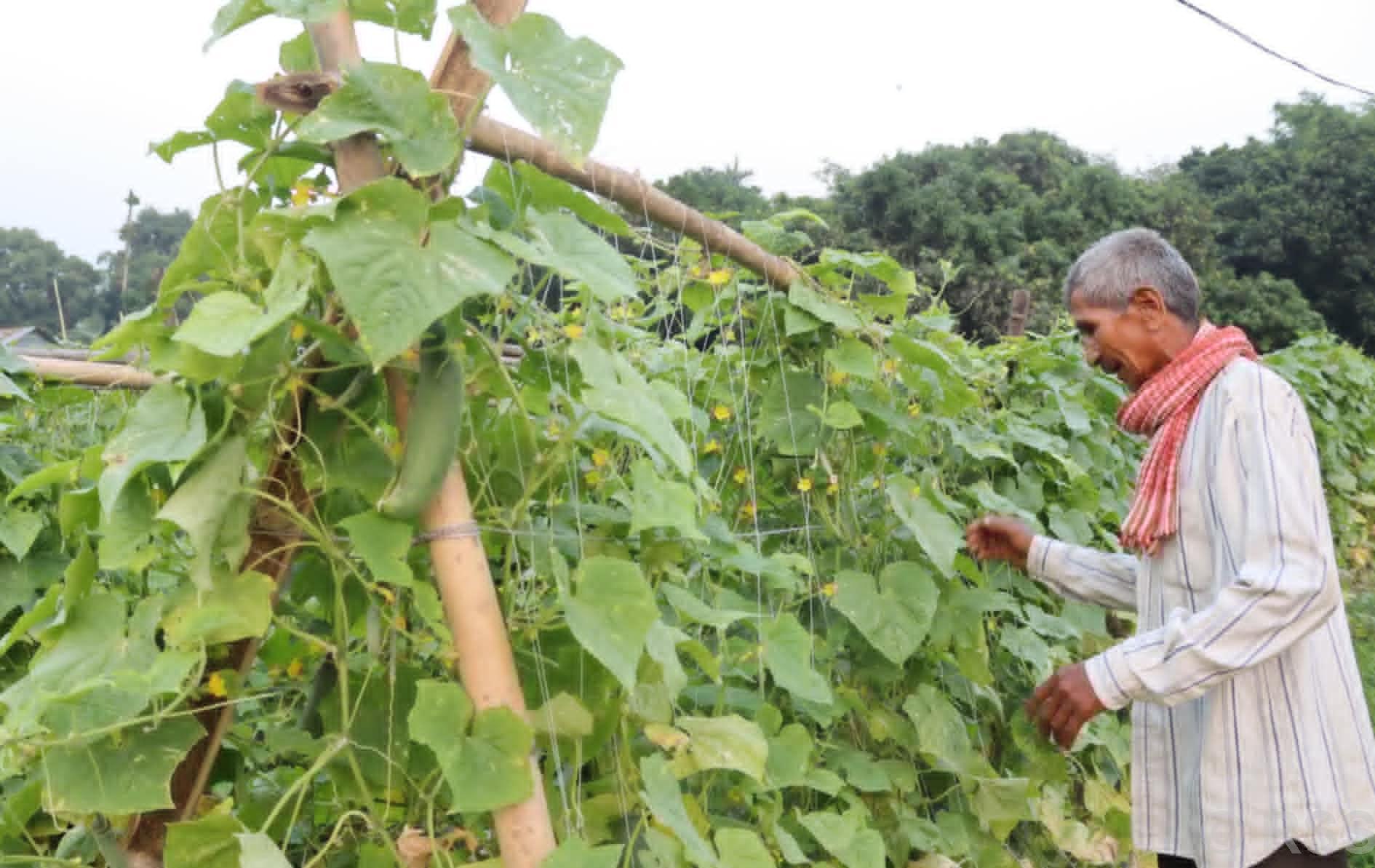
Kathmandu, June 7: Farmers in the Barahakshetra Municipality area of Sunsari district are showing increasing interest in commercial vegetable farming.
Fields that once lay barren have now been transformed into lush vegetable farms, and farmers are becoming more self-reliant by earning substantial incomes while remaining in their own villages. Even before sunrise, farmers can be seen harvesting cucumbers, tomatoes, beans, sponge gourds, cabbages, and other vegetables from their fields.
The vegetables produced are sold in markets in Dharan, Itahari, Inaruwa, Barahakshetra, and surrounding areas. Dinesh Rajbanshi of Barahakshetra Municipality–7 has been engaged in commercial vegetable farming on nearly two bighas of land for the past six years. After spending three years working abroad, he returned home and now earns a satisfactory income through vegetable cultivation.
“Even after working very hard abroad, it was difficult to cover household expenses. Now the entire family works together in vegetable farming. If one is willing to work hard, it is possible to earn a good income from our own soil,” he said. According to Rajbanshi, income from vegetable sales comfortably covers household expenses, and he is able to save more than NPR 70,000 per month.
Likewise, Nitu Rajbanshi and her husband Ramesh Rajbanshi cultivate vegetables commercially on three bighas of land. They grow seasonal vegetables such as cucumbers, beans, sponge gourds, cabbages, and tomatoes. According to Nitu Rajbanshi, in the past, maize and millet farming only met the family’s food requirements.
However, since switching to vegetable farming, they have been earning a good income. “The land used to remain barren, but vegetable farming has greatly improved our situation. If the weather cooperates and irrigation and fertilizer management are adequate, vegetables worth NPR 700,000 to 800,000 can easily be sold annually,” the couple said.
Similarly, Yukti Chaudhary of Tinkune, Barahakshetra Municipality–8, has been cultivating seasonal vegetables on four bighas of land. What began six years ago on just one kattha of land has now expanded into a business generating more than NPR 1 million annually. Operating Ritika Agriculture Farm, Chaudhary says that family support and continuous hard work have enabled him to expand the enterprise.
“I will continue farming as long as I am able to work. With my family’s support and dedication, agriculture offers great potential,” he said.
Chaudhary uses manure from his cattle and goats as organic fertilizer, which he believes helps produce healthier and higher-quality crops. He added that there is no shortage of market demand for his vegetables.
According to him, traders come directly to the farm to purchase produce. “We sell vegetables at about NPR 10 less per kilogram than the market price. Since traders come to the farm themselves, we do not have to deal with the hassles of marketing,” he said.
Prabin Lal Shrestha, Information Officer at the Sunsari Agriculture Knowledge Centre, said that various programmes are being implemented to promote vegetable farming in Barahakshetra and other rural areas of the district.
According to him, the centre provides farmers with subsidies, improved seeds, irrigation equipment, soil testing services, training on fertilizer and pesticide management, and other forms of technical support. Modern vegetable farming has helped many farmers become self-reliant.
He said, “There has been a positive impact on production growth, market access, and income expansion.”
Shrestha added that the Agriculture Knowledge Centre continues to provide advisory services to address issues such as vegetable storage, pest infestations, market management, and weather-related challenges.
Vegetables produced by farmers in Barahakshetra are sold at the Dharan Agricultural Produce Market as well as in Itahari, Inaruwa, Barahakshetra, Karabanzar, and other local markets. Farmers say there is no shortage of markets for their produce.
Government subsidies, support from various organizations, and the increasing use of digital marketing have further facilitated commercial vegetable farming.
As vegetable cultivation becomes increasingly profitable, farmers in Barahakshetra are showing greater enthusiasm for investing their labor and skills in their own communities rather than seeking employment abroad. This trend has contributed not only to job creation in rural areas but also to the development of a more self-reliant local economy.
According to Mayor Ramesh Karki, most farmers in Barahakshetra are now cultivating vegetables and earning good incomes by selling them in local markets.
He said the municipality annually provides technical training, improved seeds, fertilizers, irrigation facilities, subsidies for plastic tunnel construction, and support for market management. As a result, employment opportunities within the community are increasing.
Young people who had previously gone abroad for employment are also beginning to return to agriculture. Awareness is spreading across villages that it is possible to earn a respectable income by working hard in one’s own country and on one’s own land.
However, farmers occasionally face discouragement due to crop losses, pest outbreaks, and reduced production caused by irregular rainfall, extreme heat, hailstorms, and other weather-related factors.
Mayor Karki emphasized that farmers can continue to earn good incomes from vegetable farming by adopting climate-appropriate crop selection, plastic tunnels, drip irrigation systems, and other modern agricultural technologies.
People’s News Monitoring Service.

Login to add a comment