







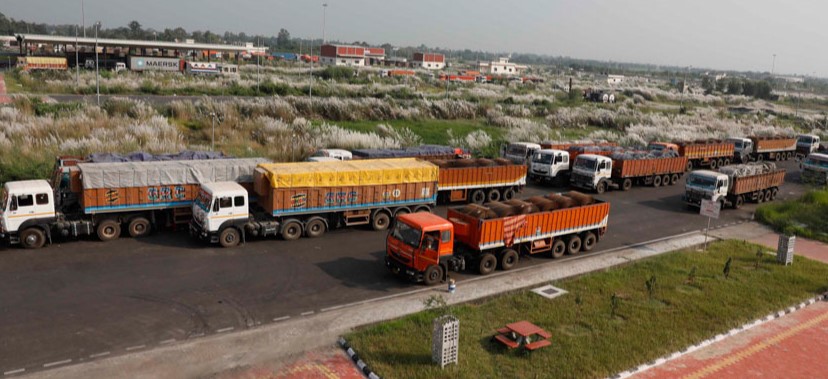
Kathmandu, May 8: The government has temporarily backed down from strictly enforcing mandatory Maximum Retail Price (MRP) labeling at customs points, ending days of confusion and disruption at the country’s major trade checkpoints. A rare moment when bureaucracy blinked first. Nature is healing.
Customs clearance processes that had stalled over the MRP dispute resumed from Wednesday after an agreement between the Department of Customs and importers.
The department has now allowed importers to self-declare the MRP of imported goods, opening the way for cargo movement to resume immediately.
Under the agreement, importers must declare the MRP at customs, but they can take the goods to their own warehouses and attach MRP labels there before releasing them into the market.
The arrangement comes with a condition that all goods entering the market must display price information. Following the new understanding, customs clearance has resumed rapidly at major border points including Birgunj and Biratnagar.
According to Shyam Prasad Bhandari, all customs offices were instructed on Wednesday to clear imported goods based on self-declared MRPs provided by importers.
The Department of Customs said revenue collection increased significantly once clearance resumed.
According to the department, customs points collected Rs 1.59 billion in revenue in a single day on Wednesday.
The temporary arrangement will remain effective for three months. During this period, the government is expected to introduce further clarification through the upcoming budget or other legal mechanisms.
Instead of issuing formal written directives, the department instructed subordinate offices through internal circulars and virtual meetings. Because nothing says “stable economic policy” like emergency Zoom calls and verbal patchwork.
Officials say the temporary compromise was necessary given legal complexities surrounding the Consumer Protection Act and related regulations.
Business groups also see the three-month window as an opportunity to press the government for amendments and more practical implementation measures.
Earlier, on March 30, 2026, the Department of Commerce, Supplies and Consumer Protection had issued a notice requiring that only imported goods carrying MRP labels would be cleared from customs starting April 28, 2026.
Importers, however, refused to release goods, arguing that unloading cargo at border points and labeling every individual item there was impractical.
To break the deadlock, the Department of Customs proposed clarifying the MRP issue through the Economic Act for the upcoming fiscal year 2026/27.
Although the government initially rejected the importers’ proposal to allow self-declaration at customs and labeling after entry into Nepal, it eventually agreed.
The legal basis for the dispute lies in Section 6 of the Consumer Protection Act 2018, which requires all goods sold in the market to carry labels. The law mandates details such as the manufacturer’s name, address, registration number, expiry date, MRP, batch number, and production date.
Subsection 3 of the same section assigns responsibility for labeling imported goods to the importer, while Subsection 4 prohibits the import, sale, or distribution of unlabeled goods.
According to Hari Prasad Gautam, the government only sought a practical solution after customs revenue fell by more than 50 percent, thousands of cargo trucks became stranded, and traders suffered major losses.
He said the Department of Customs had earlier forwarded the issue to the Ministry of Industry, Commerce and Supplies, which then took it to the Prime Minister’s Office. The easing came after heavy revenue losses prompted intervention from the finance minister.
Business groups expect the upcoming national budget to permanently revise or simplify what they describe as an impractical system.
Importers say the disruption caused severe financial damage, including high truck rental costs, spoilage of goods, mounting bank interest, and expiring letters of credit.
“In Birgunj alone, around 2,000 trucks were stranded, causing huge losses for both traders and the government,” Gautam said.
He warned that the current rule could encourage smuggling if implemented without practical revisions.
People’s News Monitoring Service

Login to add a comment