







By Sharachchandra Bhandary

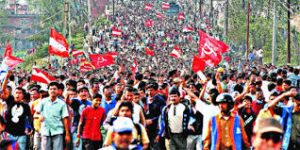
Kathmandu, 24 April: The declaration of Baisakh 11, 2063 was the conclusion of the people’s revolution, movement and armed struggle in Nepal for the establishment of democracy. After that, Nepali people had expected that better days would come ending inequality, ensuring justice to everyone and usher in an era of overall development of Nepal. The following years were not a pleasant for them. Many rays of hope were seen, but the expectations of the Nepali people were not fulfilled. The Nepali people had an expectation of political stability and economic prosperity. But the political struggle did not bring happiness to them. Their dreams of prosperity and progress were shattered.
Since the April uprising of 2006, election to the Constituent Assembly (CA) had become a talk of the town, politics could not take the expected path and pace. Following the two elections to the CA and promulgation of a new constitution with federalism, secularism and republic set up but processes, practices and mentality of the key political actors have not changed according to democratic values and norms. Their malpractice and influence fell on all spheres of the society. According to the new constitution, two general and local elections were held. Although the new constitution was made, the peace process that started almost two decades ago remained incomplete.
If we compare to countries, Loktantra or democracy was established quickly and easily, as the monarch abdicated the throne for the betterment of Nepal and here citizen. Probably for this reason, the development and expansion of democratic culture was not possible along with the political changes, and the development of democratic culture was not given importance.
As a result, the narrative that politicians are all corrupt and entrepreneurs are just as much frauds was deliberately created. The behavior of some also confirmed that wrong comment. It increased anger and frustration in the society. When there is widespread despair in the society, when the leaders fail to show the way and instill hope, the influence of clowns increase in politics. When such jesters come to power, the society and the nation must pay the price.
The clowns without political character and democratic culture are eager to excite and mislead the people. Many countries and societies have suffered great losses in the past when the illusions spread by such clowns were believed to be true. The success of the movement, which gave the last blow to the feudal monarchy, was the starting point of the national resolve to change the face of the country, so that it would never have to take to the streets again for the sake of political order. However, despite the many political achievements in the past 17 years, the dream of Nepalis to change the face society remined shattered. Their hope has turned into extreme disappointment so quickly. Why? This is the most important point to ponder on Loktantra Diwas.
Even though the rest of the world, including two neighboring countries, is progressing at a rapid pace, our pace is at a snail’s pace. In a self-made democracy, ordinary people cannot stand up as sovereign citizens anywhere except on the day of voting. There is a situation where people have to go abroad even to manage their household affairs, and other indicators of good governance in the country are also critical. Citizens whose only option is to go abroad are doomed to face many hardships even when it comes to obtaining everything from passports to driving licenses. Corruption is rampant, some of the economic indicators of the country are alarming . Leaders have to be taught the rule of law by the court every now and then. The court itself is not without controversy.
The Nepali society is also entering the same stage of frenzy and confusion, but on the Loktantra Diwas or Democracy Day, it seems that the time has come for the leaders of all sections of the society, including political party leaders and workers, as well as the general public to think seriously. The top leaders of the major political parties are well aware of such clowns and people have still faith in them that as they are in the last half of their lives fulfill their historical responsibility of making Nepal a prosperous country.
There is no alternative to moving forward on the path of development of democratic culture, economic and social progress. At present, society can return to the right path only with simple efforts, but if the distortions increase too much, there is a risk of turning the tide. Therefore, every possible effort should be made to fulfill the people’s desire so that the people know it so as not to let the society reach that situation. For this, the character of power-centers should be made people-oriented.

Login to add a comment