








Regional/International Affairs

By N. P. Upadhyaya
Kathmandu: “The optimist people see opportunity in every danger and conversely the pessimist sees danger in every opportunity”.
The quote is even fitting for our readers which is as follows, “The greatest mistake we humans make in our relationships, we listen half, understand quarter, think zero, and react double”.
The two-time-tested old adage(s) has some meaning in the article that follows.
What is the meaning, and guess wherein it fits into and then conclude yourself!
Countries trade among themselves and benefit.
And when three countries have different political systems of governance yet benefit from trilateral trade then it creates at times history.
Creating history consumes time and energy which also demands careful guidance by the higher authorities of the concerned countries for timely benefit outcomes.
And witness to this new history in recent years was the attendance of Pakistan’s Foreign Minister Shah Mahmood Qureshi, the Minister for Railways, the adviser to the prime minister for commerce and investment, and a galaxy of Ambassadors from Iran, Turkey, Kazakhstan, and Tajikistan respectively plus the representative of the ECO Secretariat.
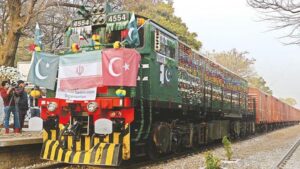
First freight train from Pakistan to Turkey
We are talking today about the freight train service that just commenced last year on December 21 2021 which originated from the Margalla Hills in Islamabad and reached Istanbul via Tehran in almost 14 days. The great going that it was.
Or else it would have taken some good twenty-one days by Sea route.
The rail distance from the point of origin to the point of destination got shortened by a good number of days which is cost-effective as well.
It was a merchandise train that crisscrossed a total of 5, 981 kilometers which are roughly 3, 666 miles.
Whatever may have been the distance in between Pakistan to Turkey, what is noteworthy is that the cargo train has commenced rolling which is sure to bring close the three countries.
The freight train that left Pakistan for Turkey reportedly had a total of eight carriages carrying each a load of 22 tons or even more.
What is most important and highly significant about this locomotive has accomplished a very “friendly” task that will, expectedly, glue the three countries, e.g. Pakistan, Iran, and Turkey in what could be taken as a “trade bond” which time permitting benefit all the countries tied up in this union.
It is altogether a different matters that these three countries now linked by the rail links with were all “friendly” to each other and the religion Islam being common in these countries that perhaps adds to their strength of friendship.
This trilateral friendship between the three countries is logical in that the countries are all founders of the Economic Cooperation Organization (ECO).
Notably, the ECO is an Asian political and economic intergovernmental organization founded in 1985 by the leaders of Iran, Pakistan, and Turkey.
Media sources say that at the moment, some 10 countries are members of this ECO, for example, Afghanistan, Azerbaijan, Iran, Kazakhstan, Kyrgyzstan, Pakistan, Tajikistan, Turkey, Turkmenistan, and Uzbekistan-all Muslim countries.
Interestingly, the ECO’s secretariat and cultural department are located in Iran, its economic bureau is placed in Turkey and most importantly the scientific bureau is in Pakistan.
The inaugural of this freight train is sure to increase regional commerce which could also benefit other countries who wish to join the trilateral cooperation — Turkey, Iran, and Pakistan.
The expected expansion of this trilateral cooperation appears likely to be at a later stage when the Central Asian Countries in the ECO itself exhibit a keen interest in benefitting from this freight train.
If the countries housed in the ECO begin trading amongst themselves then the entire “ECO” region would be a formidable economic force.
Interested men and experts engaged in the business and trade sector have hailed the “goods” train service reiterating that the 6,500-kilometer railway line will not only save money, but also expedite cargo and container transportation, and thereby greatly reduce travel time.
Since China and Pakistan have excellent relations with the countries of Central Asia, the likelihood of joining this TROIKA appears round the corner.
Media reports have it that “bilateral talks” are in progress between Islamabad and China to link this rail corridor with Kashgar, which lies in the southern province of Xinjiang.
Interestingly, China’s involvement in several rail projects in Pakistan is motivated primarily by commercial considerations, but concurrently it also sees distinct advantages for its improved transportation and access to Central Asia and the Persian Gulf, as Pakistan’s national rail network connects through to Pakistan’s seaports at Karachi and Gwadar, so views the Silk Road Briefing (December 28, 2021) while penning a story on the three countries fresh initiative as regards the freight train.
“The ITI train service previously ran on a trial basis as back as in 2009-2011 and after several abortive attempts to resume operations”, the Train succeeded in resuming its move on December 21, 2021, writes Arshad Mahmoud in the Jerusalem Post.
“The resumption of the ECO freight train is a step towards better regional communication in between the three countries that surely will later facilitate trade and public transportation for the long-term economic benefit of the entire region, so claimed a high official from Pakistan’s Prime Minister who was present at the ceremony for the departure of the freight train.
Given the fact that Pakistan has close and cordial ties with the entire central Asian countries and China and Russia. The leaders of these countries have just met on the eve of the Beijing Winter Olympics in China, let’s presume that both Russia and China must have sent enough political signals to the countries of the CAR’s to benefit from the Iran-Turkey-Pakistan endeavor that aims at enhancing the regional commerce.
China-Russia meets in Beijing
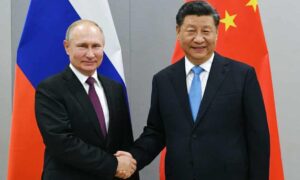
The one-on-one meeting of the Chinese President with Russian macho man, President Vladimir Putin in Beijing on February 4 will certainly go a long way not only in cementing their ties giving a new height in order to influence the global politics supposedly dominated by the United States. The Beijing meet is sure to benefit Pakistan much as it is this country that enjoys cordial ties with these emerging powers and also is in the good book of the US which is Pakistan’s former Cold War time ally.
Putin wrote an article in Xinhua News, “Our countries play an important role in stabilizing today’s challenging international environment, promoting greater democracy in the system of international relations to make it more equitable and inclusive”.
Putin in the article also “opposed the politicization” of the sporting events which could be taken as an indirect message to the countries which boycotted the Beijing Olympics.
A subtle message is here from Putin to the developed West.
Says Jens Stoltenberg on increasing China-Russia friendship, “China and Russia work so closely together that NATO doesn’t consider “them” as two “separate” threats.
This means that both the rivals of the US — Russia and China — are on the same wavelength on most global issues and by implication also the five leaders of the Central Asian nations who attended the Beijing Olympics.
Rahul Gandhi had “correctly” accused PM Modi that it was Modi who has forced China and Pakistan to come closer with his wrong foreign policy steps.
This too has meaning as PM Khan has just visited Beijing and met President Xi.
Veteran political analyst Ashok Swain, Professor of Peace and Conflict Research, at Uppsala University, Sweden, writes, “the US is seriously worried over the strong alliance between China and Russia as it seriously threatens to bring a formal end to Pax Americana.
Adds Professor Swain, “instead of adopting a Nixonian ‘divide and rule’ policy, the US is actually facilitating the two countries to cement their partnership” (Gulf News February 1).
The Swedish Professor in an interview with Newsweek recently, said, “The US has already started facing challenges to its superpower status from China and that growing alliance between China and Russia has added further force to it”.
Professor Swain in his recent Tweet, said, “Cold War has already taken a shape”.
Perhaps Prof. Swain is the first scholar to make such hair-raising comments, yet appears close to the truth.
The arrival of Putin and PM Imran Khan in Beijing speaks so many things unspoken and the meeting of the three political stalwarts, Putin. Xi and Khan, should sound to the US that the US now must review its foreign policy priorities in the world more for the regions like Central Asia and South Asia — a region that the devil rules.
The US under President Joe Biden needs to review its somewhat egotistical foreign policy and replace confrontation with competition and reconciliation both with China and Russia.
As the US hobnob with India increases, Pakistan is sure to attract the attention of Russia and China more for obvious political reasons. In such a scenario, Russia and China will both be obliged to support Pakistan perhaps for stabilizing the power balance.
In yet another not-so-good news for the US, Alexander Cooley, political science Professor at Columbia University’s Barnard College in New York, said to Newsweek, “the US has already ceded global hegemony, while its worldwide influence continues to wane”.
He adds, “in certain parts of the world, such as Central Asia, Russia and China are now playing critical roles in providing regional economic leadership and security”.
Perhaps he is hinting at the likelihood of the increased regional commerce in and among the CAR’s, Pakistan included, with the tacit support from Russia and China thus the net result is the US loss in this part of the world.
It is this moment that could be exploited by Pakistan. Russian President Putin is most likely to visit Pakistan any time soon.
A tough time that shall test the Pakistani diplomatic skills. To be with Russia, China, and the US at the same time is indeed a difficult proposition for Pakistan but it can’t escape.
However, it will need high diplomatic wisdom in balancing ties with these countries as the US at the moment has soured its ties with both China and Russia and has inched closer to India.
If Pakistan is to enjoy cordial and intimate ties with the Central Asian nations, in that case, it will have to take both China and Russia into confidence as the countries of the CAR’s too possess intimate ties with both the countries being world powers.
Given the fact that the Central Asian nations are breakaway parts of the former USSR so the former in many more ways are close to the heir apparent of the USSR that is today’s Russian federation.
And China’s intimacy too is increasing with the CAR’s so a “real” political balance has to be maintained in taking trading advantages from the countries of the CAR’s.
The fresh statement made by the Ambassador of Kazakhstan Yerzhan Kistafin, January 28, “a potential links between Islamabad and Kazakh capital Astana through the connection of railways such as Kazakhstan–Turkmenistan-Iran and Pakistan-Iran-Turkey”.
Ambassador Kistafin said clearly that “Pakistan provided a natural link to connect the Eurasian heartland with the Arabian Sea and South Asia”.
This means if India plus other South Asian countries and the Arabian nations so desire then Pakistan could offer the critical land routes and connectivity for mutually beneficial trade to the countries who wish to expand their trade and commerce.
Ambassador Kistafin was also present when the freight train departed from Pakistan on its final destination to Turkey.
His statement thus assumes greater significance in enhancing the regional commerce with such rail connectivity.
Ryan Erik King writes for the JALOPNIK (February 1), “each of three countries would benefit if the rail service were heavily used and if it is so then China would like to better relations with each country on the route to integrate the railway into its Belt and Road Initiative, BRI”.
Now back to Russia-China Summit in Beijing.
Both Russia and China opposed the expansion of NATO and issued a veiled rebuke to the US, criticizing “certain states” for trying to impose democratic standards on other countries.
Winding up all the threads together, what is for sure is that China and Russia appear more than ready to take up the Western challenges which is sure to ensure the emergence of the Cold War as hinted by Swedish Professor Swain.
Time to confirm your camp: whether you are with the WEST or with China and Russia?
And for the Road, Prof. Swain writes once again: Five Central Asian leaders refused to visit Delhi for the 26 January Republic Day Parade. But they promised President Xi on 25th to be in the Beijing Olympics. Xi could give a $ 500 million grant in aid and 50 million Covid vaccines. Gasbag had nothing to offer. That’s all.

Login to add a comment