







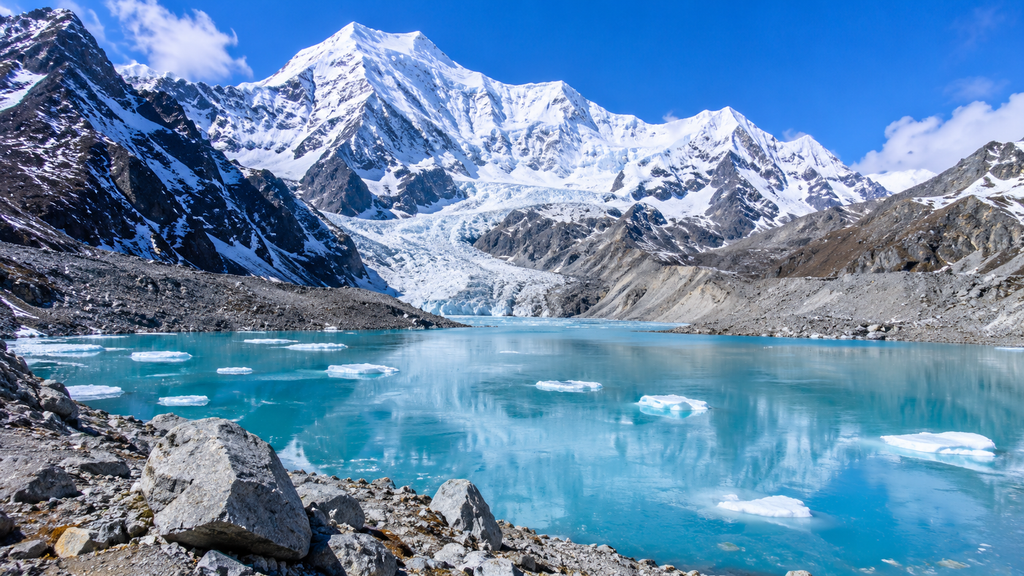
Kathmandu, November 25: The government is set to implement a project worth around Rs 7 billion (US$50 million), titled ‘Sanjivani’, to reduce the risks of glacial lake outburst floods (GLOFs). The project aims to mitigate risks posed by four highly vulnerable glacial lakes as glaciers in the Himalayan region are melting rapidly due to climate change, making the lakes increasingly unstable.
According to Sanjiv Baral, Executive Director of the Hydrology and Water Resources Research Centre, the project aims to protect vulnerable communities, livelihoods and properties from glacial lake outburst floods and climate-induced flooding.
The project plans to lower the water levels of four glacial lakes: Hongu-2 and Lumding Tsho in Solukhumbu, Lower Barun in Sankhuwasabha, and Thulagi in Manang. According to the preliminary design, the water level of Hongu-2 will be lowered by one metre, while that of the remaining three lakes will be reduced by three metres each. Monitoring, early warning systems and downstream protection programmes will also be implemented, Baral said.
“The Himalayan cryosphere is undergoing extremely rapid changes. Glacial lake outbursts and avalanches are increasing every year, so we can no longer afford to work at a slow pace,” Executive Director Baral said. “We cannot wait until 2000 to mitigate the risks of one glacial lake, another 16 years for a second and another 30 years for a third. Studies show that glaciers melted 65 percent faster during the decade from 2011 to 2020 than in the previous decade. The Thulagi Glacier in Manang alone is retreating at a rate of 30 metres annually.”
Baral said that although the overall area of glacial lakes decreased by around 23 percent over the 30 years between 1987 and 2017, the continued retreat of glaciers and expansion of lakes have increased the risks.
More than 30 glacial lake outburst incidents have been recorded in Nepal and neighbouring areas over the past six decades, he said. The 2016 Bhote Koshi glacial lake outburst alone caused damage worth approximately US$112 million. A 2020 study identified 47 high-risk glacial lakes in Nepal, including 21 that could potentially cause damage within the country.
Baral said the seven-year project has received a grant of US$36.16 million from the Green Climate Fund (GCF), while the Government of Nepal and the United Nations Development Programme (UNDP) will jointly contribute US$13.78 million.
“We mitigated the risks of Tsho Rolpa in 2000 and Imja Lake in 2016. Now, we have designed a project worth around US$50 million to reduce the risks posed by four glacial lakes,” he said. “Around 2.4 million people are expected to benefit from the project. After its seven-year implementation period, the Government of Nepal itself will assume responsibility for its operation and maintenance for another seven years.”
Meanwhile, Indra Prasad Sapkota, Secretary of the Koshi Province Government, called for provincial and local governments to be involved in the project’s decision-making and implementation processes.
“The Koshi Province Government is pleased that the Koshi Basin has been given priority under the project and is ready to cooperate,” he said. “Local and provincial governments have been involved as the closest levels of government in responding to climate-related disasters and managing their aftermath. Therefore, the provincial government’s 10 identified priority programmes should also be incorporated, with budgets extended to the local level.”
Similarly, Nabin Raj Singh, Secretary of the Water and Energy Commission, stressed the need to accelerate the work, warning that managing the remaining high-risk glacial lakes could take decades if the current pace continues.
“If it takes seven to 10 years to manage four glacial lakes, it could take at least another 30 to 40 years to manage the remaining 15,” Secretary Singh said. “All development partners should work together to complete the management of high-risk glacial lakes within the next seven to 10 years.”
He also suggested that monitoring stations, communication systems and data from hydropower projects located along river corridors could be utilized for early warning systems.
Likewise, Dr. Wafon Fakhruddin, a representative of the Green Climate Fund Secretariat, said the project should also lay the groundwork for expanding investment beyond the four glacial lakes to cover the remaining 17 high-risk areas.
“We are currently supporting only four river basins, but another 21 glacial lakes and glacier-related areas are at high risk,” he said. “Through the use of science and technology, we should attract other development partners and financial institutions so that support can also be extended to the remaining 17 high-risk areas.”
He also informed that the first tranche of the project funding had already been released to the UNDP.

Login to add a comment