








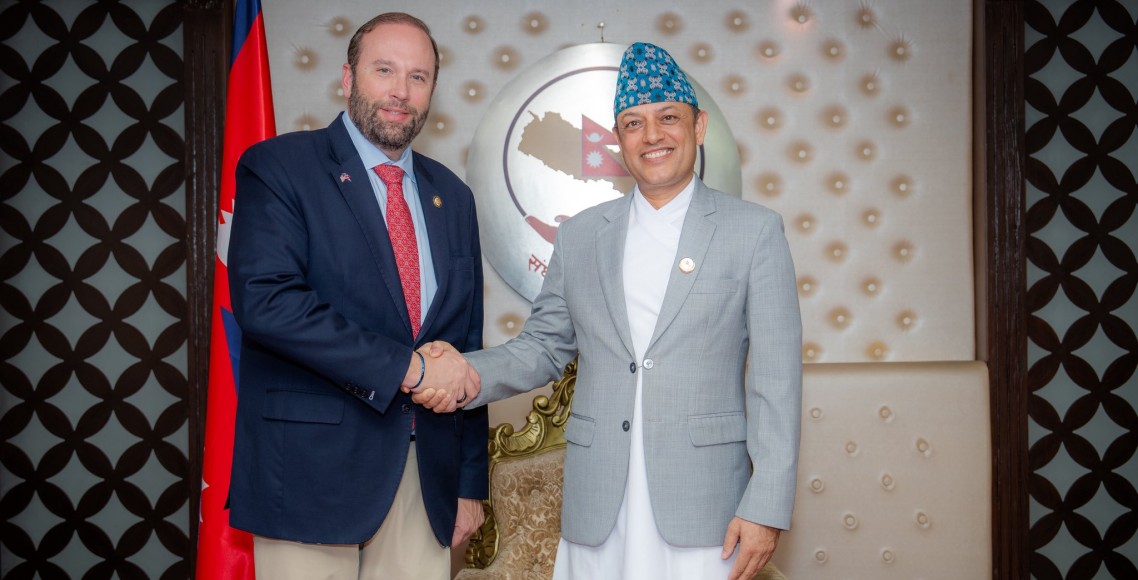
Kathmandu, October 27: A delegation of the US Congress met the Dalai Lama in Dharamshala, India, on Kartik 4. Immediately afterward, the team travelled to Bhutan on Kartik 5 to meet Prime Minister Tshering Tobgay. On Kartik 6, a 16-member delegation arrived in Kathmandu from Paro on a chartered Bhutan Airlines flight, call sign B37710.
The US delegation, which was visiting the Himalayan regions of South Asia, including Nepal, Bhutan and Himachal Pradesh in India, was led by Jason Smith, chairman of the House Ways and Means Committee. The team included committee members and staff, naval officers from the US Indo-Pacific Command, and representatives from various government agencies.
After a two-day visit to Nepal, the delegation departed for Mumbai at 6:30 pm on Kartik 8 on a chartered Shree Airlines flight, call sign SHA-4671.
Earlier, on Asoj 14, a delegation led by Brian Mast, chairman of the US House Foreign Affairs Committee, had travelled to Dharamshala to meet the Dalai Lama. The discussions focused primarily on protecting Tibetan identity and the question of the Dalai Lama’s succession.
Less than a month after the congressional delegation led by Mast held talks with the Dalai Lama, another US congressional team travelled through Dharamshala to Nepal.
Two US Delegations in Kathmandu at the Same Time
Two US delegations visited Nepal simultaneously.
The 16-member delegation that had met the Dalai Lama included US Congress members David Schweikert and his wife, Joyce Schweikert; Elise Stefanik; Laura Friedman; and William Ogles and his wife, Monica Ogles.
Meanwhile, a five-member delegation led by US Senator Todd Young arrived in Kathmandu on Kartik 5 on a Thai Airways flight via Bangkok. The delegation included Young’s office adviser, Gavin LaFoon; Senator John Pienaar of the Select Committee; and Major Anthony, a member of the military security team.
The delegation departed Kathmandu for Doha at 7 pm on Kartik 8 on Qatar Airways flight QR-645.
Young is a senator who has played a significant role in introducing and securing the passage of Tibet-related legislation in the US Congress.
The Message Behind the Visits
The visits were linked to India, Bhutan and Nepal in South Asia. The delegation led by Jason Smith met Indian Foreign Minister S. Jaishankar in Mumbai on Kartik 3. On Kartik 4, at 1 pm, it reached Dharamshala in Himachal Pradesh and held a one-hour meeting with the Dalai Lama.
Immediately afterward, the US congressional delegation travelled to Bhutan on Kartik 5 and held talks with Prime Minister Tshering Tobgay.
The repeated visits by US delegations to Himalayan countries, including Nepal, suggest that the selection of the Dalai Lama’s successor has emerged as a major agenda and that Washington’s interest in the matter is growing.
Analysts familiar with the issue say the timing of these visits, while the Assuring the Future of Tibet Act, 2026 is under consideration in the US Congress, points in that direction. The Act focuses on the selection of the 15th Dalai Lama following the death of the current Dalai Lama and on strengthening the Central Tibetan Administration (CTA), the Tibetan government-in-exile, to make it more effective in managing a potential leadership crisis within the Tibetan exile community.
The fact that the US delegation visited Bhutan and Nepal only after meeting the Dalai Lama also sends a message about the importance of these Himalayan countries in the process of selecting his successor.
Meanwhile, Todd Young, who led the second delegation, is a senator who has introduced Tibet-related legislation in the US Congress and consistently raised issues concerning Tibet. A Republican senator representing Indiana, Young is a prominent voice in the US Senate advocating for the rights of Tibetans, their right to self-determination and the preservation of Tibetan culture.
Young has repeatedly argued that the United States should consistently support the Tibetan people’s right to self-determination and religious freedom and press China to come to the negotiating table.
Young is also a principal sponsor of the Resolve Tibet Act, 2024, and the Assuring the Future of Tibet Act, 2026.
These laws recognise the Central Tibetan Administration (CTA), the Tibetan government-in-exile, as the legitimate representative of the Tibetan people. They also state that the exclusive authority to select the Dalai Lama’s successor rests with the Tibetan people and oppose Chinese interference in the process. Given Senator Young’s role in developing both pieces of legislation, the current US delegation’s visit appears to have been primarily focused on Tibet-related issues.
Furthermore, the Tibetan Policy and Support Act, 2020, emphasises the need to provide legal documents or refugee identity cards to approximately 4,000–5,000 young Tibetans living in Nepal. Children of Tibetan refugees born in Nepal since 1992 have not received identity cards. US legislation has framed this issue in terms of human rights.
According to a senior Nepal government official, the repeated visits by US senators to Nepal appear to be connected to the selection of the Dalai Lama’s successor and the provision of identity cards to young Tibetan refugees.
A Low-Profile Visit to Nepal
The Nepal government did not issue any official information about the US congressional delegation’s itinerary or meetings. The US Embassy in Nepal disclosed details of the visit only after the delegation departed on Kartik 8.
During its stay in Nepal, the delegation held a high-level meeting on Kartik 6 with Speaker of the House of Representatives Dol Prasad (DP) Aryal and members of the Parliamentary Committee on International Relations. Photographs of the meeting were made public.
The US Embassy stated on social media that the meeting discussed issues of shared interest, including Nepal-US bilateral relations, economic partnership and the management of natural disasters caused by climate change.
According to sources associated with the Ministry of Foreign Affairs, the delegation had sought meetings with Prime Minister Balendra Shah, Finance Minister Swarnim Wagle, Foreign Minister Shishir Khanal and Home Minister Sudan Gurung. However, the US Embassy publicly disclosed only the meeting with the Speaker.
On Saturday, the congressional delegation led by Jason Smith visited areas in the Kathmandu Valley where Tibetan refugee settlements are located, as well as historical and religious heritage sites. The team visited Swayambhunath, Jawalakhel and Boudhanath, which have Tibetan refugee communities. It also visited Patan Durbar Square.
Megan Boldin, Chargé d’Affaires a.i. at the US Embassy in Nepal, accompanied the delegation.
Meanwhile, details were made public of the other delegation, led by Young, visiting Chitwan National Park and the National Trust for Nature Conservation’s office in Khumaltar, Lalitpur, on Saturday.
(Reported by Chandralal Giri in Nepal Khabar)

Login to add a comment