







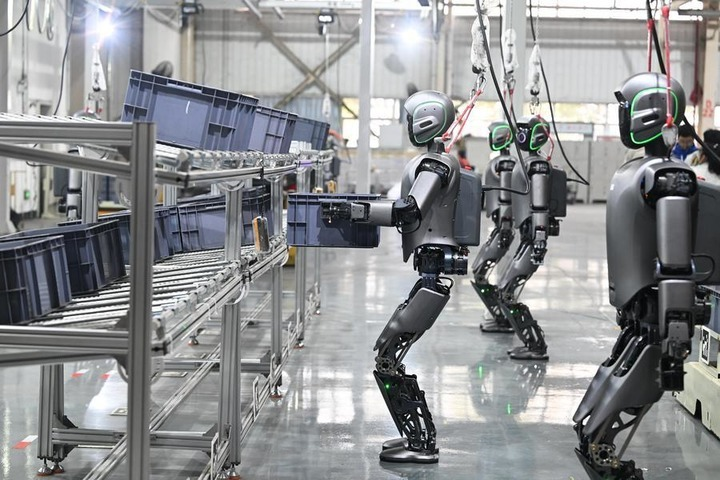
BEIJING, Sept. 30 (Xinhua) — China’s Ministry of Science and Technology said on Tuesday that the country is rapidly moving from being a participant and contributor in global science and technology to a pioneer and leader, emerging as one of the countries with the fastest-growing innovation capacity.
The message is clear: China is determined to achieve greater self-reliance and strength in science and technology, a national imperative firmly embedded in its modernization drive.
For decades, China’s growth was powered by low-value-added manufacturing, energy-intensive heavy industry and a booming property sector. That model has run its course. As the world’s largest manufacturing nation pivots toward high-quality development, it must foster new growth drivers through innovation.
Science and technology lie at the heart of that transition. The 15th Five-Year Plan, China’s development roadmap for 2026-2030, positions sci-tech self-reliance as a strategic underpinning, aimed at cultivating new quality productive forces — growth driven by innovation and rising productivity rather than by traditional inputs.
This shift is backed by hard numbers. In 2025, China’s total R&D spending exceeded 3.92 trillion yuan (about 584.5 billion U.S. dollars), accounting for 2.8 percent of GDP. The country now has the world’s largest cohort of science, technology, engineering and mathematics (STEM) graduates, a vast digital consumer market that fuels innovation, and leading positions in 5G, quantum communication and drones. In 2025, the added value of high-tech manufacturing above designated size grew by 9.4 percent, far outpacing overall GDP growth of 5 percent.
Behind these figures lies a deeper transformation. China is reshaping its industrial landscape — moving from isolated technological breakthroughs to coordinated progress across entire industrial chains, and from original innovation in key core technologies to large-scale application and industrial upgrading. It also aims to deliver tangible benefits for its people: better products and services, stronger agriculture, cleaner air and water, safer food, and healthier lives.
This drive is fueled by domestic economic needs, while remaining gaps in critical technologies underscore its urgency.
Despite remarkable progress, China still relies on imports for some of the most vital technologies. Advanced semiconductors, high-end manufacturing equipment and certain key materials remain vulnerable to external supply disruptions. Recent years of export controls and technology restrictions have made one lesson clear: core technologies must be developed through its own efforts.
This is why China is placing heavy emphasis on original innovation and breakthroughs in frontier fields such as artificial intelligence (AI), quantum technology, 6G and ultra-large-scale intelligent computing clusters. It is also prioritizing the localization of semiconductors and key materials, aiming to raise yields and capacity in advanced processes.
Yet China’s sci-tech drive is often misread as both threatening and inward-looking. In reality, the country continues to create new opportunities for global development.
It expands the global supply of innovation. China’s open-source AI models are increasingly adopted by developers, alongside U.S. models, while its advances in batteries and clean energy have made it indispensable in the global climate effort. Deeply embedded in global supply chains and capital markets, its tech-driven growth also serves as an anchor in a world facing fragmentation: expanding high-tech manufacturing creates demand for components, materials and services worldwide.
It widens the global frontiers of knowledge. China’s achievements in quantum computing, AI and space science are expanding humanity’s shared scientific base. A development plan recently released by the Chinese Academy of Sciences also pledges to step up AI-enabled scientific research — a move that could accelerate discovery and benefit the world.
It embraces shared progress. China’s development brings opportunities, not threats. It has established sci-tech cooperation with more than 160 countries and regions, and will continue to pursue an open, inclusive and mutually beneficial approach.
A more innovative China, deeply woven into the global technology ecosystem, is not a zero-sum challenge but a shared opportunity. China’s technological innovation will not only shape its own growth trajectory, but also influence the global economy for decades to come.

Login to add a comment