







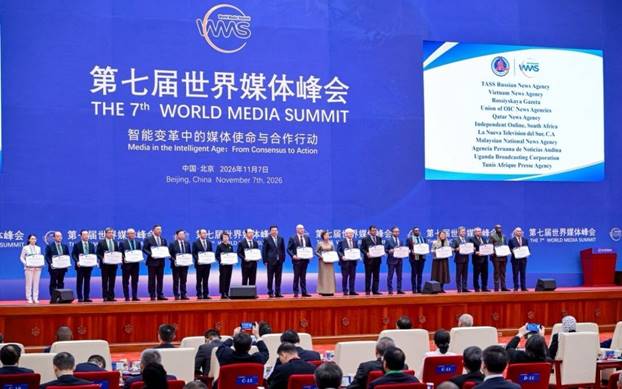
The adoption of the Beijing Consensus by nearly five hundred delegates from one hundred and twelve nations marks a consequential structural inflection in the global governance of media technologies.
By P.R. Pradhan, lately in Beijing
Nearly 500 delegates representing 330 media organizations and institutions across 112 countries and regions adopted the Beijing Consensus at the seventh World Media Summit held from November 5 to 9, 2026, in Beijing. The non-binding framework and an accompanying initiative led by Xinhua News Agency aim to establish global technical and ethical standards for artificial intelligence in journalism over the next two years. The agreement specifically focuses on bridging the digital divide facing the Global South while addressing risks related to automated misinformation, algorithmic bias, and content authenticity.
While political declarations emanating from large multilateral gatherings are frequently discounted as rhetorical posturing devoid of binding enforcement, this development matters substantially more than conventional commentary suggests. Rather than serving merely as a public diplomacy platform, the summit signals an organized institutional effort across the Global South to contest the unilateral imposition of technical, normative, and economic standards governing generative artificial intelligence in the information space. As foundation models and algorithmic distribution architectures become the core infrastructure of public knowledge, news organizations outside the North Atlantic sphere are attempting to establish a coordinated counterweight against technological dependency, uncompensated data extraction, and linguistic marginalization.
This dynamic is not unprecedented; it reflects deep historical continuities in the struggle over global communications architecture. Four decades ago, the debate over the New World Information and Communication Order and the 1980 MacBride Report exposed deep structural inequities in international news flows, where a handful of Western wire services controlled the narratives received by developing populations. The current technological paradigm rhymes closely with that era, yet accelerates the stakes. Where twentieth-century dependency centered on physical broadcast transmitters, submarine cables, and news agencies, today’s dependency resides in closed algorithmic training pipelines, specialized semiconductor compute clusters, and proprietary foundation models trained disproportionately on Anglophone datasets. Just as post-colonial states previously recognized that information sovereignty required domestic transmission capacity, contemporary developing nations increasingly perceive generative media tools as infrastructural assets that cannot be left entirely to the market imperatives of Silicon Valley platform monopolies.
Within the broader artificial intelligence landscape, the Beijing summit interfaces directly with a fracturing international regulatory environment. Over the past eighteen months, global governance has fragmented into distinct operational models, from the prescriptive risk tiers of the European Union’s AI Act to the bilateral licensing agreements negotiated between commercial labs like OpenAI and dominant Western publishing houses such as Axel Springer and the Financial Times. Concurrently, the United Nations General Assembly’s adoption of the Global Digital Compact and the work of the UN Secretary-General’s High-Level Advisory Body on Artificial Intelligence have underscored a growing international demand for equitable access to digital technologies. The initiative launched in Beijing, which pairs a high-level political declaration with a two-year technical standards roadmap under the leadership of news agencies from China, Vietnam, Russia, Malaysia, and South Africa, directly enters this contested terrain by attempting to formalize verification, copyright, and ethical benchmarks tailored to public-sector and Global South media operating outside proprietary Western licensing frameworks.
Fairly examining the core perspectives reveals legitimate competing imperatives across the international media ecosystem. Proponents of the Beijing Consensus argue that market-driven self-regulation has failed to protect publishers from intellectual property piracy, deepfake disruption, or algorithmic erasure, making state-coordinated multilateral frameworks essential to establishing equitable bargaining power for smaller media outlets. Conversely, critics, including several Western press freedom watchdogs and commercial publishers, contend that state-backed media initiatives risk elevating bureaucratic oversight over independent investigative reporting and may normalize content verification mechanisms that authoritarian regimes could deploy for narrative control. Independent technical experts occupy a pragmatic middle ground, acknowledging that while non-binding communiques lack regulatory enforcement, standardizing synthetic media provenance, metadata watermarking, and model attribution protocols is technically urgent and impossible to achieve without including non-Western publishers who collectively reach the majority of the planet’s population.
Mapping the stakeholders exposes a stark distribution of benefits and burdens. Direct beneficiaries include regional and state-supported news agencies across Africa, Asia, and Latin America, which gain institutional legitimacy, shared technical verification protocols, and collective leverage against international digital platforms. Conversely, the principal costs and operational frictions fall upon smaller independent newsrooms, regional investigative units, and underfunded community broadcasters that lack the capital, technical personnel, and engineering infrastructure to integrate complex synthetic content detection tools or establish rigorous automated verification pipelines. While multinational technology conglomerates face potential friction from competing regional standards, ordinary consumers and civic institutions in developing societies risk being caught between uncurated algorithmic disinformation generated by low-cost tools and centralized verification bodies whose algorithmic classifiers may reflect geopolitical or institutional biases.
Mainstream commentary often overlooks a critical technical reality: the profound asymmetric cost structure between automated synthetic content generation and technical verification. Generating highly convincing, localized synthetic text, audio, and video in low-resource environments requires negligible computational expense, often running on commoditized open-source models with minimal infrastructure. In contrast, verifying digital media through forensic provenance, cryptographic watermarks, and multi-source cross-referencing demands substantial ongoing computational resources, specialized technical talent, and access to authoritative training databases. Without institutional financing mechanisms or open-access verification infrastructure, voluntary ethical charters place an untenable compliance burden on fragile news organizations. Furthermore, standardizing media verification protocols without harmonizing technical interoperability risks creating parallel, non-communicative information spheres where digital authenticity is validated exclusively through proprietary or regionally segregated cryptographic registries.
For developing countries, small linguistic communities, and emerging technological ecosystems, the stakes of this governance debate are existential. Indigenous languages across sub-Saharan Africa, Southeast Asia, and the Andes remain severely under-represented in foundation model pre-training corpora, resulting in algorithmic hallucinations, translation degradation, and cultural stereotyping when Western models are deployed locally. During high-stakes electoral cycles in low-income nations, the weaponization of audio deepfakes targeting under-resourced languages often outpaces both local fact-checking capacities and the moderation priorities of multinational platforms. Establishing shared data repositories, prioritizing localized dataset curation, and demanding equitable intellectual property compensation for training on Global South cultural assets represent critical steps toward technological self-determination, transforming developing newsrooms from passive data sources into active architects of localized artificial intelligence tools.
Moving forward, several observable milestones over the next two years will reveal whether the Beijing Consensus can transcend symbolic diplomacy. Within the next three to six months, observers should look for the formal publication of the technical working group structure and the initial criteria for the planned global database of newsroom AI applications, particularly whether it accommodates open-source frameworks accessible to non-state publishers. Over the subsequent six to twelve months, participating institutions must deliver measurable operational outputs, such as pilot deployments of unified synthetic media watermarking and content attribution standards across participating newsrooms in diverse jurisdictions like Malaysia, Vietnam, and South Africa. Over the twelve to twenty-four month horizon, the ultimate test will be whether these proposed technical benchmarks gain institutional recognition within standard-setting bodies like the International Organization for Standardization and the International Telecommunication Union, or whether they remain isolated within a geopolitical bloc.
Ultimately, the Beijing Consensus demonstrates that the debate over artificial intelligence in communications has irrevocably shifted from speculative philosophical ethics to practical geopolitical and industrial negotiations. Ethical guidelines alone cannot bridge profound disparities in computing access, linguistic representation, or capital allocation, nor can political declarations substitute for autonomous technological capacity. However, by establishing a formal multilateral coalition aimed at codifying technical benchmarks for information authenticity and economic protection, the summit reflects a decisive refusal by Global South media institutions to accept a digital future designed entirely by foreign commercial monopolies. The enduring measure of this initiative will not be the breadth of its diplomatic signatures, but its concrete ability to provide vulnerable newsrooms, under-resourced languages, and developing nations with the technical and economic sovereignty required to survive in an automated information ecosystem.

Login to add a comment