







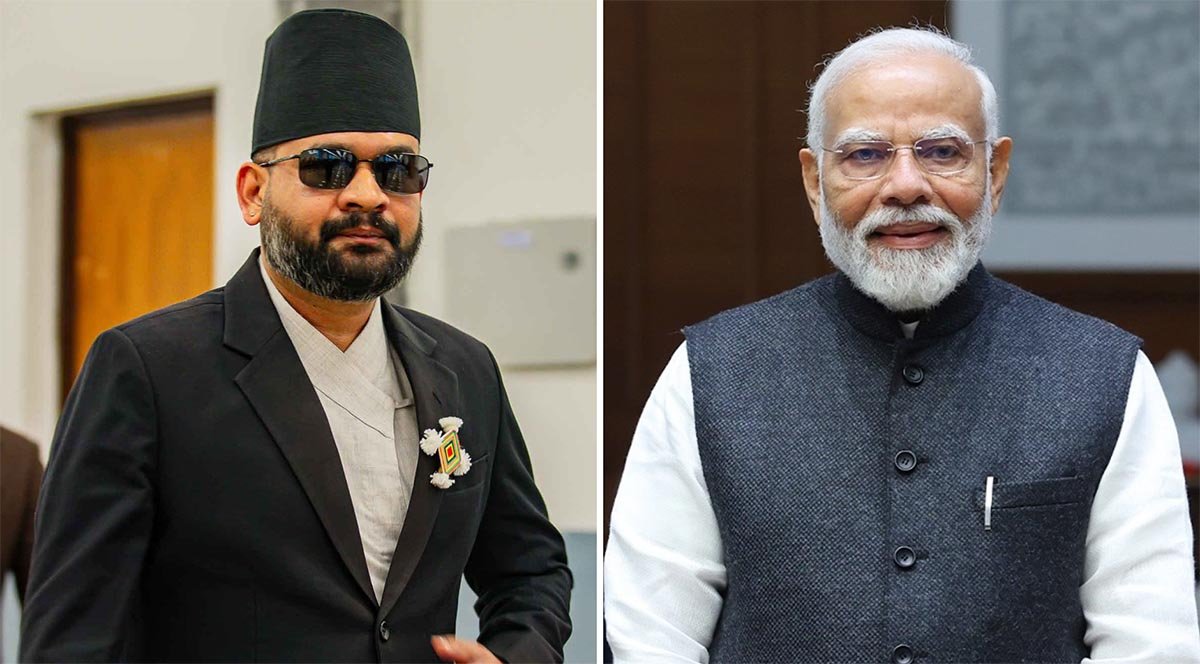
Kathmandu, Nov 18: The Ministry of Industry, Commerce and Supplies has proposed a series of strategic economic agendas for Prime Minister Balendra (Balen) Shah’s upcoming visit to India, including petroleum and LPG pipeline expansion, the groundbreaking of the Dodhara Chandani dry port, and the inauguration of the Bhairahawa Integrated Check Post (ICP).
The ministry has also proposed discussions on removing non-tariff barriers affecting Nepali exports to India.
Ministry spokesperson Jitendra Bahadur Basnet said the ministry had submitted its priorities and key concerns to the Ministry of Foreign Affairs. However, the final agenda will be decided by the Foreign Ministry, and the ministry has yet to receive confirmation of which proposals have been selected.
The groundbreaking of the Dodhara Chandani dry port in Kanchanpur has been proposed as a major agenda item. The facility will be built on approximately 42.36 hectares of land in Gaurishankar Community Forest in Dodhara Chandani Municipality-1, with financial and technical assistance from India.
Under a memorandum of understanding signed by Nepal and India on June 1, 2023, India has agreed to undertake the construction of the infrastructure.
The project is viewed as a strategically important trade gateway connecting Nepal, India and China. Its proximity to major Indian industrial centres, including Delhi, Punjab and Haryana, as well as western seaports such as Mundra and Mumbai’s Jawaharlal Nehru Port, is expected to reduce Nepal’s transit costs and transportation time.
Nepal has already completed a four-lane bridge over the Mahakali River and a six-lane access road. India is also accelerating road construction towards the border. The government hopes the two prime ministers will jointly lay the foundation stone during the visit.
Push for LPG pipeline
Securing long-term supplies of petroleum products and cooking gas is another priority.
A recent high-level discussion at the National Planning Commission concluded that pipelines were the most effective alternative to transporting LPG in bullet tankers. Experts warned that even a one-day disruption of road transport could trigger a nationwide shortage.
Nepali businesses currently depend entirely on Indian LPG tankers, resulting in more than Rs 6 billion in annual transportation payments to India.
The ministry has prioritised the proposed Motihari-Sarlahi LPG pipeline and storage facilities. According to a detailed engineering survey by Indian Oil Corporation (IOC), the project is estimated to cost around Rs 15 billion. Nepal Oil Corporation plans to seek grant assistance from IOC.
The project could be completed within two years of a bilateral agreement. Nepal Oil Corporation has 14 bighas of land in Sarlahi for the facility, where three storage tanks with a combined capacity of 15,000 metric tonnes are planned. The terminal will also be equipped to load and unload eight tankers simultaneously.
Expansion of the existing Motihari-Amlekhgunj petroleum pipeline to its second phase and further extension to Chitwan are also on the proposed agenda.
Bhairahawa ICP and export barriers
The ministry has proposed the formal inauguration and full operation of the completed Bhairahawa ICP to modernise cross-border trade and streamline import and export procedures in Rupandehi and the wider Lumbini corridor.
Removing non-tariff barriers to Nepali exports is another priority. Nepali cement, plywood, footwear and agricultural products have faced delays at the Indian border due to problems obtaining Bureau of Indian Standards (BIS) certification.
The ministry has asked the Foreign Ministry to raise the issue with India and seek a lasting solution to the procedural obstacles faced by Nepali exporters.
People’s News Monitoring Service

Login to add a comment