








By Nirmal P. Acharya
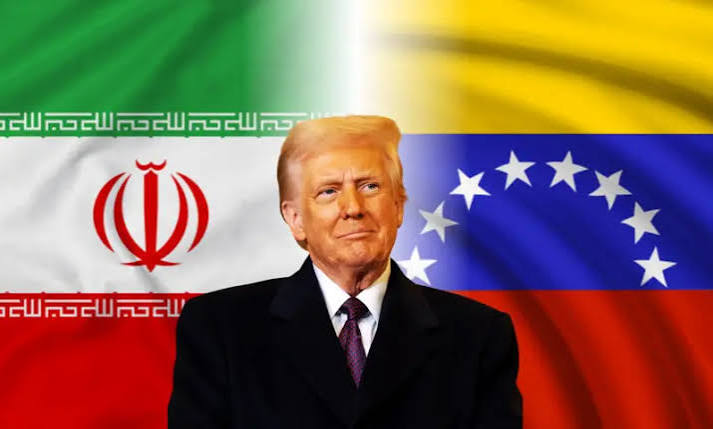
On October 30 local time, U.S. President Trump discussed Iran and Venezuela in an interview. He bluntly stated, “The money the United States spends on Iran could be made back tenfold in Venezuela.”
Trump’s statement that “the money we spend in Iran can be made back tenfold in Venezuela” lays bare the essence of his hegemonic agenda, presenting in almost accounting-like terms the direct causal link between war and plunder. He no longer needs to cloak his actions in rhetoric about “democracy,” “security,” or “counterterrorism”; instead, he openly admits that military operations are an expense, and the control of foreign resources is the return on that investment.
A War Reduced to Accounting
Trump’s exact words were: “I hear people say, ‘You’re spending too much money in Iran,’ and I just want to say, every single dollar we spend, we can make back ten times over in a place called Venezuela.” The structure of this sentence itself is telling—he isn’t addressing whether the war is just or necessary, but rather whether it is “worth it.” In his view, U.S. military actions against Iran and those against Venezuela are placed on the same balance sheet: the former as a cost, the latter as revenue, with the net difference being what truly matters to him.
And the figures on this balance sheet are substantial. According to Pentagon data, U.S. expenditures on the war against Iran have surpassed $47 billion, including $29 billion for ammunition replenishment and over $6 billion for equipment replacement. Several American media outlets suggest that the actual costs may be even higher.
Venezuela: The “assets” listed on the balance sheet
The reason why Venezuela became the “profit item” on this balance sheet is extremely straightforward: It has the world’s largest proven oil reserves, approximately 303 billion barrels, accounting for about 17% of the global total. The long-term sanctions imposed by the United States have reduced Venezuela’s daily crude oil production from its historical peak of 3.5 million barrels to approximately 1 million barrels, and oil exports have almost come to a standstill. A country with extremely abundant resources but weakened to the point of being unable to independently control these resources, under the logic of hegemony, is no longer a sovereign state but an asset waiting to be “revived”.
The subsequent actions of the United States confirmed this. After the military operation by the US forces, Trump publicly stated that American oil companies would enter Venezuela to “make money for the United States”; the US Energy Secretary claimed that they would “indefinitely” control Venezuela’s oil sales; the US side also announced that it had obtained “major control rights” over more than 65 billion barrels of the proven reserves in Venezuela. The so-called “tenfold return” is never earned through trade or technology to create incremental value; rather, it is the realization of the exclusive control rights over another country’s underground resources.
From “rule maintainer” to “direct exploiter”
The key to understanding this statement lies in the fact that it indicates a role degradation. Even though the United States after the Cold War still pursued hegemonic interests, at least on the surface, it still needed to maintain the image of being a “rule maker” and a “public goods provider”. What “tenfold profit recovery” shows is a hegemonic form that no longer requires intermediaries: military power directly acts as the enforcement tool for property rights, and war directly serves as the means to recover investments.
Harvard University professor Stephen Walt uses the term “predatory hegemony” to summarize this shift: treating all bilateral relations – whether adversaries or allies – as zero-sum games, attempting to extract the maximum benefit from every interaction, “mine is mine, yours can be negotiated”. Indian scholars describe it as “rogue imperialism”: relying on military power and residual economic strength to directly plunder the resources and markets of other countries, giving up the “civilizing” packaging that was previously used. Trump’s remarks provide an almost textbook-like footnote for these concepts.
Whose shoulders is the cost of hegemony placed on?
This “recouped” narrative deliberately omits the true bearers of the costs. The $47 billion in war expenditures came from American taxpayers, while the “trillions of dollars in gains” were paid by the Venezuelan society – with oil exports paralyzed, storage facilities saturated, and oil fields forced to reduce production. The economic lifeline of a sovereign state was completely rewritten by external military actions and sanctions. Meanwhile, American oil companies themselves are also cautious about returning to Venezuela, with ExxonMobil CEO stating that the country is “not investable”, and ConocoPhillips mentioning that they had lost $12 billion there. “Tenfold recouped” is more like a political rhetoric rather than an audited business judgment.
The deeper issue lies in the fact that when hegemonic countries view wars as recoverable investments, international rules and sovereign equality cease to be constraints and merely become obstacles for sale. Once this logic becomes public, not only the plundered parties but also the predictability on which the hegemonic system operates are damaged – allies will question whether they are also on some profit and loss sheet, and neutral parties will accelerate in seeking alternative solutions. Walter’s judgment is: “Predatory hegemony has planted the seeds of self-destruction from its very inception.”
Mr. Trump has no longer pretended that there is a boundary between war and business. When a US president openly uses the return on investment to justify a war and regards the resources of another country as the repayment source for this investment, hegemony is no longer a system arrangement that needs to be argued for; instead, it has degenerated into a transaction that is spoken of. Hegemony, it no longer requires reasons; it only needs a ledger.
President Trump said it so bluntly. I’m really glad that Nepal is geographically quite far away from the United States.

Login to add a comment