








By Our Reporter
War and elections are often treated as separate political phenomena, but history demonstrates that the two are closely interconnected. War changes the political mood of a country, influences public priorities, strengthens the authority of governments in some circumstances and weakens it in others. Elections, meanwhile, provide an opportunity for citizens to endorse, reject or modify the policies pursued during a conflict.
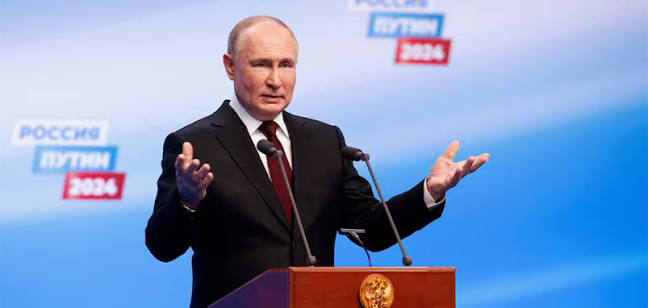
The recent parliamentary election in Russia provides a significant example. At a time when Russia remains engaged in its war against Ukraine, President Vladimir Putin’s ruling United Russia party secured a decisive victory in the September 2026 parliamentary election. With more than 95 percent of ballots counted, United Russia had won 57.83 percent of the vote and was projected to hold 355 of the 450 seats in the State Duma, compared with 49.8 percent in the 2021 election. Putin had presented the election as a test of public support for his government’s policies during the war.
The result can therefore be viewed as evidence of continued electoral support for Putin’s government and its policies. The Russian result demonstrates an important political reality: war does not automatically destroy the electoral strength of a government. When a population perceives an external threat, questions of national security, sovereignty and national identity can become more important in determining political choices. A government may attempt to portray itself as the defender of the nation against an external adversary, while opposition forces may face greater difficulty in presenting an alternative during wartime.
The situation in Ukraine presents almost the opposite problem. Ukraine has not held national elections during the full-scale war, and the question of when elections can constitutionally and practically be held has become a major political issue. President Volodymyr Zelenskyy’s presidential term was due to expire in 2024, but elections could not be conducted under the country’s continuing martial-law regime. Ukraine’s Constitution provides that parliamentary authority continues until the first meeting of a newly elected parliament following the cancellation of martial law or a state of emergency. A parliamentary working group reported in May 2026 that there was consensus that elections could not be held under martial law and was examining the legal and practical arrangements for elections during the post-war period.
Thus, describing Ukraine’s election postponement simply as an unconstitutional attempt by Zelenskyy to remain in power does not capture the legal circumstances. At the same time, the continuation of political authority without a normal electoral contest inevitably raises questions about democratic accountability. The longer a war continues, the more difficult it becomes to maintain the ordinary rhythm of democratic politics. Millions of Ukrainians have been displaced, large areas have been affected by military operations, and the security conditions required for a nationwide election remain extremely difficult.
This leads to a broader question: Can a democracy maintain normal electoral procedures during an extraordinary war? The answer depends not only on constitutional provisions but also on security, the ability of citizens to vote freely, the status of displaced populations, the integrity of electoral administration and the existence of genuine political competition.
The Israeli experience offers another important contrast. Prime Minister Benjamin Netanyahu is not simply avoiding an election. Israel’s governing coalition agreed in July 2026 to dissolve the Knesset and hold a general election on October 27, 2026. The election is expected to be an important test of Netanyahu’s political position amid continuing divisions over military policy and exemptions from military service for ultra-Orthodox Jews.
The Israeli case demonstrates that even during periods of military conflict, political systems can continue to use elections as a mechanism for determining public support. But elections can also become deeply intertwined with security questions. Voters may judge a government on its conduct of war, its handling of national security, the release of hostages, economic conditions and its approach to negotiations and regional diplomacy. Consequently, war can become not merely a foreign-policy issue but the central issue around which an entire election is organised.
The United States provides yet another example of the relationship between electoral politics and economic promises. The country is preparing for the 2026 midterm elections, in which control of Congress will be contested. President Donald Trump told the Republican midterm convention in September that every adult American would receive a $5,000 “dividend” if Republicans won both the House of Representatives and the Senate. He suggested that tariff revenues would finance the payment.
The episode illustrates another feature of democratic politics: governments and political parties frequently connect economic benefits to electoral choices. In wartime or periods of international tension, the same principle can be applied to national security, defence spending, sanctions, energy policy and foreign relations.
The Russian election is therefore significant, whereas, the Ukrainian situation demonstrates the constitutional and practical difficulties of holding elections during an ongoing war. Israel demonstrates that elections can remain a functioning mechanism of political accountability during prolonged security crises. The United States shows how economic promises can become part of electoral competition even amid major international conflicts.

Login to add a comment