








Kathmandu, September 19: If a tall, bearded, turbaned man is seen in Kathmandu, a hill-origin Nepali might assume he is an Indian “Sardar.” But there are Nepali-speaking Sikhs in Nepal. Ravi Singh is one of them. Born in Dharmapath, Kathmandu, Ravi was born into the Sikh faith and grew up in Kathmandu’s Newar neighbourhoods and settlements.
A permanent resident of Kathmandu, Ravi is currently the Chief Executive Officer of the Gurdwara in Kupandole and is also involved in the handicraft and textile business.
The story of the Sikh community is not simply a story of migration. The Sikh presence in Nepal is linked to Guru Nanak Dev’s visit to Nepal some 500 years ago. Today, however, the Sikh community in Kathmandu has dwindled to just 22 households.
“There are only 22 Sikh households in Nepal at present,” Ravi says. “The children went abroad. Once an entire generation left, the Sikh population in Nepal continued to decline.”
Asked why the Sikh community became so small in Nepal, Ravi points to three factors: history, administration and migration.
According to Ravi, one important reason for the decline of the Sikh community was the problem of citizenship.
During the reign of King Mahendra, when citizenship certificates were being issued, photographs had to be taken showing both ears. The turban is an integral part of Sikh identity, and removing it to have a photograph taken was not easy for many Sikhs.
“A Sardar has to wear a turban. It was difficult to take a photograph showing both ears,” Ravi recalls. “As a result, they could not obtain citizenship. Without citizenship, it was difficult to establish themselves here.”
Citizenship was not merely a piece of paper. It was connected to education, business, property and the future.
“One of the main reasons many Sikhs migrated from Nepal was the citizenship issue,” he says.
The problem is not as serious today as it was in the past. But the impact of an entire generation being prevented from establishing itself in Nepal can still be felt.
Another major centre of the Sikh community in Nepal is Birgunj. According to Ravi, around 50 Sikh households live there.
Guru Nanak and the Sikh Connection with Nepal
The question of how Sikhs first came to Nepal is closely associated with Guru Nanak Dev, who stands at the centre of the Sikh faith. Ravi says Sikhism spread in Nepal following Guru Nanak’s visit to the country.
“In the Kathmandu Valley, traditions of monasteries and Akharas associated with Nanak can be found around Gyaneshwar, Balaju, Shobha Bhagwati, Kalmochan and the Pashupati area,” he says. “It is also said that the Nanak Math located at the site of Bhasmeshwar Mahadev in the Pashupati area houses the Guru Granth Sahib.”
Did Guru Nanak really come to Nepal about 500 years ago?
Sikh traditions and some books mention Guru Nanak Dev’s visit to Nepal, and Ravi accepts this account.
“There is a historical account that Guru Nanak came to Nepal during the reign of the Malla kings,” he says.
According to him, Surinder Singh Kohli’s Travels of Guru Nanak, published in 1969, contains detailed claims about Guru Nanak’s visit to Nepal.
The Indian Embassy in Nepal also mentioned Guru Nanak’s visit to Nepal in Sikh Heritage of Nepal, published in 2019. Ravi also points to land provided by the then government as evidence of Nanak’s connection with Nepal.
Similarly, he says there was 34 ropanis of land in Mhepi, Balaju, but the property has gradually been encroached upon due to political upheavals.
“We are still trying to reclaim the Mhepi land, but the government does not listen to us,” he says. “We could build a gurdwara there in the name of Guru Nanak and contribute to tourism promotion.”
According to Ravi, even the signboard marking the Mhepi property was thrown away, forcing the community to operate the langar by the roadside.
Ravi says his father was able to settle in Nepal because of the country’s environment and social harmony.
“He stayed here because of the environment and the behaviour of the decent and helpful people here,” he says.
The name of Nanak and traces of Sikh tradition can be found at some of Kathmandu’s old religious sites. Ravi therefore believes Nepal can teach and promote Sikh history and culture and attract Sikh tourists.
According to him, another interesting aspect connecting Nepal with Sikh history is the Pashupati area. The presence of Nanak Maths and Akharas reflects an old connection between Sikh traditions and Kathmandu’s religious geography.
That is why Ravi says, “This is a country run by Pashupatinath.”
Nepal as a Shared Home
Although Sikhs follow their own religion, they regard Nepal as their common home.
“I travel abroad as well. I also go to India. I stay for two or four weeks, or even a month, but I become eager to return to Nepal. I cannot find peace anywhere else as I do here,” he says.
The langar is a well-known feature of Sikhism. Sikhs believe that feeding others brings spiritual satisfaction, and food is served every Saturday at the gurdwara in Kupandole.
Even though there are only 22 Sikh households in Kathmandu, the community continues to operate the langar through good times and bad.
“We do not ask the religion of anyone who comes to eat,” he says. “It is perhaps the simplest yet deepest symbol of the Sikh community’s relationship with Nepal—for those who serve, Nepal is also like a shared langar.”
At the langar, nobody asks who has come, what religion they follow, what caste they belong to, or whether they are rich or poor. The food is for everyone.
“The Sikh langar is famous,” Ravi says. “We believe that service itself is religion.”
For him, this is not merely a religious tradition but a way of life.
Whenever earthquakes, pandemics or other disasters occur in Nepal, the Sikh community has operated langars. It has also provided food and other material assistance wherever needed.
Why do they come forward during disasters?
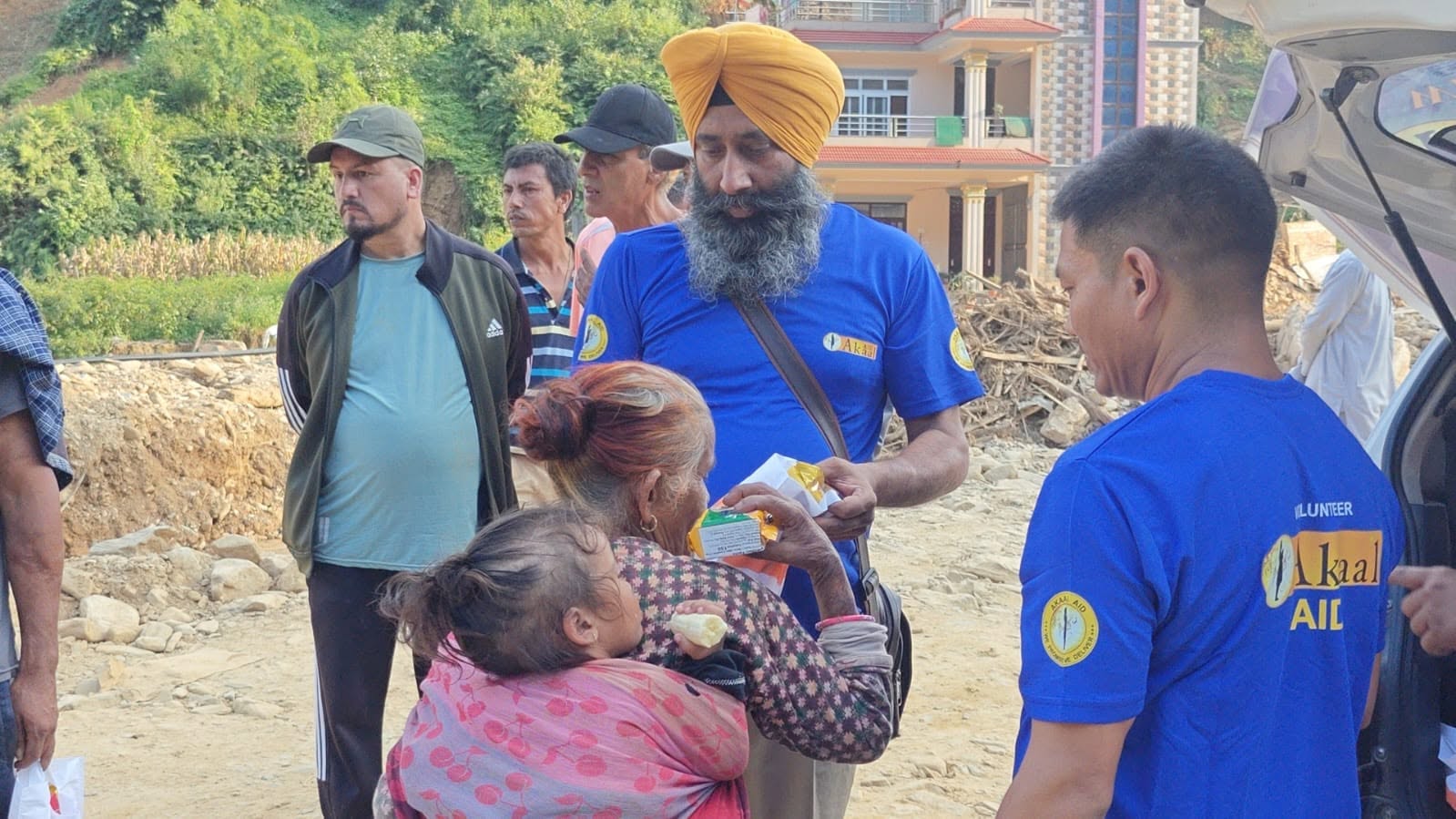
Ravi’s answer is simple: reaching out to someone when they are in difficulty is service.
Thousands of people have been rendered homeless by the recent Bhotekoshi floods in Rasuwa, while many have lost family members. Ravi says Sikhs have also operated langars in response to the disaster.
The turban, beard and lifestyle of Sikh men make them visibly distinct in Nepali society. But beneath that outward identity lies a strong value system—service.
Concerns About Nepal’s Development Model
Ravi does not want to remain silent about such disasters by simply considering them natural events. His concerns are also linked to Nepal’s development model.
“How were 14 hydropower projects allowed in a single area?” he asks.
Ravi’s concerns extend beyond the Sikh community.
He also complains about the state of development and infrastructure in Nepal.
“For 40 years, the situation at Krishnabhir has remained the same. It still has not been properly developed,” he says.
From Krishnabhir to Bhotekoshi, his question appears to be the same: Why has development failed to progress at a pace that makes people’s lives safer?
Hydropower projects are being built. Roads are being constructed. Cities are expanding. But if those very development structures become sources of risk when disasters strike, how should development be assessed?
He worries that if development projects continue to be added without considering the relationship between rivers, mountains and settlements, disaster risks could increase further.
For him, a flood does not wash away only houses, roads or bridges. It also shakes people psychologically.
“There are many social and psychological impacts from the current disaster as well,” he says.
Therefore, relief is not merely about rice and water. It is also about giving people confidence that they can return to normal life.
Ravi says the Sikh community has continued to provide whatever assistance it can during disasters. But he also has an expectation from the state.
“We want to help in many more ways,” he says. “We also want the government to have a soft corner [for us].”
By “soft corner,” he does not mean special privileges. Rather, he is asking the state to understand the identity, needs and contributions of minority communities.
Sikhs and Nepal’s Development
As Nepal’s road network expanded, many Sikhs from Punjab became involved as skilled manpower in driving, mechanics, transportation and construction.
“The partition of India and Pakistan is one reason why Sardars came to be seen in many different fields,” he says.
According to Ravi, when India and Pakistan were partitioned, many Sikhs became homeless. They made jokes about themselves as a way of coping with life. Some became truck drivers to travel and earn a living, while others turned to agriculture.
“Today, Sardars are scattered across the world,” he says. “No job is considered small or big. In India, a large number of Sikhs are in the army. They are involved in the defence of the country. They have worked in everything from offices to farming. In this way, they became traders, entered industry, ran hotels and became involved in export businesses.”
Ravi, too, is a representative of that journey.
(Courtesy: Deshsanchar)

Login to add a comment