








By Nirmal P. Acharya
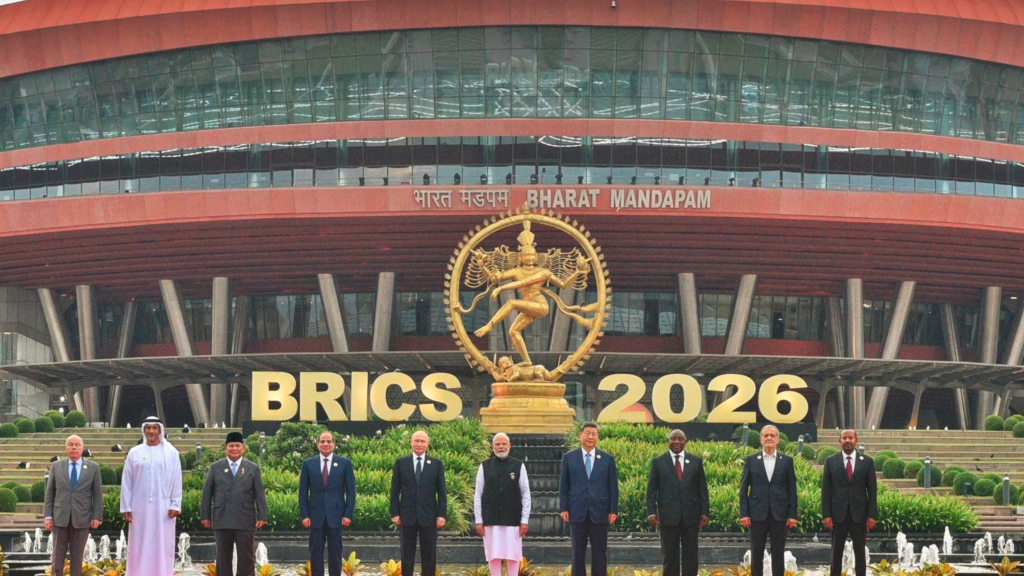
New Delhi, September 13 morning—The 18th BRICS summit was held.
Among the BRICS nations, China is the most powerful. The Chinese President Xi Jing-ping pointed out that the world is undergoing accelerated changes in its century-long transformation, with the collective rise of the Global South emerging as a key driver of global multipolarity. At the same time, the international landscape is marked by intertwined chaos and instability, with various risks and challenges arising one after another. To stabilize and improve the world, BRICS countries must seize the initiative in history, unite the broader group of Global South nations, and play a positive, stable, and constructive role in international affairs to advance the common well-being of humanity.
Interpreting the above passage, we can grasp this meaning: the West is in decline.
Yes, the West is in decline, manifesting across several dimensions:
1. The collapse of hegemonic foundations and entry into a period of chaos: The U.S.-led hegemonic order is declining, and the world is entering a prolonged “period of chaos” similar to that between 1914 and 1949. A key indicator is the continuous rise in global military conflicts since hitting a low point in 2010, reaching 65 by 2025—demonstrating America’s inability to maintain global stability under its leadership.
2. Economic imbalance and the risk of “South Africanization”: The United States is relatively weakening due to internal inequality, debt burdens, and industrial hollowing. Meanwhile, Europe and Japan face erosion of their manufacturing bases and lagging digital economies. Without addressing deep-seated structural issues, both regions risk falling into a “South Africanization” type of economic decline.
3. Decoupling and the emergence of parallel systems: The decoupling between China and the U.S. in technology, trade, and other areas is accelerating, fragmenting the once-unified global market into two parallel and competitive systems—a process expected to continue until around 2035.
4. Erosion of social consensus and soft power: Internal social cohesion in the West is deteriorating, shifting from multiculturalism toward extreme “woke culture,” which has intensified societal division and polarization—forming an internal, intangible driver of Western decline.
The indicators for measuring the decline of the West can be based on a series of quantifiable metrics and historical analogies:
1. “Globalization Index”: A composite index that includes the proportion of global trade in GDP, the proportion of FDI in the total assets of the Federal Reserve, and the proportion of outstanding international bonds in the total assets of the Federal Reserve. This index reveals that globalization has been on a downward trend since its peak in 2008 and has been in a rapid downward cycle for more than 15 years.
2. Data on the power balance between the East and the West: By comparing the power of the G7 and the “BRICS+” bloc, a basic conclusion of “East rising and West declining” can be drawn. The industrial sectors in Europe and Japan are being eroded, and they are completely lagging behind in the fields of digital economy and AI. Although the United States still leads, it is no longer able to monopolize and is facing comprehensive competition from China.
3. Historical cycle analogy: The current de-globalization can be compared with the period of the decline of the British Empire (1914-1949). The old hegemon (the United States) is in decline and gradually withdrawing from Europe and the Middle East, and the chaotic period it has triggered may last longer.
In summary, based on quantifiable globalization indicators, power comparison data, and historical cycle analogies, it can be seen that this is not a short-term fluctuation, but rather a long-term process of the world system transitioning from a unipolar center to a parallel dual system.
All over the world, including Nepal, the wealthy elites and most of the political elites are not willing to witness the decline of the West. However, the West is indeed in decline.

Login to add a comment