







By Rabi Raj Thapa

Since the prospect of joining foreign forces has waned, Nepali youths have started creating their own uniformed outfits and labelling them as armies with different names. Among the new camouflaged outfits, Green Army Nepal has surprised Nepali people almost as much as the devastating flash floods in Rasuwa, Nuwakot and adjoining districts.
Seriously speaking, establishing an army of whatever colour is neither a joke nor child’s play. Nepal has already seen too much bloodshed and mayhem from the Red Army, called the Communist Party of Nepal (Maoist), led by Chairman Pushpa Kamal Dahal, “Prachanda,” which pushed the country into conflict and disrupted peace, development and harmony from 1996 onwards—a legacy that continues to affect the country even today.
What makes Nepali people so infatuated with uniforms and names that sound grand but look hollow inside? One of the latest and best examples is the creation of the Green Army Nepal, with its founding father, marshal and chairman Sabin Sharma.
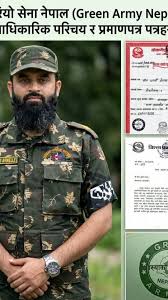
The formation of the Green Army Nepal may be one of the most reckless developments tacitly approved and supported by successive governments, concerned ministries such as Home and Defence, and even the country’s sole national army.
How can a country have a uniformed marshal and chairman emerge out of the blue without a proper government mandate and approval? In the past, when the chairman of the Communist Party Nepal declared himself the supreme commander of the People’s Liberation Army (Maoist), the Government of Nepal and the security forces never gave him leverage to place himself above the commander of the CPN (Maoist)’s armed insurgent combatants.
When people think of the “ARMY,” they understand it to mean an organised military force trained and equipped primarily to fight land warfare. Then come paramilitary forces and law-enforcement agencies, visible government institutions with legitimate coercive powers.
Today, the Nepali government has horribly failed to distinguish between a national defence force and civilian uniformed outfits that proclaim themselves to be armies despite having no weapons, logistics or budget. Today, the question concerns the status of Nepal’s legendary security forces, which are being steadily degraded and diminished by major political parties, political leaders and responsible government offices. This is very unfortunate.
Since the political changes of the 1990s, there have been constant attacks on the status and credibility of the security forces, including the Nepal Army. There have also been constant debates over the size and justification of having a national army.
The first ingredient of a national army is that it must be recognised by the constitution and have a legal mandate to use force as prescribed by the law of the land. It must also have publicly visible ends and means, with clear jurisdiction and limitations on the application of force.
Second, it must have a transparent budget. The Green Army cannot behave like Al-Qaeda, Hamas or Hezbollah, with opaque foreign funding and resources.
Resilience is the third ingredient of an army. National armies are born alongside the birth of sovereign nations. For example, the US Army was born with the independence of the USA, while the Nepal Army was born alongside the unification of Nepal. Green Army Nepal can be no better than the Salvation Army, and certainly not the Nepal Police or Armed Police Force. It is absurd and unnatural to raise thousands of Green Army cadres clandestinely within the timeframe and in the manner that they claim to have done so.
In a recent interview, prominent security think-tank Dr Uddav Sigdel opined that there cannot be two armies in Nepal. Professor Sigdel sees a great game behind the creation of Green Army Nepal. He suspects that the Green Army may have been created with ulterior motives by covert players, similar to the Khampa armies of the 1970s and the CPN (Maoist) armed insurgents of the 2000s.
The Balen government must learn a lesson from the ten-year armed conflict waged by the Communist Party of Nepal (Maoist) from 1996 to 2006. At that time, the Government of Nepal never recognised the PLA of the CPN (Maoist) as an army, despite its combat successes. The PLA was later elevated to army status by UNMIN and the associated arrangements, which eventually forced the government to integrate its combatants into the Nepal Army. During the integration process, the PLA showed little interest in joining the police agencies because it was aiming to capture the Nepal Army.
This time, Green Army seems to have taken an interest in joining and working alongside police organisations. They appear more interested in working in internal domestic security affairs than in external defence. In that case, the Green Army contradicts its own infatuation with the word “Army.”
As far as the registration and cancellation of the Green Army are concerned, it is absurd to see so many agencies silently allowing a uniformed armed force to be raised with their full knowledge and tacit acknowledgement.
Therefore, the government and all concerned stakeholders must take responsibility for explaining the rationale for allowing two armies to exist under one government.
Going back to the origins—Wagner Group, Hamas and Hezbollah are recognised as armed organisations, but they do not qualify as government national military forces and have been labelled terrorist organisations by some foreign governments.

Login to add a comment