







By Our Reporter
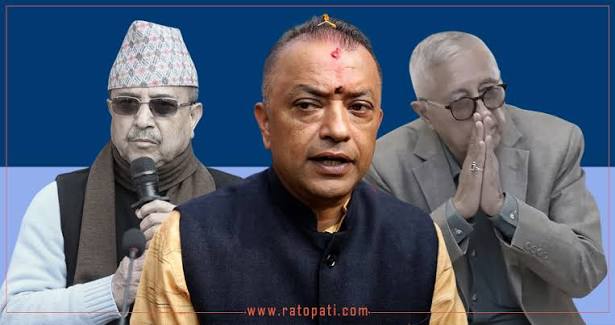
Another split in the Nepali Congress has become a real possibility. The dissident faction is openly discussing a new party, reportedly under the name “National Congress,” while retaining the familiar four-star flag. Although its leaders insist they are still waiting for a breakthrough, every public statement suggests they are preparing for separation rather than reconciliation.
If the split happens, it will mark the second major rupture in the party’s modern history. The first came in 2001, when Sher Bahadur Deuba broke away to form Nepali Congress (Democratic), then known as Nepali Congress (Prajatantrik), after a bitter power struggle with the Girija Prasad Koirala camp. That division weakened the party at a critical political moment before the two factions eventually reunited in 2007. Nearly two decades later, the Congress again finds itself standing at a similar crossroads.
The circumstances are different, but the underlying problem looks familiar. Once again, the dispute is less about ideology than about organizational legitimacy, leadership, and control over the party’s future.
The dissident faction believes the party has deviated from its organizational process. It accuses the establishment of using legal decisions and procedural control to consolidate power while sidelining leaders elected under the previous structure. The establishment, on the other hand, considers the current leadership legally and institutionally valid after decisions by the Election Commission and the Supreme Court.
When both sides claim democratic legitimacy, compromise becomes much harder. The proposals put forward by the dissident faction show that it has not completely shut the door on unity. It has offered to merge the central committees, allow Gagan Thapa to remain party president, give the establishment majority control in key convention committees, and move ahead with the 15th General Convention. Those are not the demands of a faction seeking immediate confrontation.
At the same time, they are not easy demands to accept. Accepting them would require the establishment to partially reverse a political process that has already received legal recognition. It would also mean reopening questions that the leadership believes have already been settled. Any such move carries legal and political risks. It may create uncertainty within the party and encourage future factions to challenge institutional decisions through political pressure.
Every day without meaningful dialogue strengthens the perception that reconciliation is no longer a priority. Once the dissident faction announces its national convention and begins organizational expansion, returning to the negotiating table becomes politically more difficult. Leaders who invest time and credibility in building a new party rarely retreat without securing significant concessions.
For Gagan Thapa, this may become the defining leadership test of his presidency. Political leadership is measured not only by winning internal elections but also by preventing avoidable divisions. The Congress has long presented itself as Nepal’s broad democratic platform capable of accommodating diverse opinions. If a large section of experienced leaders walks away under his watch, questions will inevitably be raised about whether the party has become less inclusive in managing internal disagreements.
That does not mean the establishment should accept every demand. Doing so would weaken institutional authority and create a precedent that future disputes could be settled through threats of separation.
Instead, it should distinguish between negotiable and non-negotiable issues. Procedural grievances surrounding active membership, convention schedules, and organizational representation deserve fresh discussion. If members genuinely feel excluded, rebuilding trust requires transparency rather than political messaging. At the same time, legally settled questions should not become bargaining chips every time dissatisfaction emerges.
The dissident faction also faces difficult choices. Launching a new party may satisfy leaders frustrated with the current leadership, but it offers no guarantee of political success. Nepal’s voters have repeatedly shown little enthusiasm for parties born mainly from internal disputes. Unless the new party presents a distinct political vision beyond organizational grievances, it risks becoming another personality-based faction competing for the same support base.
History offers a clear lesson. The 2001 split weakened both camps before reunification became inevitable. The Congress recovered only after recognizing that internal competition had benefited its political rivals more than either faction.
The same lesson remains relevant today. Neither side appears to have exhausted every possibility for compromise. The dissidents are still waiting. The establishment has not formally closed the door. That narrow space is where responsible leadership is most needed.
If dialogue fails, the Congress may survive organizationally, but it will emerge politically weaker. If compromise succeeds, it could demonstrate that democratic parties can resolve even their deepest internal disputes without creating another permanent fracture in Nepal’s already fragmented political landscape.

Login to add a comment