








By Our Reporter
Nepal built two international airports with one promise: bring tourists directly into the country’s major destinations, reduce Kathmandu’s monopoly and spur regional economic growth. Pokhara was expected to become the gateway to the Himalayas. Bhairahawa was envisioned as the main entry point for Buddhist pilgrims visiting Lumbini.
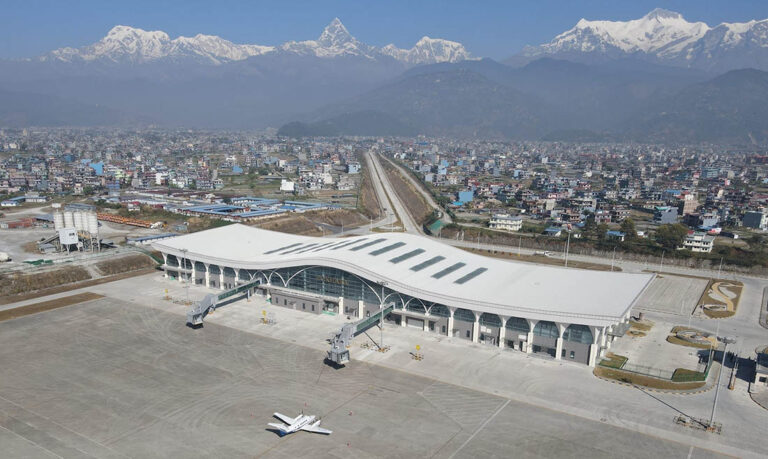
Years later, both airports remain symbols of unrealized ambition. The runways are ready. The terminals are operational. What remains missing are regular international flights.
The consequences extend far beyond the aviation sector. Hotels, restaurants, travel agencies, bars, casinos and transport businesses that expanded in anticipation of foreign visitors are now struggling to generate the returns they expected. In Bhairahawa and nearby Butwal alone, investors estimate that hospitality businesses worth nearly Rs 100 billion are under pressure because the airport has failed to attract sustained international traffic.
The problem is no longer about airports. It is about economic planning. Both projects were justified on the assumption that aviation infrastructure would unlock private investment. That assumption proved correct. Investors responded quickly. New hotels rose across Pokhara. Luxury properties appeared in Bhairahawa and Lumbini. Restaurants expanded. Casinos invested. Banks financed ambitious tourism projects. Provincial governments encouraged even more investment, arguing that international visitors would soon arrive in large numbers.
The visitors, however, never came in the numbers that had been projected. Pokhara International Airport opened in January 2023 amid enormous optimism. More than three years later, regular international commercial flights remain absent. Charter services have demonstrated that the airport can operate internationally, but occasional flights cannot sustain an economy built around year-round tourism.
The planned FlyDubai service offers fresh hope, yet one airline alone cannot transform the airport into the international gateway that planners envisioned. Sustainable growth requires multiple destinations, frequent schedules and commercially viable routes.
Bhairahawa faces a similar challenge. Built to serve Lumbini, the birthplace of Lord Buddha, Gautam Buddha International Airport was expected to attract pilgrims from across Asia. Instead, airlines have repeatedly suspended services because passenger numbers failed to meet commercial expectations. The airport has become trapped in a familiar cycle. Airlines hesitate because demand appears uncertain, while passengers avoid the airport because flight options remain limited. Breaking that cycle has proved far more difficult than building the infrastructure itself.
The economic impact is becoming increasingly visible. Hotels built with expectations of rising occupancy now compete for a limited domestic market. Restaurants that planned for international visitors depend largely on local customers. Casinos expected foreign tourists but instead face underutilized facilities. Investors continue paying bank loans while revenue falls below projections.
This has created growing financial stress throughout the hospitality sector. Many businesses made investment decisions based on government assurances that international connectivity would follow airport construction. From their perspective, the airports were never meant to be standalone infrastructure projects. They were economic ecosystems meant to support tourism, employment and regional development. Without flights, that ecosystem cannot function as intended.
Responsibility does not rest solely with airlines. Nepal’s aviation strategy has often focused heavily on building physical infrastructure while paying less attention to route development, market incentives and international airline partnerships. Airports do not automatically attract carriers simply because terminals exist. Airlines evaluate passenger demand, operating costs, fuel prices, ground handling, bilateral air service agreements and commercial profitability.
Those preparations should have advanced alongside construction. Pokhara’s experience illustrates another lesson. The airport has undoubtedly strengthened the city’s global profile. Yet reputation alone does not fill hotel rooms or repay business loans. Economic success depends on sustained passenger traffic rather than ceremonial inaugurations.
Bhairahawa presents an even stronger case because its market already exists. Millions of Buddhist pilgrims travel across Asia every year. Northern India lies only a short distance away. Lumbini remains one of Buddhism’s holiest sites. Yet Nepal has struggled to convert that geographic advantage into regular air connectivity. That represents a missed opportunity rather than a lack of demand.
The government now needs a far more coordinated strategy. Diplomatic efforts should prioritize expanding bilateral air service agreements with countries supplying large numbers of tourists and pilgrims. Temporary incentives for airlines launching new routes deserve consideration until passenger demand stabilizes. Immigration, customs and ground handling services must match international standards. Equally important, tourism promotion should focus on selling complete travel experiences instead of merely advertising airport facilities.
Local governments, tourism boards and the private sector also need stronger coordination in attracting international operators. Patience is certainly necessary. Major airports rarely become profitable overnight. But patience cannot substitute for policy.
Every year without regular international flights increases financial pressure on investors who responded to the government’s own vision. It also weakens confidence in future public infrastructure projects. Investors are less likely to support ambitious national plans if promised economic benefits repeatedly fail to materialize.
Pokhara and Bhairahawa have already received the airports they fought for. What they are still waiting for is the aviation strategy that makes those airports work. Until regular international flights become the norm rather than the exception, the two airports will remain monuments to potential instead of engines of regional prosperity.

Login to add a comment